
Muscle · Lower limb
Extensor digitorum longus: origin, insertion, action and innervation
The extensor digitorum longus runs from the tibia and fibula to toes 2 to 5. It extends those toes, dorsiflexes the ankle and has the deep fibular nerve.
Quick answer
- Latin name
- Musculus extensor digitorum longus
- Origin
- Lateral condyle of the tibia, upper three quarters of the medial surface of the fibula and the interosseous membrane
- Insertion
- Middle and distal phalanges of the second to fifth toes, through the dorsal digital expansions
- Action
- Extends the lateral four toes at the metatarsophalangeal and interphalangeal joints; dorsiflexes the ankle
- Innervation
- Deep fibular nerve (L5-S1)
- Blood supply
- Anterior tibial artery
See it on the 3D body
The extensor digitorum longus lit on the 3D leg and foot, as in the leg and foot quiz. Turn the body, peel the layers, tap any structure for its name.
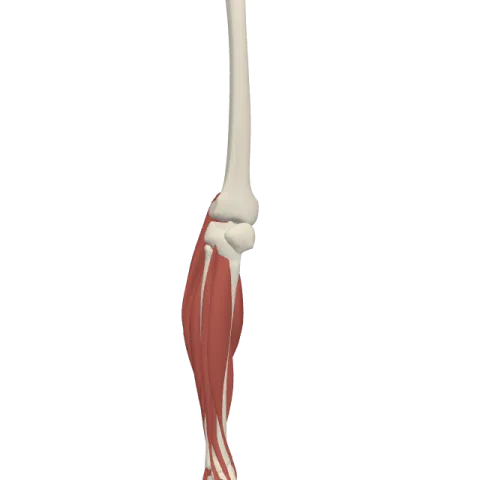
The extensor digitorum longus is a long, feather-shaped muscle on the front and outer side of the leg that sends four tendons to the second to fifth toes. It extends those toes, dorsiflexes the ankle, and is supplied by the deep fibular nerve (L5-S1).
Where it is
The extensor digitorum longus is one of the muscles of the anterior compartment of the leg. It lies lateral to the tibialis anterior and runs along the front of the fibula, just in front of the fibularis muscles of the lateral compartment. In the lower half of the leg, the extensor hallucis longus appears between it and the tibialis anterior.
At the ankle, its tendon passes under the superior and inferior extensor retinacula, the straps that hold the tendons against the front of the ankle. It then splits into four tendons that fan out over the top of the foot to the four lateral toes. Lift your toes and you can see these tendons stand out under the skin, crossing over the extensor digitorum brevis.
A small part of the muscle often separates off at its lower end and inserts on the fifth metatarsal instead of a toe. This part is the fibularis tertius, which helps evert the foot. See the leg compartments on muscles of the leg.
Origin and insertion
- Origin: the lateral condyle of the tibia, the upper three quarters of the medial (front) surface of the fibula, and the interosseous membrane between the two bones.
- Insertion: each tendon forms a dorsal digital expansion (extensor hood) over a toe. The central slip of the hood attaches to the middle phalanx and the two side slips join to reach the distal phalanx of toes 2 to 5. See the toe bones on the phalanges of the foot page.
The tendons of the extensor digitorum brevis join those of the long extensor to toes 2 to 4 on their lateral side.
What it does
- Extension of the lateral four toes: it lifts toes 2 to 5 at the metatarsophalangeal joints and helps straighten the interphalangeal joints.
- Dorsiflexion of the ankle: because it crosses the front of the ankle, it helps the tibialis anterior pull the foot upward.
- Help with eversion: its tendons run toward the outer side of the foot, so it tends to tilt the sole outward, especially through the fibularis tertius.
In walking, the anterior compartment muscles lift the foot and toes while the leg swings forward, so the toes clear the ground. They also lower the foot gently after the heel strikes.
Innervation and blood supply
The extensor digitorum longus is supplied by the deep fibular nerve (L5-S1), the nerve of the anterior compartment. The deep fibular nerve starts at the neck of the fibula, pierces the extensor digitorum longus, and then runs down on the interosseous membrane.
Its blood comes from the anterior tibial artery, which runs down the front of the leg with the deep fibular nerve.
How to remember it
- It crosses the ankle, so it dorsiflexes: unlike the short extensor on the foot, the long one passes in front of the ankle and helps lift the foot.
- Four tendons, four toes: digitorum longus goes to toes 2 to 5, the same pattern as the extensor digitorum in the forearm going to the four fingers.
- Fibular side of the ankle: of the long tendons crossing the front of the ankle, it is the most lateral one, with only its fibularis tertius slip farther out.
- Its spare part is the fibularis tertius: a split-off slip that lands on the fifth metatarsal.
Test yourself in the leg and foot quiz.
Frequently asked questions
What does the extensor digitorum longus do?
It extends the second to fifth toes and dorsiflexes the ankle. It also helps evert the foot.
What nerve supplies the extensor digitorum longus?
The deep fibular nerve, from roots L5 and S1.
Where does the extensor digitorum longus originate?
From the lateral condyle of the tibia, the upper three quarters of the fibula and the interosseous membrane.
What is the fibularis tertius?
A small muscle that splits off from the lower part of the extensor digitorum longus and inserts on the fifth metatarsal. It helps dorsiflex and evert the foot.
