Region · Trunk
Abdominal muscles: rectus abdominis, obliques, transversus and diaphragm
The abdominal muscles are the rectus abdominis, the two obliques and the transversus abdominis in front, the quadratus lumborum behind and the diaphragm above.
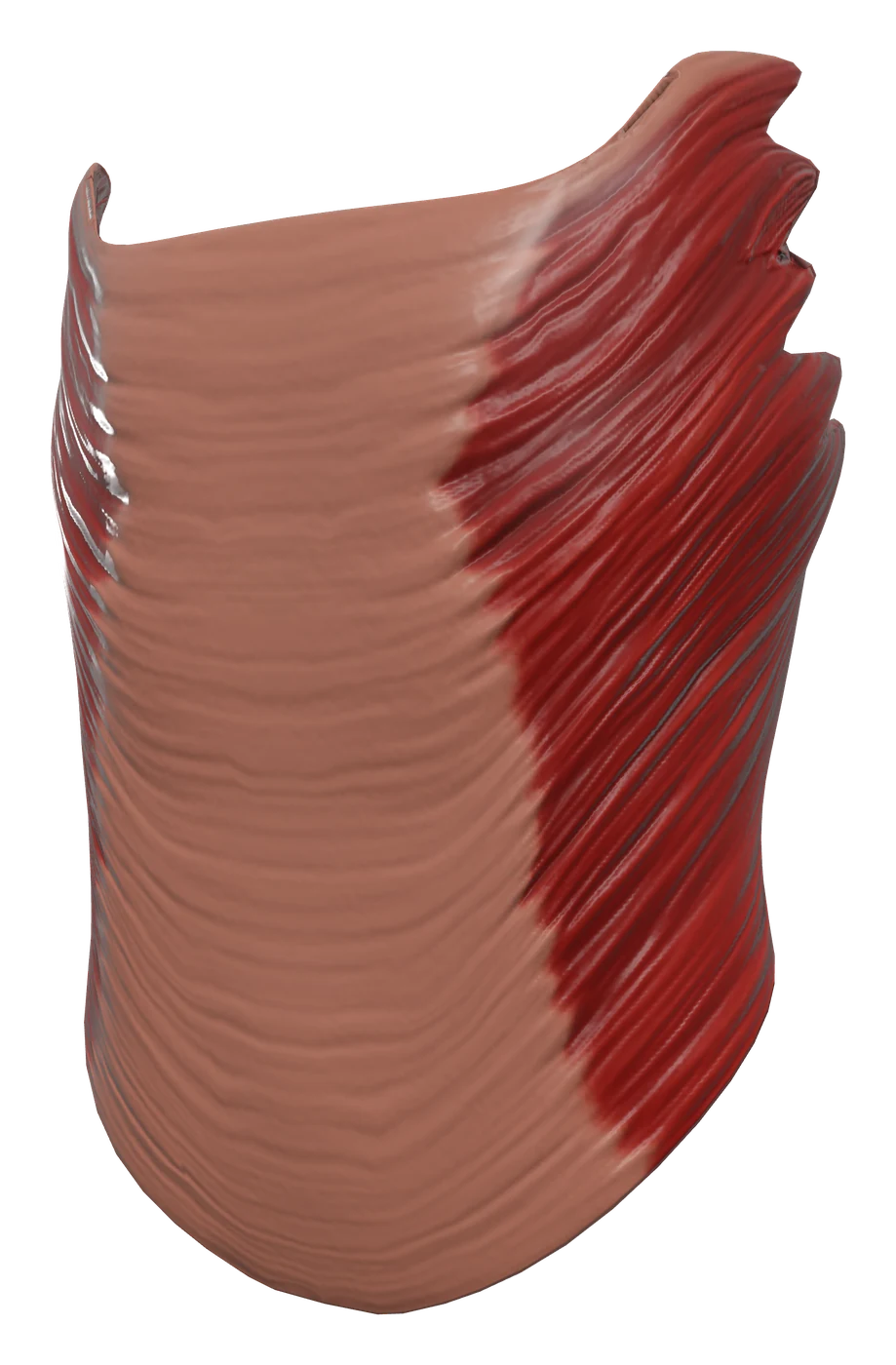
The main abdominal muscles are the rectus abdominis down the front and three flat muscles on each side, the external oblique, the internal oblique and the transversus abdominis, stacked in layers. The quadratus lumborum completes the wall at the back, and the diaphragm forms the roof of the abdomen, separating it from the chest.
At a glance
| Muscle | Origin | Insertion | Action |
|---|---|---|---|
| Rectus abdominis | Pubic crest, Pubic symphysis | Xiphoid process, Costal cartilages of ribs 5–7 | Flexes the trunk; compresses the abdomen |
| External abdominal oblique | Fifth to twelfth ribs | Hip bone, Linea alba, Pubic tubercle | Flexes and rotates the trunk; compresses the abdomen |
| Internal abdominal oblique | Thoracolumbar fascia, Hip bone, Inguinal ligament | Tenth rib, Eleventh rib, Twelfth rib, Linea alba | Flexes and rotates the trunk; compresses the abdomen |
| Transversus abdominis | Hip bone, Thoracolumbar fascia, Costal cartilages of ribs 7–12 | Linea alba, Pubic crest | Compresses the abdomen |
| Quadratus lumborum | Hip bone | Twelfth rib, Vertebrae L1–L4 | Laterally flexes the trunk; steadies the twelfth rib |
| Diaphragm | Xiphoid process, Costal cartilages of ribs 7–12, Vertebrae L1–L3 | Central tendon | Principal muscle of inspiration |
From the anatomical data behind Anatomy Atlas 3D (Z-Anatomy, CC BY-SA 4.0, reviewed). Names link to the detailed page when there is one.
How they are organized
Unlike the chest, the abdomen has no rib cage around most of it. Its walls are made almost entirely of muscle and of the flat tendons, or aponeuroses, of those muscles. This page covers six muscles.
The front: rectus abdominis
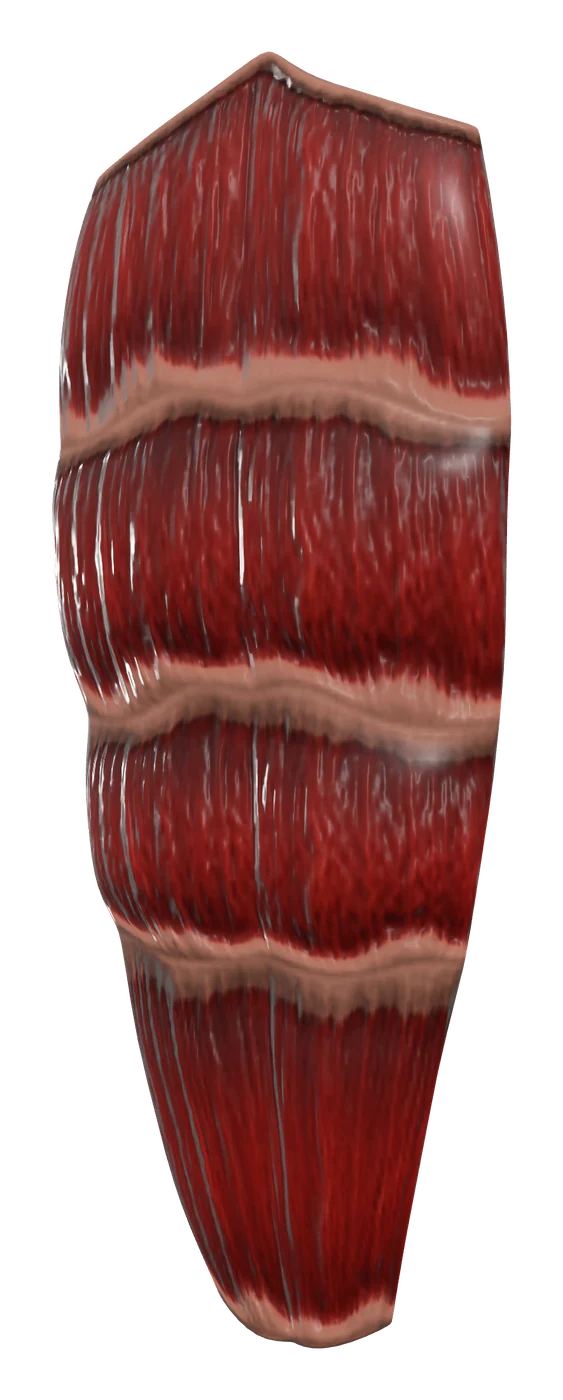
The rectus abdominis is a long, strap-like muscle on each side of the midline, from the pubis to the lower ribs and the sternum. Bands of tendon cross it, usually three, sometimes more, which produce the "six-pack" outline in lean people. Each rectus lies inside a sleeve, the rectus sheath, made from the aponeuroses of the three flat muscles. The two sheaths meet in the midline at the linea alba, a white seam of tendon from the sternum to the pubis. A small triangular muscle, the pyramidalis, sits in front of the lower rectus in many people and is absent in others.
The sides: three flat layers
From the surface inwards:
- The external oblique, whose fibers run down and toward the midline, the direction of your fingers when you put your hands in your front pockets. Its lower edge folds over to form the inguinal ligament.
- The internal oblique, whose fibers run roughly at right angles to those of the external oblique, up and toward the midline.
- The transversus abdominis, the deepest, whose fibers run horizontally around the abdomen like a belt.
Because the fibers of the three layers run in different directions, the wall resists stretching from every angle, the same principle as plywood. These muscles are supplied by the lower thoracic nerves (T7 to T12) and, for the lowest fibers, by branches of L1.
The back: quadratus lumborum
The quadratus lumborum is a thick, roughly rectangular muscle on each side of the lumbar spine, between the twelfth rib and the iliac crest. It forms part of the posterior abdominal wall, alongside the psoas major.
The roof: diaphragm
The diaphragm is a dome-shaped sheet of muscle with a central tendon. It attaches all around the lower opening of the rib cage, to the lower ribs, the xiphoid process and the lumbar vertebrae. It is supplied by the phrenic nerve, from spinal segments C3 to C5. Three large openings let structures pass between chest and abdomen: the inferior vena cava, the esophagus and the aorta.
What they do together
- Breathing in. The diaphragm is the main muscle of inspiration. When it contracts, its dome flattens and moves down, enlarging the chest so that air flows into the lungs.
- Breathing out hard, coughing, straining. The flat muscles and the rectus squeeze the abdomen. That pushes the organs up against the relaxed diaphragm and helps empty the lungs. Quiet breathing out is mostly passive.
- Moving the trunk. The rectus abdominis flexes the trunk, as in a crunch. The obliques bend the trunk to the side and rotate it: turning to one side uses the external oblique of the opposite side with the internal oblique of the same side. The quadratus lumborum bends the lumbar spine to the side and steadies the twelfth rib during breathing.
- Bracing. The transversus abdominis tightens the wall like a corset before you lift something, which stiffens the trunk and supports the lumbar spine.
The abdominal muscles also hold the stomach and intestines in place. Unlike most of the trunk, this protection comes from muscle tension rather than bone.
How to learn them
- Learn the layers by fiber direction: external oblique "hands in pockets", internal oblique at right angles to it, transversus horizontal, rectus vertical.
- Diaphragm openings: "I 8 10 Eggs At 12". The inferior vena cava passes at the level of T8, the esophagus at T10 and the aorta at T12. Levels vary slightly between people, but these are the numbers exams expect.
- "C3, 4, 5 keeps the diaphragm alive" for the roots of the phrenic nerve.
- Front, side, back, roof: rectus, three flat muscles, quadratus lumborum, diaphragm. Sketch a cross-section of the trunk and place each one.
In the app, peel the external oblique to reveal the internal oblique and then the transversus beneath it, use an axial cross section to see the three layers and the rectus sheath at once, and quiz yourself on the abdomen by tapping each muscle on the 3D body.
Frequently asked questions
How many abdominal muscles are there?
The front and sides of the abdomen have four on each side: the rectus abdominis, the external oblique, the internal oblique and the transversus abdominis. Counting the quadratus lumborum at the back and the diaphragm above, this page covers six.
What is the deepest abdominal muscle?
The transversus abdominis, whose fibers run horizontally around the abdomen.
Is the diaphragm an abdominal muscle?
It is the muscle that separates the chest from the abdomen. It forms the roof of the abdominal cavity and the floor of the chest, and it is the main muscle of breathing.
What creates the six-pack?
Bands of tendon, called tendinous intersections, that cross the rectus abdominis and divide it into segments.