Region · Trunk
Bones of the rib cage: sternum, ribs and thoracic vertebrae
The rib cage, or thoracic cage, is made of the sternum, 12 pairs of ribs with their cartilages and the 12 thoracic vertebrae. Learn true, false and floating ribs.
The rib cage, or thoracic cage, is made of the sternum in front, 12 pairs of ribs with their costal cartilages on the sides, and the 12 thoracic vertebrae behind. It protects the heart and lungs and, because the ribs can move, it also takes part in every breath.
At a glance
| Bone | Muscles that originate here | Muscles that insert here |
|---|---|---|
| Sternum | Pectoralis major | – |
| First rib | – | Scalenus anterior, Scalenus medius |
| Second rib | – | Scalenus posterior |
| Third rib | Pectoralis minor | – |
| Fourth rib | Pectoralis minor | – |
| Fifth rib | Pectoralis minor | – |
| Sixth rib | – | – |
| Seventh rib | – | – |
| Eighth rib | – | – |
| Ninth rib | – | – |
| Tenth rib | – | Internal abdominal oblique |
| Eleventh rib | – | Internal abdominal oblique |
| Twelfth rib | – | Internal abdominal oblique, Quadratus lumborum |
| Vertebra T1 | Rhomboid minor | – |
| Vertebra T12 | – | – |
From the anatomical data behind Anatomy Atlas 3D (Z-Anatomy, CC BY-SA 4.0, reviewed). Names link to the detailed page when there is one.
How they are organized
This page lists 15 structures: the sternum, the twelve ribs (each present on both sides of the body) and the first and last thoracic vertebrae, T1 and T12, which mark the top and bottom of the cage at the back. The ten thoracic vertebrae in between are covered with the bones of the spine.
Sternum
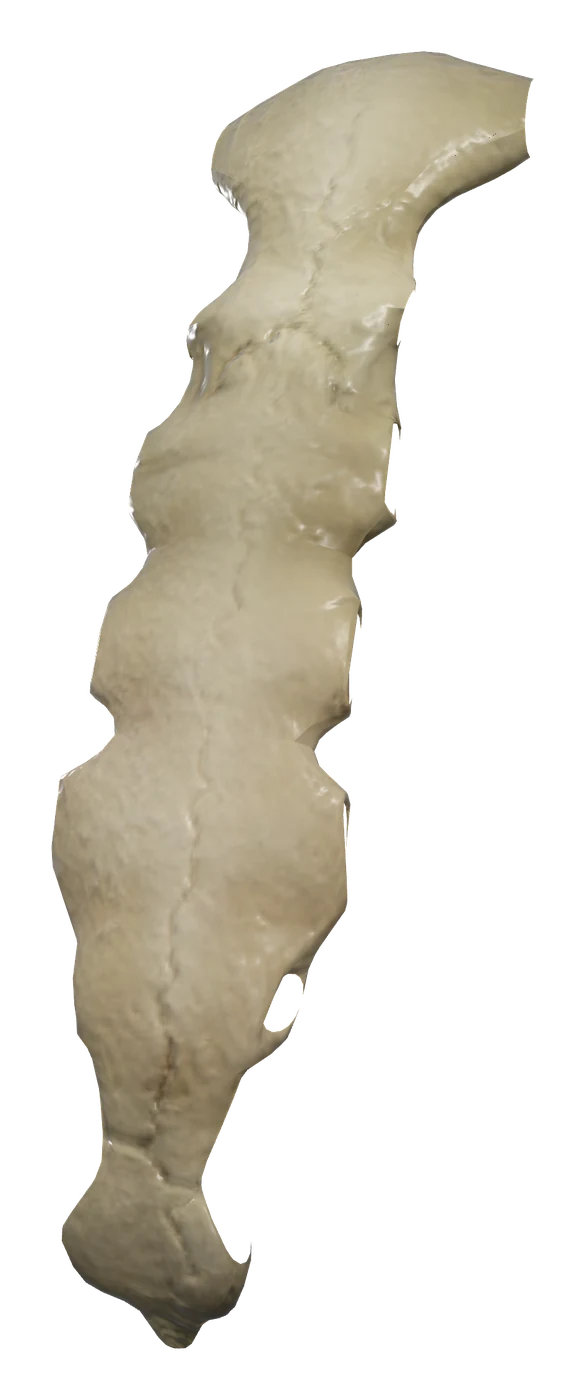
The sternum, or breastbone, is a flat bone in the midline of the chest, in three parts:
- The manubrium, at the top, with the jugular notch you can feel at the base of the neck. It joins the clavicles and the first ribs.
- The body, the long middle part, which receives the costal cartilages of ribs 2 to 7.
- The xiphoid process, a small tip at the bottom, made of cartilage in young people and gradually turning to bone.
The joint between the manubrium and the body forms a ridge, the sternal angle, at the level of the second costal cartilages.
Ribs
Every rib articulates with the spine at the back. They are grouped by how they reach the front:
- True ribs (1 to 7) attach directly to the sternum through their own costal cartilage.
- False ribs (8 to 12) do not reach the sternum on their own. Ribs 8, 9 and 10 join the cartilage of the rib above, forming the curved lower edge of the cage, the costal margin.
- Floating ribs (11 and 12) are false ribs with no attachment at the front at all.
A typical rib has a head, a short neck, a tubercle and a long, curved shaft that turns forward at the angle of the rib. A groove under the lower edge of the shaft protects the intercostal vein, artery and nerve.
Some ribs are atypical. The first rib is the shortest, broadest and most sharply curved, and it lies almost flat under the clavicle. The eleventh and twelfth are short and have no neck or tubercle.
Thoracic vertebrae
Most ribs meet the spine at two points: the head articulates with the bodies of two vertebrae, its own and the one above, and the tubercle with the transverse process of its own vertebra. T1 has a complete facet for the first rib and half a facet for the second. T12 carries only the twelfth rib. These two vertebrae also mark a change in shape: T1 looks partly cervical, and T12 partly lumbar.
Variation
The rib count is not identical in everyone. A small minority of people have an extra cervical rib from C7, and occasionally a rib from L1; ribs can also be forked or fused.
What they do together
- Protection. The cage surrounds the heart, the lungs and the great vessels, and its lower part shelters the liver, stomach and spleen.
- Breathing. The ribs are hinged at the spine and connected by flexible cartilage at the front. When the intercostal muscles and the diaphragm contract, the upper ribs lift the sternum forward, like a pump handle, and the lower ribs swing outwards, like the handle of a bucket. Both movements enlarge the chest so that air flows in.
- Attachment. Many muscles anchor here: the intercostals between the ribs, the diaphragm on the inner surface, and muscles of the shoulder, neck and abdomen such as the serratus anterior, the pectoralis muscles and the rectus abdominis.
How to learn them
- 7, 3, 2. Seven true ribs, three false ribs that join the costal margin, two floating ribs.
- Count from the sternal angle. The second costal cartilage meets the sternum at the sternal angle. Find the ridge, slide sideways to the second rib and count down from there. This avoids the first rib, which is hidden behind the clavicle.
- "VAN" in the costal groove. From top to bottom: Vein, Artery, Nerve.
- Head with two vertebrae, tubercle with one. For a typical rib, the head meets its own vertebra and the one above; the tubercle meets its own transverse process.
Exams often ask you to classify a rib as true, false or floating, to name the parts of the sternum, or to identify the first rib by its shape. In the app, hide the muscle layers to see the bare cage, isolate one rib and follow it from the spine to the sternum, and quiz yourself on the thorax by tapping each bone on the 3D body.
Frequently asked questions
How many ribs do humans have?
Usually 24, in 12 pairs. Men and women have the same number. A few people have an extra cervical or lumbar rib.
What is the difference between true, false and floating ribs?
True ribs (1 to 7) reach the sternum through their own cartilage. False ribs (8 to 12) do not. The floating ribs (11 and 12) are the false ribs with no front attachment at all.
What are the three parts of the sternum?
The manubrium, the body and the xiphoid process.
Which vertebrae do the ribs attach to?
The twelve thoracic vertebrae, T1 to T12.