
Study guide · Study
Anatomical directional terms, with examples and body planes
Anatomical directional terms in pairs with examples from the body (anterior, posterior, medial, lateral, proximal, distal) and the three body planes.
Anatomical directional terms are pairs of words that say where one structure lies compared with another: anterior and posterior (front and back), superior and inferior (above and below), medial and lateral (toward and away from the midline), proximal and distal (nearer to and farther from the trunk, on a limb), superficial and deep (nearer to and farther from the surface). They always describe the body in the anatomical position, whatever way the person is actually lying.
What is the anatomical position?
The body standing upright, facing you, feet parallel and about shoulder width apart, toes forward, arms at the sides with the palms facing forward. Every directional term refers to this position. The kneecap is still described as anterior when the person lies face down, and the palm is the anterior side of the hand even when you hold it flat on a desk.
Two more words describe a body lying down: supine is face up, prone is face down.
The directional terms in pairs
| Term | Means | Opposite | Example |
|---|---|---|---|
| Anterior (ventral) | Toward the front | Posterior (dorsal) | The sternum is anterior to the heart. |
| Posterior (dorsal) | Toward the back | Anterior (ventral) | The scapula lies on the posterior side of the rib cage. |
| Superior (cranial) | Above, toward the head | Inferior (caudal) | The atlas (C1) is superior to the axis (C2). |
| Inferior (caudal) | Below, toward the tailbone | Superior (cranial) | The diaphragm is inferior to the heart. |
| Medial | Toward the midline of the body | Lateral | The ulna is medial to the radius. |
| Lateral | Away from the midline, toward the side | Medial | The fibula is lateral to the tibia. |
| Proximal | On a limb, nearer to the trunk | Distal | The humerus is proximal to the radius and ulna. |
| Distal | On a limb, farther from the trunk | Proximal | The phalanges are distal to the metacarpals. |
| Superficial | Nearer to the body surface | Deep | The rectus femoris is superficial to the vastus intermedius. |
| Deep | Farther from the body surface | Superficial | The vastus intermedius lies deep to the rectus femoris, on the femur. |
On the human trunk, ventral means the same as anterior and dorsal the same as posterior, because we stand upright. There are exceptions: the dorsum of the foot is its upper surface, and in the brain dorsal points toward the top of the head. That is one reason human anatomy prefers anterior and posterior.
Proximal and distal, and the forearm
Proximal and distal are used mostly on the limbs. On the upper limb, the shoulder end is proximal and the fingertips are distal; on the lower limb, the hip end is proximal and the toes are distal. For positions on the trunk wall, use superior and inferior; along a tube such as the gut, a vessel or a nerve, proximal means nearer its start.
On the forearm and hand, medial and lateral follow the anatomical position with the palm forward: the little finger and the ulna are medial, the thumb and the radius are lateral. If you turn your palm backward, the radius crosses over the ulna, but the radius is still called lateral. The page on the bones of the arm shows this on the three arm bones.
What are the anatomical planes?
Three flat, imaginary cuts at right angles to each other describe any slice of the body, whether in a dissection, a scan or a 3D model:
| Plane | Also called | Divides the body into |
|---|---|---|
| Sagittal | Median (or midsagittal) through the exact middle; parasagittal off to one side | Right and left parts |
| Coronal | Frontal | Anterior (front) and posterior (back) parts |
| Transverse | Horizontal, axial (in imaging) | Superior (upper) and inferior (lower) parts |
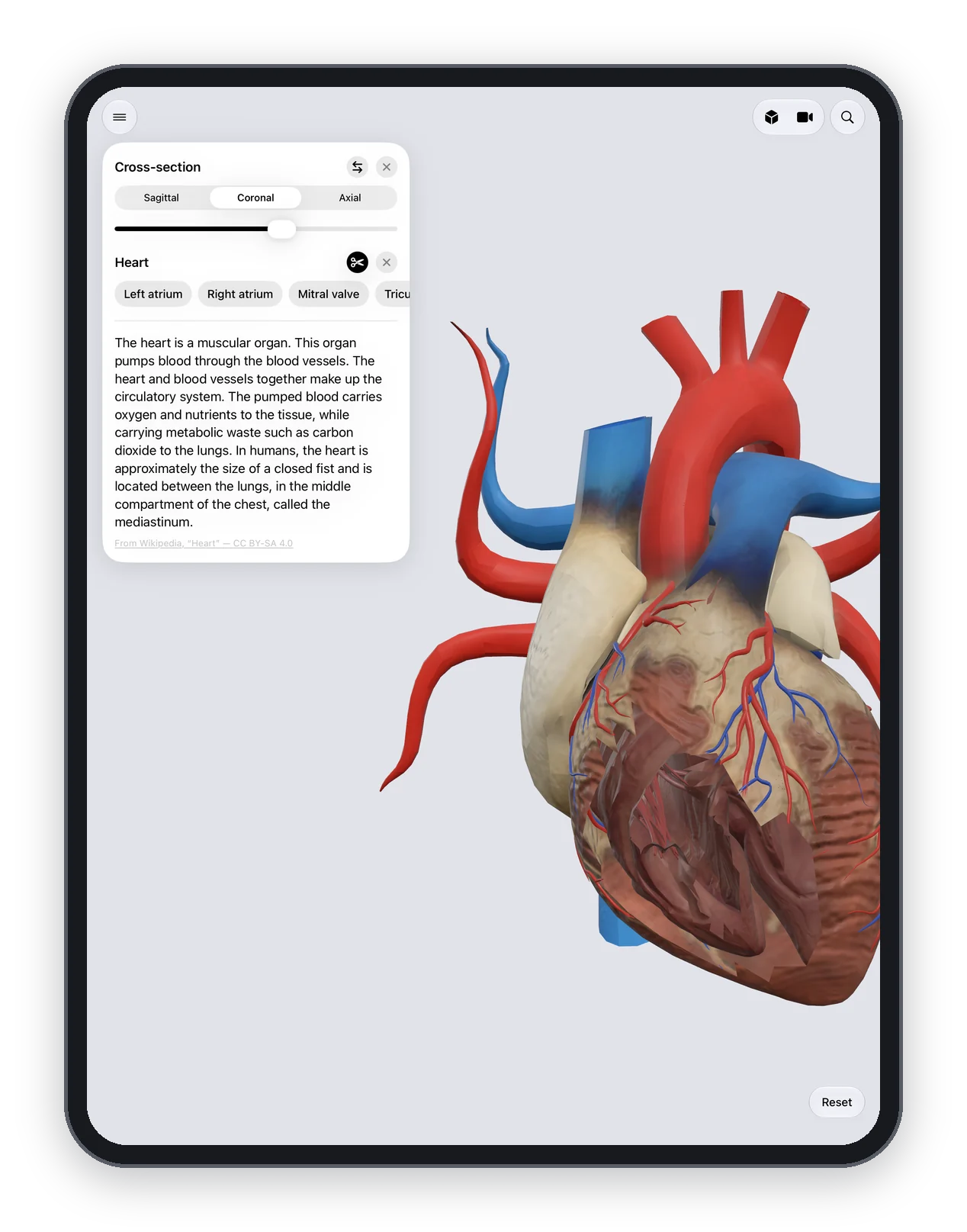
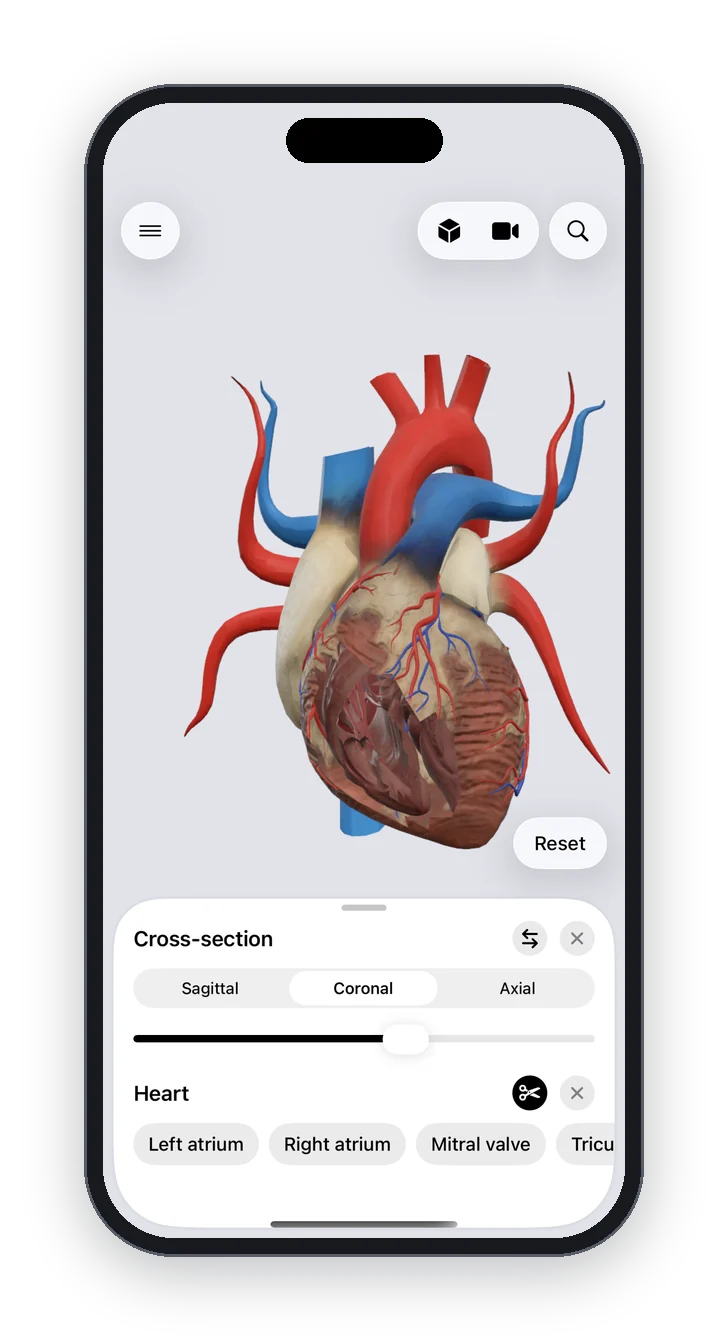
The sagittal plane goes with medial and lateral, the coronal plane with anterior and posterior, the transverse plane with superior and inferior. Any cut that is tilted between them is called oblique. CT is usually read in transverse (axial) slices, while MRI is read in all three planes. Textbooks often keep the words "cross section" for a transverse cut; in the app, a cross section is a cut along any of the three planes.
Latin and English names
The Latin forms appear in Terminologia Anatomica (TA2), the international list of anatomical terms, and in the Latin names of many structures:
| English | Latin | Seen in |
|---|---|---|
| Anterior, posterior | Anterior, posterior | Tibialis anterior, tibialis posterior |
| Superior, inferior | Superior, inferior | Superior and inferior gemellus |
| Medial, lateral | Medialis, lateralis | Vastus medialis, vastus lateralis |
| Proximal, distal | Proximalis, distalis | Phalanx proximalis, phalanx distalis |
| Superficial, deep | Superficialis, profundus | Flexor digitorum superficialis, flexor digitorum profundus |
Once you know the pairs, many muscle names describe their own position: the vastus lateralis is the outer head of the quadriceps, the vastus medialis the inner one.
How to learn the directional terms
- Learn them in pairs. Each term has one opposite; recite both together.
- Link the word to something you know. Proximal sounds like proximity (close), distal like distance (far), medial like median (middle).
- Say every example out loud in a full sentence: "the ulna is medial to the radius". The structure being described comes first, the reference second.
- Stand in the anatomical position when you get lost, palms forward, and check which side you mean.
- Use the planes on a 3D model. In Anatomy Atlas 3D the cross sections cut the whole body or one organ along a sagittal, coronal or axial plane, and you slide the cut to see what lies in front, behind, above or below. Then test yourself with the free anatomy quiz.
Frequently asked questions
What are the main directional terms in anatomy?
Five pairs: anterior and posterior, superior and inferior, medial and lateral, proximal and distal, superficial and deep. On the trunk, ventral and dorsal are used for anterior and posterior, and cranial and caudal for superior and inferior.
What is the difference between medial and lateral?
Medial means closer to the midline of the body, lateral means farther from it. In the anatomical position, the ulna is medial to the radius, and the fibula lateral to the tibia.
What is the difference between proximal and distal?
Both describe positions on a limb. Proximal is closer to where the limb joins the trunk, distal is farther away: the elbow is proximal to the wrist, and the wrist is distal to the elbow.
What are the three planes of the body?
The sagittal plane divides the body into right and left parts, the coronal (frontal) plane into front and back parts, and the transverse plane into upper and lower parts.
Is coronal the same as frontal?
Yes. The coronal plane and the frontal plane are two names for the vertical plane that divides the body into front and back parts.
Why is the anatomical position important?
Because every directional term is defined in it. Describing the body as if it were always standing with the palms forward means a structure has the same description whether the person is standing, lying or moving.
