
See them on the 3D body
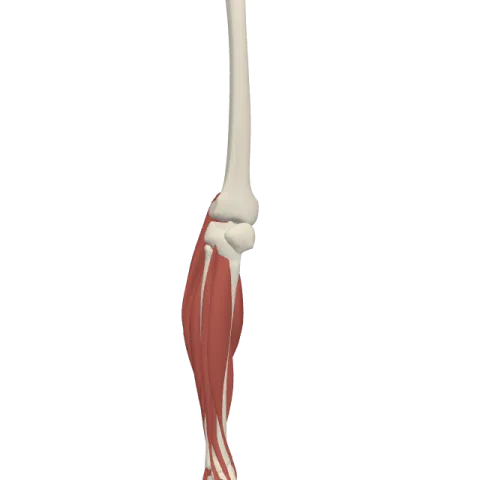
The phalanges of the foot lit on the 3D leg and foot, as in the leg and foot quiz. Turn the body, peel the layers, tap any structure for its name.
Quick answer
- Latin name
- Ossa digitorum pedis (phalanges)
- Type
- Long bones (fourteen phalanges per foot)
- Location
- Toes, beyond the heads of the metatarsals
- Joints
- Metatarsophalangeal joints with the metatarsals; proximal and distal interphalangeal joints in toes 2 to 5; a single interphalangeal joint in the great toe
The phalanges of the foot are the bones of the toes. The great toe has two (proximal and distal), and each of the other four toes has three (proximal, middle and distal), for 14 phalanges in each foot. They follow the same plan as the phalanges of the hand, but they are much shorter.
Where they are and what they touch
The toe bones start at the ball of the foot. Each proximal phalanx joins the head of a metatarsal, then the middle and distal phalanges follow toward the tip. Toes are numbered from the inner side: the great toe (hallux) is 1 and the little toe is 5.
The toes help you balance, grip the ground and push off at the end of each step. The great toe does most of this work, which is why its bones are so much bigger. The bones of the foot page shows the toes alongside the tarsals and metatarsals.
Parts of a phalanx
Each phalanx has a base toward the foot, a shaft and a head toward the tip. The base of a proximal phalanx is hollow to fit the rounded metatarsal head. The heads of the proximal and middle phalanges are shaped like small pulleys. Each distal phalanx ends in a widened tuberosity under the toenail.
The great toe
The great toe has two large phalanges, and no middle one.
- The proximal phalanx of the great toe is the biggest phalanx of the foot. Its base receives the short muscles of the big toe: the abductor hallucis on its inner side, the adductor hallucis on its outer side, the flexor hallucis brevis underneath (through the two sesamoid bones) and the extensor hallucis brevis on top.
- The distal phalanx of the great toe is broad and flat. The flexor hallucis longus inserts on its underside and the extensor hallucis longus on its top. These two long tendons come from muscles of the leg.
When you push off to walk or run, the joint between the first metatarsal and this proximal phalanx bends upward and carries much of the body's weight.
The lesser toes (2 to 5)
Proximal phalanges
The proximal phalanges are the longest bones of the lesser toes, slim with a narrow shaft. The extensor tendons spread over their backs, and the interossei and lumbricals act around their bases. The abductor digiti minimi of the foot inserts on the base of the proximal phalanx of the fifth toe.
Middle phalanges
The middle phalanges are short, almost as wide as they are long. The flexor digitorum brevis, a muscle of the sole, splits into slips that insert on the sides of the middle phalanges of toes 2 to 5.
Distal phalanges
The distal phalanges are tiny, with a flattened tip under the nail. The flexor digitorum longus inserts on their bases from below, and the extensor digitorum longus reaches them from above through the extensor expansion.
The fifth toe
The little toe has the smallest phalanges of all. In many people its middle and distal phalanges are fused into one bone, a common variation that causes no trouble. The app shows them as two separate bones.
Joints
- Metatarsophalangeal (MTP) joints: between the metatarsal heads and the proximal phalanges. The toes can bend down, lift up, and spread a little. Upward bending at these joints is what lets you rise onto the ball of the foot.
- Proximal interphalangeal (PIP) joints: between the proximal and middle phalanges of toes 2 to 5.
- Distal interphalangeal (DIP) joints: between the middle and distal phalanges of toes 2 to 5.
- Interphalangeal joint of the great toe: the only joint between its two phalanges.
All interphalangeal joints are hinge joints: they bend and straighten only.
Muscles attached
Two groups of muscles move the toes:
- Long muscles from the muscles of the leg: the flexor hallucis longus and flexor digitorum longus from the back of the leg, and the extensor hallucis longus and extensor digitorum longus from the front. Their tendons reach the distal phalanges.
- Short muscles inside the foot: the flexor digitorum brevis, the abductor and adductor of the great toe, the short extensors on the top of the foot and the small muscles of the little toe. Most of them insert on the proximal or middle phalanges.
How to remember them
- Same count as the hand. Fourteen phalanges per foot, fourteen per hand: two in the big digit, three in each of the others.
- Long ones go long. The long flexors and extensors, from the leg, reach the far end of the toes, the distal phalanges. The short flexor of the sole stops at the middle phalanges.
- "Hallux" is the great toe, as "pollex" is the thumb. Muscles with "hallucis" in their name move the big toe.
- The little toe cheats. Its middle and distal phalanges are often one bone.
In Anatomy Atlas 3D
Each toe bone is named by row and toe in the app, such as "Proximal phalanx of great toe" or "Middle phalanx of fourth toe". Look at the foot from above, then from below, to follow the tendons to their phalanges. Quiz yourself in the leg and foot quiz. The app is free on iPad and iPhone.
Frequently asked questions
How many phalanges are in one foot?
Fourteen: two in the great toe and three in each of the other four toes.
Why does the big toe have only two phalanges?
Like the thumb, it has a proximal and a distal phalanx but no middle one. Its two bones are larger and stronger to take the load of pushing off.
Which muscle inserts on the distal phalanx of the great toe?
The flexor hallucis longus underneath and the extensor hallucis longus on top.
Are the toe phalanges smaller than the finger phalanges?
Yes. Apart from the bones of the great toe, the toe phalanges are shorter and thinner than those of the fingers, especially the middle and distal ones.
From the anatomical data behind Anatomy Atlas 3D (Z-Anatomy, reviewed). In the app, tap the bone, then each muscle around it to open its card.
