Muscle · Lower limb
Obturator internus: origin, insertion, action and innervation
The obturator internus runs from the inner obturator membrane to the greater trochanter. It rotates the hip laterally; nerve to obturator internus.
Quick answer
- Latin name
- Musculus obturatorius internus
- Origin
- Inner (pelvic) surface of the obturator membrane and the bone around the obturator foramen of the hip bone
- Insertion
- Medial surface of the greater trochanter of the femur, with the two gemelli
- Action
- Laterally rotates the extended hip; abducts the flexed hip; holds the head of the femur in the acetabulum
- Innervation
- Nerve to obturator internus, from the sacral plexus (L5–S2)
- Blood supply
- Internal pudendal and obturator arteries
See it on the 3D body
The obturator internus lit on the 3D pelvis, as in the pelvis quiz. Turn the body, peel the layers, tap any structure for its name.
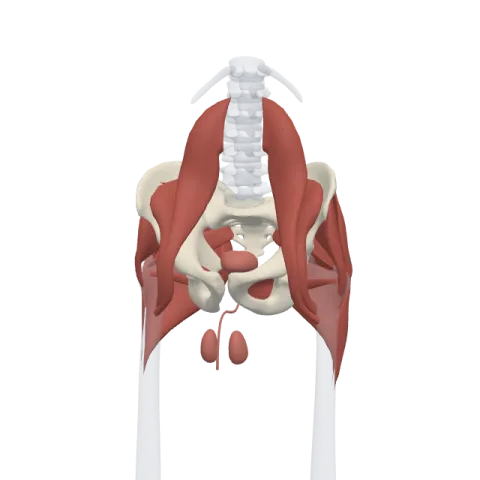
The obturator internus is a fan-shaped muscle that starts on the inner wall of the pelvis, leaves it through the lesser sciatic foramen and ends on the greater trochanter of the femur. It rotates the extended hip laterally and is supplied by its own nerve, the nerve to obturator internus.
Where it is
The obturator internus has an unusual course: half of it is inside the pelvis and half is in the buttock.
- Inside the pelvis, it covers most of the side wall of the lesser pelvis, spread over the inner surface of the obturator foramen, the large hole in the hip bone closed by the obturator membrane. The fascia on its inner surface forms a thickened line, the tendinous arch, from which part of the pelvic floor (the levator ani) arises.
- The corner. Its fibers converge toward the back and leave the pelvis through the lesser sciatic foramen. Here the tendon bends at about a right angle around the lesser sciatic notch of the ischium, which works like a pulley. A bursa lets it glide over the bone.
- In the buttock, the tendon runs horizontally outward, deep to the gluteus maximus, with a small muscle on each side of it: the superior and inferior gemelli ("twins"). Together they reach the greater trochanter of the femur.
In the row of deep hip rotators, it sits below the piriformis and above the quadratus femoris.
Origin and insertion
- Origin: the inner (pelvic) surface of the obturator membrane and the bony margins of the obturator foramen, on the ilium, ischium and pubis.
- Insertion: the medial surface of the greater trochanter, just above the trochanteric fossa, together with the tendons of the two gemelli.
What it does
- Lateral rotation of the extended hip. With the leg straight, it turns the thigh so that the knee and foot point outward.
- Abduction of the flexed hip. When the hip is bent, as in sitting, the same pull moves the thigh away from the midline.
- Stabilizing the hip. Like the other short rotators, it pulls the head of the femur into the acetabulum and keeps it steady while the larger muscles move the limb.
Innervation and blood supply
The obturator internus is supplied by the nerve to obturator internus (L5, S1 and S2), a branch of the sacral plexus. The nerve leaves the pelvis through the greater sciatic foramen below the piriformis, gives a branch to the superior gemellus, crosses the ischial spine and re-enters through the lesser sciatic foramen to reach the muscle.
Watch the trap: despite its name, the obturator internus is not supplied by the obturator nerve. The obturator nerve supplies the obturator externus and the adductor muscles of the thigh.
Its blood comes from the internal pudendal artery and the obturator artery.
How to remember it
- Internus starts inside. The obturator internus arises from the inside of the obturator membrane; the obturator externus arises from the outside.
- The pulley muscle. Its tendon turns a right angle around the lesser sciatic notch, like a rope over a pulley.
- Twins on each side. Superior gemellus above, inferior gemellus below, obturator internus in the middle: the classic "P-G-O-G-Q" order of the deep rotators (piriformis, gemellus, obturator internus, gemellus, quadratus femoris).
- Own nerve, not the obturator nerve. The nerve is named after the muscle, the nerve to obturator internus, and it also supplies the superior gemellus.
Revise the deep rotators on the muscles of the hip page, then find the obturator internus on the 3D model in the pelvis quiz.
Frequently asked questions
What is the action of the obturator internus?
It laterally rotates the extended hip, abducts the flexed hip and helps hold the head of the femur in its socket.
Is the obturator internus supplied by the obturator nerve?
No. It is supplied by the nerve to obturator internus (L5 to S2), from the sacral plexus. The obturator nerve supplies the obturator externus.
How does the obturator internus leave the pelvis?
Through the lesser sciatic foramen, where its tendon turns around the lesser sciatic notch of the ischium.
Where does the obturator internus insert?
On the medial surface of the greater trochanter of the femur, together with the superior and inferior gemelli.
