Muscle · Lower limb
Pectineus: origin, insertion, action and innervation
The pectineus runs from the pecten pubis to the pectineal line of the femur. It adducts and flexes the hip and is usually supplied by the femoral nerve (L2-L3).
Quick answer
- Latin name
- Musculus pectineus
- Origin
- Pecten pubis (pectineal line of the pubis) on the superior pubic ramus of the hip bone
- Insertion
- Pectineal line of the femur, just below the lesser trochanter
- Action
- Adducts and flexes the hip; helps rotate the thigh medially
- Innervation
- Femoral nerve (L2-L3); sometimes also a branch of the obturator nerve
- Blood supply
- Medial circumflex femoral artery and obturator artery
See it on the 3D body
The pectineus lit on the 3D hip and thigh, as in the hip and thigh quiz. Turn the body, peel the layers, tap any structure for its name.
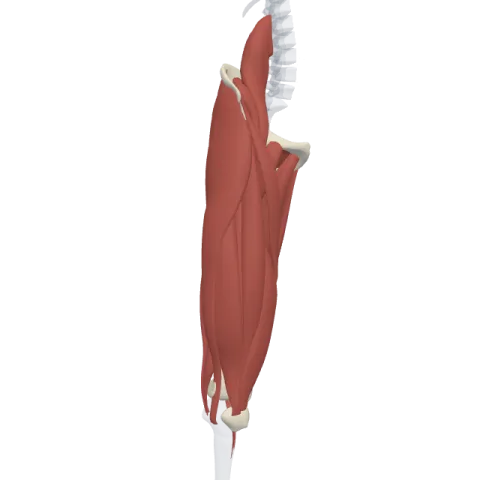
The pectineus is a flat, four-sided muscle at the top of the inner thigh that runs from the superior pubic ramus to the femur just below the lesser trochanter. It adducts and flexes the hip and is supplied by the femoral nerve (L2-L3).
Where it is
The pectineus sits high in the groin, in the floor of the femoral triangle. That triangle is the hollow just below the inguinal ligament, bounded by the sartorius on the outside, the adductor longus on the inside and the inguinal ligament above. Its floor is made of two muscles side by side: the iliopsoas laterally (with the psoas major) and the pectineus medially. The femoral vein, artery and nerve run over this floor.
It is the most superior of the adductor group. Its lower edge touches the adductor longus, and the adductor brevis and the obturator externus lie behind it. See its neighbors on muscles of the thigh.
The name comes from the pecten pubis, the sharp ridge on the pubis where the muscle starts. Pecten is Latin for "comb".
Origin and insertion
- Origin: the pecten pubis (the pectineal line of the pubis), on the upper surface of the superior pubic ramus of the hip bone.
- Insertion: the pectineal line of the femur, a short ridge running from the lesser trochanter down toward the linea aspera.
Both attachments share the same root word, which makes this muscle one of the easiest to learn: it runs from the pectineal line of the pubis to the pectineal line of the femur.
What it does
- Adduction of the hip: it brings the thigh toward the midline, with the other adductors.
- Flexion of the hip: it lies in front of the hip joint, so it also lifts the thigh forward. When the hip is flexed, it can help draw the leg across the body.
- Medial rotation: it adds a small inward twist to the thigh.
Its two actions combine in movements such as crossing one leg over the other while sitting, or kicking a ball with the inside of the foot.
Innervation and blood supply
The pectineus is usually supplied by the femoral nerve (L2-L3), which makes it the odd one out among the adductors. Sometimes it also gets a branch from the obturator nerve, or from the accessory obturator nerve when that small nerve is present. Textbooks explain this double supply by its position on the border between the anterior and medial compartments of the thigh.
Its blood comes from the medial circumflex femoral artery and the obturator artery.
How to remember it
- Pecten to pecten: pectineal line of the pubis to pectineal line of the femur. Learn one word, get both attachments.
- The adductor with the femoral nerve: the adductor longus, brevis and magnus all get the obturator nerve; the pectineus usually gets the femoral nerve.
- Floor of the femoral triangle: "the iliopsoas and pectineus carry the femoral vessels" helps you remember what lies under the artery in the groin.
- Top of the stack: going down the inner thigh from the pubis, the pectineus comes first, then the adductor longus.
Test yourself in the hip and thigh quiz.
Frequently asked questions
What is the action of the pectineus?
It adducts and flexes the thigh at the hip, and helps rotate it medially.
What nerve supplies the pectineus?
The femoral nerve, from roots L2 and L3. It sometimes also receives a branch of the obturator nerve.
Where does the pectineus attach?
From the pecten pubis on the superior pubic ramus to the pectineal line of the femur, just below the lesser trochanter.
Is the pectineus part of the femoral triangle?
Yes. It forms the medial part of the floor of the femoral triangle, beside the iliopsoas.
Is the pectineus an adductor or a hip flexor?
Both. It is grouped with the adductors of the medial thigh, but it also flexes the hip.
