
Muscle · Lower limb
Iliacus muscle: origin, insertion, action and innervation
The iliacus runs from the iliac fossa of the hip bone to the lesser trochanter of the femur. It flexes the hip with the psoas major; femoral nerve (L2–L3).
Quick answer
- Latin name
- Musculus iliacus
- Origin
- Upper two thirds of the iliac fossa and inner lip of the iliac crest of the hip bone; ala of the sacrum and the anterior sacroiliac ligaments
- Insertion
- Lesser trochanter of the femur, through the tendon of the psoas major, and the shaft just below it
- Action
- Flexes the hip; with the thigh fixed, flexes the trunk on the thigh (as in sitting up from lying)
- Innervation
- Femoral nerve (L2–L3)
- Blood supply
- Iliac branch of the iliolumbar artery; deep circumflex iliac and obturator arteries
See it on the 3D body
The iliacus lit on the 3D pelvis, as in the pelvis quiz. Turn the body, peel the layers, tap any structure for its name.
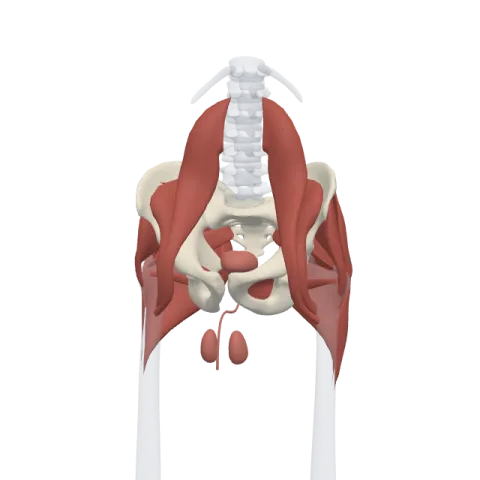
The iliacus is a flat, fan-shaped muscle that fills the inner bowl of the hip bone (the iliac fossa) and ends on the lesser trochanter of the femur. Together with the psoas major it forms the iliopsoas, the main flexor of the hip, and it is supplied by the femoral nerve.
Where it is
Look into the pelvis from the front and you see the two wings of the ilium flaring out on each side like the sides of a bowl. The iliacus lines the inside of each wing, in the iliac fossa of the hip bone. It lies behind the abdominal organs: the cecum on the right, the sigmoid colon on the left.
Its fibers converge downward and forward. On the way they join the lateral side of the psoas major tendon, which comes down from the lumbar spine. The two muscles then pass together under the inguinal ligament, into the front of the thigh, and end on the inner side of the upper femur. Because they share a tendon and an action, they are usually named together as the iliopsoas.
In the upper thigh, the iliopsoas forms the lateral part of the floor of the femoral triangle. The femoral nerve, which supplies the iliacus, runs in the groove between the iliacus and the psoas major before it enters the thigh.
Origin and insertion
- Origin: the upper two thirds of the iliac fossa and the inner lip of the iliac crest; also the ala (wing) of the sacrum and the anterior sacroiliac ligaments.
- Insertion: the lesser trochanter of the femur, mostly through the tendon of the psoas major, with some fibers attaching to the shaft of the femur just below.
What it does
- Flexes the hip. With the psoas major, it lifts the thigh forward: climbing a step, kicking a ball, marching with the knee high. The iliopsoas is the strongest hip flexor.
- Flexes the trunk on the thigh. When the legs are held down, the iliopsoas pulls the pelvis and trunk forward. This is the second half of a full sit-up, after the abdominal muscles have curled the upper trunk.
- Posture. It is active in standing and helps stop the hip from overextending, so the trunk does not tip backward.
Unlike the psoas major, the iliacus does not attach to the lumbar vertebrae, so it does not bend the lumbar spine to the side. Its action is limited to the hip.
Innervation and blood supply
The iliacus is supplied by the femoral nerve (roots L2 and L3), which gives branches to it while running in the groove next to the psoas major. This is a classic exam contrast: the psoas major is supplied directly by the anterior rami of the lumbar nerves, while the iliacus is supplied by the femoral nerve.
Its blood comes mainly from the iliac branch of the iliolumbar artery, with help from the deep circumflex iliac artery and the obturator artery.
How to remember it
- Iliacus lives in the iliac fossa. The name tells you the origin.
- Ilio + psoas = iliopsoas. Two bellies, one tendon, one insertion on the lesser trochanter, one main action: hip flexion.
- Femoral feeds the iliacus. "F" for femoral, "F" for the fossa it lines and for flexion.
- No lumbar vertebrae, no side bend. The iliacus starts on the pelvis and sacrum, not the lumbar spine, so it only moves the hip.
See the full hip group on the muscles of the hip page, then find the iliacus on the 3D pelvis in the pelvis quiz.
Frequently asked questions
What is the action of the iliacus?
It flexes the hip, lifting the thigh forward. With the thigh fixed, it flexes the pelvis and trunk on the thigh.
What nerve supplies the iliacus?
The femoral nerve, roots L2 and L3. The psoas major, by contrast, is supplied directly by the lumbar anterior rami.
Where does the iliacus insert?
On the lesser trochanter of the femur, through the tendon it shares with the psoas major, and on the shaft just below.
Is the iliacus part of the hip flexors?
Yes. It shares a tendon with the psoas major, and the pair, called the iliopsoas, is the most powerful hip flexor.
