
Muscle · Lower limb
Semitendinosus: origin, insertion, action and innervation
The semitendinosus runs from the ischial tuberosity to the medial tibia. This hamstring extends the hip, flexes the knee and is supplied by the tibial nerve.
Quick answer
- Latin name
- Musculus semitendinosus
- Origin
- Ischial tuberosity of the hip bone, by a tendon shared with the long head of the biceps femoris
- Insertion
- Upper medial surface of the tibia, as part of the pes anserinus
- Action
- Extends the hip; flexes the knee; rotates the leg medially when the knee is bent
- Innervation
- Tibial division of the sciatic nerve (L5-S2)
- Blood supply
- Perforating branches of the deep femoral artery, with branches of the inferior gluteal and medial circumflex femoral arteries
See it on the 3D body
The semitendinosus lit on the 3D hip and thigh, as in the hip and thigh quiz. Turn the body, peel the layers, tap any structure for its name.
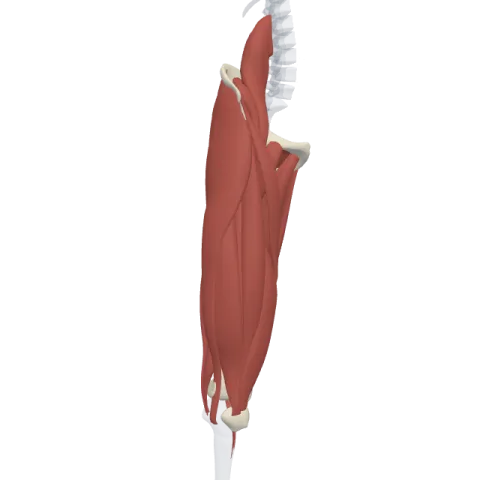
The semitendinosus is one of the three hamstrings, a long muscle on the inner side of the back of the thigh that runs from the ischial tuberosity to the upper medial tibia. It extends the hip, flexes the knee and is supplied by the tibial division of the sciatic nerve (L5-S2).
Where it is
The semitendinosus lies in the posterior compartment of the thigh, on its medial side. It runs on top of the broader semimembranosus, so of the two medial hamstrings it is the more superficial. The biceps femoris runs down the outer side of the same compartment.
Its shape gives it its name. The upper half is a fleshy, spindle-shaped belly, often crossed by a tendinous line across its middle. About halfway down the thigh it narrows into a long, round tendon, so it is "half tendon". Behind a bent knee you can feel that tendon as the most prominent cord on the inner side, with the semimembranosus deeper and slightly wider. See all three hamstrings on muscles of the thigh.
Origin and insertion
- Origin: the ischial tuberosity of the hip bone. It shares a common tendon there with the long head of the biceps femoris.
- Insertion: the upper part of the medial surface of the tibia, just below the medial condyle.
At its insertion it joins the tendons of the sartorius and the gracilis. The three tendons spread out together on the tibia like the toes of a goose foot, a pattern called the pes anserinus. The semitendinosus tendon is the lowest and most posterior of the three.
What it does
- Extension of the hip: it pulls the thigh backward, with the other hamstrings and the gluteus maximus. This is its main role in walking, when it decelerates the forward swing of the leg and then helps drive the body over the foot.
- Flexion of the knee: it bends the knee, as when you bring your heel toward your buttock.
- Medial rotation of the leg: with the knee bent, it turns the leg and foot inward, opposite to the biceps femoris.
Because it crosses two joints, the semitendinosus is stretched when the hip is flexed and the knee is straight, which is the position of a toe-touch.
Innervation and blood supply
The semitendinosus is supplied by the tibial division of the sciatic nerve (L5-S2), like the semimembranosus and the long head of the biceps femoris. The nerve often sends two branches, one to each part of the belly on either side of the tendinous line.
Its blood comes from the perforating branches of the deep femoral artery, helped higher up by the inferior gluteal and medial circumflex femoral arteries.
Its long tendon is often used as a graft in anterior cruciate ligament reconstruction.
How to remember it
- Tendinosus means tendon: the semitendinosus is half muscle, half tendon. The semimembranosus has a flat, membrane-like tendon at the top instead.
- T on top: the semi-T lies on the semi-M, like a pencil on a ruler.
- T comes last: in "Say Grace before Tea" (Sartorius, Gracilis, semiTendinosus), the semitendinosus is the last word, just as its tendon is the lowest and most posterior in the goose foot.
- One rule for three hamstrings: hamstrings arise from the ischial tuberosity, cross the knee and take the tibial part of the sciatic nerve. Only the short head of the biceps femoris breaks the rule.
Test yourself in the hip and thigh quiz.
Frequently asked questions
What does the semitendinosus do?
It extends the hip, flexes the knee and turns the leg inward when the knee is bent.
What nerve supplies the semitendinosus?
The tibial division of the sciatic nerve, from roots L5 to S2.
Where does the semitendinosus insert?
On the upper medial surface of the tibia, in the pes anserinus with the sartorius and the gracilis.
Is the semitendinosus superficial to the semimembranosus?
Yes. The semitendinosus lies on top of the semimembranosus on the inner side of the back of the thigh.
