Muscle · Lower limb
Vastus medialis: origin, insertion, action and innervation
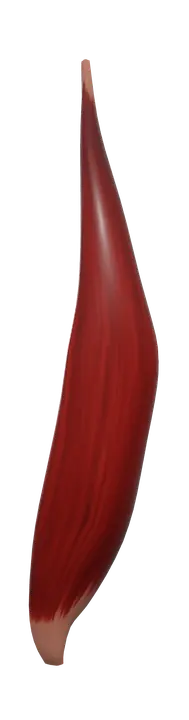
The vastus medialis is a quadriceps muscle from the femur intertrochanteric line and linea aspera to the tibial tuberosity. It extends the knee.
Quick answer
- Latin name
- Musculus vastus medialis
- Origin
- Lower intertrochanteric line, spiral line, medial lip of the linea aspera and upper medial supracondylar line of the femur; tendons of adductor longus and magnus
- Insertion
- Medial border of the patella through the quadriceps tendon, then the tibial tuberosity of the tibia through the patellar ligament
- Action
- Extends the knee; its lowest, oblique fibers help keep the patella in its groove
- Innervation
- Femoral nerve (L2–L4)
- Blood supply
- Muscular branches of the femoral and deep femoral arteries, and the descending genicular artery
See it on the 3D body
The vastus medialis lit on the 3D hip and thigh, as in the hip and thigh quiz. Turn the body, peel the layers, tap any structure for its name.
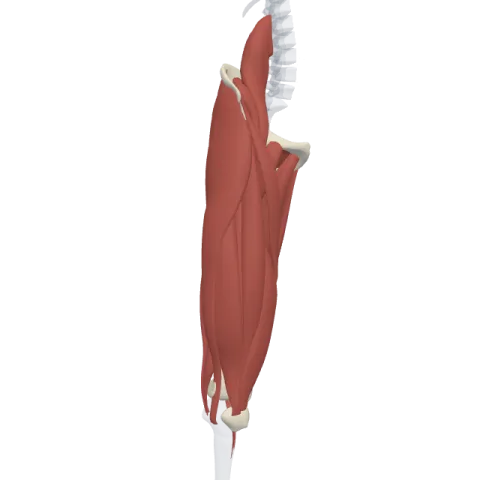
The vastus medialis is the quadriceps muscle on the inner side of the thigh, running from the back of the femur to the medial border of the patella. It extends the knee, helps keep the kneecap on track, and is supplied by the femoral nerve (L2–L4).
Where it is
The vastus medialis lies on the front and inner side of the thigh, in the anterior compartment. Its lower part forms the rounded, teardrop-shaped bulge just above and inside the knee, which becomes easy to see when you straighten the leg and tighten the thigh.
It sits beside the rectus femoris in front and the vastus intermedius underneath, with the vastus lateralis on the opposite side of the thigh. Along its inner edge it borders the adductors; the sartorius crosses over it, and the femoral vessels run in the groove between it and the adductors, in the adductor canal. For the full layout of the compartments, see muscles of the thigh.
Origin and insertion
Although it looks like a front-of-the-thigh muscle, the vastus medialis starts mostly on the back of the femur and curls around to the front:
- Origin: the lower part of the intertrochanteric line, the spiral line, the medial lip of the linea aspera, and the upper part of the medial supracondylar line of the femur. Some fibers also arise from the tendons of the adductor longus and adductor magnus and from the medial intermuscular septum.
- Insertion: the medial border of the patella through the quadriceps tendon, and, through the patellar ligament, the tibial tuberosity of the tibia. Some fibers join the medial patellar retinaculum beside the kneecap.
Its fibers do not all run the same way. The upper fibers run nearly vertically, while the lowest fibers run almost horizontally to the patella. These lower fibers are often called the vastus medialis obliquus in sports science and physiotherapy courses.
What it does
- Knee extension: with the other three quadriceps muscles, it straightens the knee. It works through the whole range of extension, not only at the end of the movement.
- Patellar stability: the quadriceps as a whole tends to pull the patella slightly outward, because of the angle between the thigh and the leg. The low, oblique fibers of the vastus medialis pull it inward and help keep it centered in the groove between the femoral condyles.
- Controlled bending: like the other vasti, it works while lengthening to control knee bending when you sit down, squat or go down stairs.
The vastus medialis does not cross the hip, so it has no action there.
Innervation and blood supply
The femoral nerve (L2–L4) supplies it, through a branch that runs with the femoral vessels in the adductor canal. This is the same nerve as for the rest of the quadriceps.
Blood comes from muscular branches of the femoral artery and the deep femoral artery, and from the descending genicular artery, which arises from the femoral artery just above the knee.
How to remember it
- Medialis = medial side; its partner, the vastus lateralis, is on the outer side.
- Picture a teardrop above the inner knee: that's the vastus medialis.
- "Starts at the back, ends at the front": it arises from the linea aspera behind the femur and wraps around to the patella.
- Same rule as all the quadriceps: femoral nerve, knee extension, patellar ligament to the tibial tuberosity.
Frequently asked questions
What does the vastus medialis do?
It extends the knee with the rest of the quadriceps, and its lower oblique fibers help hold the patella in its groove by pulling it medially.
Where is the vastus medialis located?
On the front and inner side of the thigh. Its lower end makes the teardrop-shaped bulge just above the medial side of the knee.
What is the vastus medialis obliquus?
It's the name often given to the lowest fibers of the vastus medialis, which run almost horizontally to the medial border of the patella. Anatomically they are part of the same muscle, with the same nerve.
Which nerve supplies the vastus medialis?
The femoral nerve, from roots L2 to L4.
Does the vastus medialis cross the hip?
No. Of the four quadriceps muscles, only the rectus femoris crosses the hip. The vastus medialis acts only on the knee.
