
Muscle · Lower limb
Flexor digitorum longus: origin, insertion, action and innervation
The flexor digitorum longus runs from the back of the tibia to the distal phalanges of toes 2 to 5. It flexes those toes and is supplied by the tibial nerve.
Quick answer
- Latin name
- Musculus flexor digitorum longus
- Origin
- Medial part of the posterior surface of the tibia, below the soleal line
- Insertion
- Bases of the distal phalanges of the second to fifth toes
- Action
- Flexes the second to fifth toes, mainly at the distal interphalangeal joints; helps plantarflex the ankle and invert the foot; supports the longitudinal arch
- Innervation
- Tibial nerve (S2-S3)
- Blood supply
- Posterior tibial artery
See it on the 3D body
The flexor digitorum longus lit on the 3D leg and foot, as in the leg and foot quiz. Turn the body, peel the layers, tap any structure for its name.
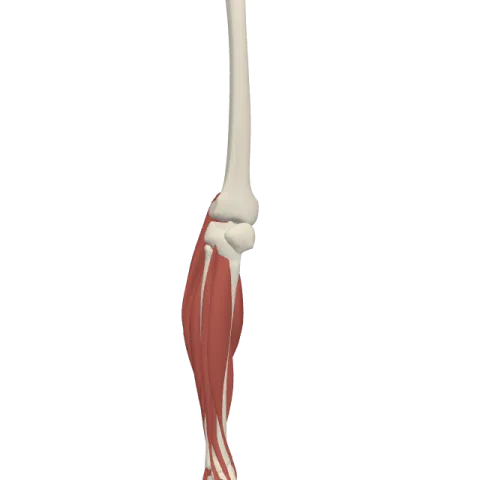
The flexor digitorum longus is a deep muscle at the back of the leg that starts on the tibia and sends four tendons through the sole to the tips of the second to fifth toes. It flexes those toes, mainly at the distal interphalangeal joints, and is supplied by the tibial nerve (S2-S3).
Where it is
The flexor digitorum longus belongs to the deep group of the posterior compartment of the leg, under the soleus and the gastrocnemius. It is the most medial of the three deep muscles, lying on the back of the tibia. The tibialis posterior lies lateral to it at first, and the flexor hallucis longus lies on the fibula side.
Its tendon follows an unusual path, with two crossings:
- Above the ankle, it crosses over the tendon of the tibialis posterior, so that tibialis posterior ends up in front. Behind the medial malleolus, the order from front to back is tibialis posterior, then flexor digitorum longus.
- In the sole, it crosses over (superficial to) the tendon of the flexor hallucis longus, which is heading the other way, toward the big toe. The two tendons are often joined by a slip at this crossing.
After the second crossing, its tendon fans out into four tendons for toes 2 to 5. See the deep group on muscles of the leg.
Origin and insertion
- Origin: the medial part of the posterior surface of the tibia, below the soleal line, and a fibrous band that links it to the fibula.
- Insertion: the bases of the distal phalanges of the second to fifth toes (see the phalanges of the foot). Each tendon passes through the split in the matching tendon of the flexor digitorum brevis to get there.
Two groups of small sole muscles attach to its tendons. The quadratus plantae pulls on the tendon from the side to straighten its oblique line of pull. The four lumbricals arise from its four tendons.
What it does
- Flexion of the lateral four toes: it bends toes 2 to 5 at all their joints, starting with the distal interphalangeal joints, the joints closest to the tips.
- Plantarflexion of the ankle: it crosses behind the ankle, so it helps point the foot down, a small role beside the calf muscles.
- Inversion of the foot: its tendon passes medial to the subtalar joint, so it helps tilt the sole inward.
- Supporting the arch: its tendons under the foot help hold up the longitudinal arch and press the toe pads onto the ground.
When you stand on tiptoe or grip the floor with your toes, the flexor digitorum longus keeps the toes pressed flat against the ground.
Innervation and blood supply
The flexor digitorum longus is supplied by the tibial nerve (S2-S3), which supplies every muscle of the posterior compartment of the leg. The nerve runs down between this muscle and the flexor hallucis longus.
Its blood comes from the posterior tibial artery, which travels with the tibial nerve in the deep compartment.
How to remember it
- Tibia for digitorum, fibula for hallucis: the toe flexor for the four small toes starts on the tibia; the big-toe flexor starts on the fibula. The two muscles then cross in the sole and end up on the "wrong" side.
- Two crossings: crural crossing above the ankle (over tibialis posterior), plantar crossing in the sole (over flexor hallucis longus).
- Pulled from the side: its tendon enters the sole at a slant, so the quadratus plantae tugs on it to straighten the pull toward the toes.
- Foot copy of the profundus: like the flexor digitorum profundus in the forearm, it passes through split tendons and gives origin to lumbricals.
Test yourself in the leg and foot quiz.
Frequently asked questions
What does the flexor digitorum longus do?
It flexes the second to fifth toes, mainly at the distal interphalangeal joints. It also helps plantarflex the ankle, invert the foot and support the arch.
What nerve supplies the flexor digitorum longus?
The tibial nerve, from roots S2 and S3.
Where does the flexor digitorum longus insert?
On the bases of the distal phalanges of the second to fifth toes.
Which muscles attach to the flexor digitorum longus tendon?
The quadratus plantae, which pulls on it from the side, and the four lumbricals, which arise from its tendons.
