
Muscle · Lower limb
Flexor hallucis longus: origin, insertion, action and innervation
The flexor hallucis longus runs from the back of the fibula to the distal phalanx of the big toe. It flexes the great toe and is supplied by the tibial nerve.
Quick answer
- Latin name
- Musculus flexor hallucis longus
- Origin
- Lower two thirds of the posterior surface of the fibula and the interosseous membrane
- Insertion
- Base of the distal phalanx of the great toe
- Action
- Flexes the great toe at the interphalangeal and metatarsophalangeal joints; weakly plantarflexes the ankle; supports the medial arch
- Innervation
- Tibial nerve (S2-S3)
- Blood supply
- Fibular artery and posterior tibial artery
See it on the 3D body
The flexor hallucis longus lit on the 3D leg and foot, as in the leg and foot quiz. Turn the body, peel the layers, tap any structure for its name.
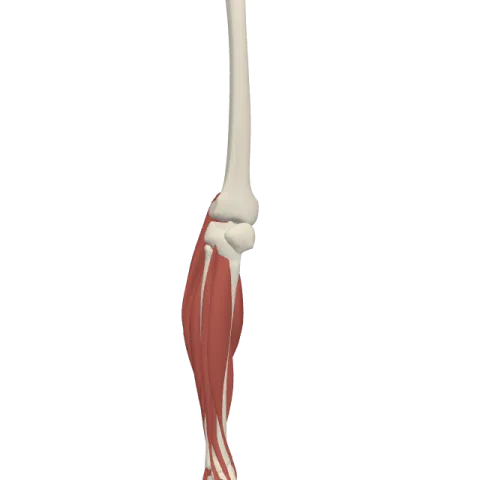
The flexor hallucis longus is a strong, deep muscle at the back of the leg that runs from the fibula, behind the talus and under the calcaneus, to the tip of the big toe. It flexes the great toe at both of its joints, helps push the body forward in walking, and is supplied by the tibial nerve (S2-S3).
Where it is
The flexor hallucis longus is the largest of the three deep muscles of the posterior compartment of the leg, under the soleus. Although it moves the big toe on the inner side of the foot, it starts on the outer side of the leg, on the back of the fibula. The tibialis posterior lies between it and the flexor digitorum longus.
Its tendon takes a long, winding route to reach the big toe:
- It runs down behind the ankle and enters a groove on the back of the talus, between two small tubercles.
- It then passes under the sustentaculum tali, a shelf of bone on the inner side of the calcaneus, using it like a pulley.
- In the sole, it crosses under the flexor digitorum longus tendon and runs forward between the two sesamoid bones of the big toe to its tip.
Behind the medial malleolus, it is the most posterior of the tendons, behind the tibial nerve. See the deep group on muscles of the leg.
Origin and insertion
- Origin: the lower two thirds of the posterior surface of the fibula and the lower part of the interosseous membrane.
- Insertion: the base of the distal phalanx of the great toe, on its plantar side (see the phalanges of the foot).
Its fleshy belly reaches low, close to the ankle, so the tendon itself is short before it enters the groove on the talus.
What it does
- Flexion of the great toe: it bends the big toe at the interphalangeal joint and at the metatarsophalangeal joint.
- Push-off in walking and running: at the end of each step, it presses the big toe into the ground and gives the final push that lifts the foot.
- Weak plantarflexion and support of the medial arch: its tendon runs behind the talus and under the sustentaculum tali like a sling, helping hold up the inner arch.
Ballet dancers working on pointe load this muscle heavily, so its tendon is often discussed in dance medicine.
Innervation and blood supply
The flexor hallucis longus is supplied by the tibial nerve (S2-S3), like all the muscles of the posterior compartment of the leg.
Its blood comes mainly from the fibular artery, which runs close to the fibula and through the muscle, with help from the posterior tibial artery.
How to remember it
- Starts lateral, ends medial: from the fibula to the big toe, it crosses the whole back of the ankle. The flexor digitorum longus does the opposite, from the tibia to the lateral toes.
- Last in line: behind the medial malleolus, the tendon order front to back ends with the flexor Hallucis longus. It is the H of "Tom, Dick And Very Nervous Harry".
- Pulley under the shelf: the sustentaculum tali "sustains" the talus, and its underside is the pulley for this tendon.
- Toe-off muscle: picture the big toe pushing off last at every step.
Test yourself in the leg and foot quiz.
Frequently asked questions
What does the flexor hallucis longus do?
It flexes the big toe at the interphalangeal and metatarsophalangeal joints, helps push off during walking, weakly plantarflexes the ankle and supports the medial arch.
What nerve supplies the flexor hallucis longus?
The tibial nerve, from roots S2 and S3.
Where does the flexor hallucis longus originate?
From the lower two thirds of the back of the fibula and the interosseous membrane.
Why does the flexor hallucis longus groove the talus?
Its tendon runs in a groove on the back of the talus, between the medial and lateral tubercles, before passing under the sustentaculum tali of the calcaneus.
