
Muscle · Head and neck
Depressor anguli oris: origin, insertion, action and innervation
The depressor anguli oris runs from the mandible to the corner of the mouth. It pulls the corner down and out; facial nerve, marginal mandibular branch.
Quick answer
- Latin name
- Musculus depressor anguli oris
- Origin
- Oblique line of the mandible, below the canine, premolar and first molar teeth
- Insertion
- Modiolus at the angle of the mouth, blending with the orbicularis oris
- Action
- Draws the angle of the mouth downward and laterally
- Innervation
- Facial nerve (CN VII), marginal mandibular and buccal branches
- Blood supply
- Inferior labial artery (from the facial artery) and the mental artery
See it on the 3D body
The depressor anguli oris lit on the 3D head, as in the head quiz. Turn the body, peel the layers, tap any structure for its name.
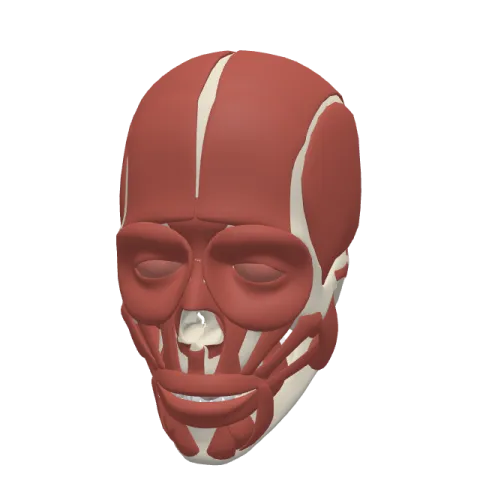
The depressor anguli oris is a triangular muscle on the side of the chin that pulls the corner of the mouth downward and outward, the movement of a sad face. It runs from the oblique line of the mandible to the angle of the mouth and is supplied by the marginal mandibular and buccal branches of the facial nerve (CN VII).
Where it is
The muscle lies just under the skin below the corner of the mouth. It is shaped like a triangle with its wide base along the lower jaw and its tip at the corner of the mouth, which is why older books call it the triangularis.
It is the most superficial of the muscles below the mouth. It overlaps the depressor labii inferioris, which lies deeper and closer to the midline. At its lower border, its fibers are continuous with the platysma, the thin sheet of muscle that covers the front of the neck.
The Latin name reads directly: depressor (it lowers), anguli (of the angle), oris (of the mouth).
Origin and insertion
- Origin: the oblique line of the mandible, a faint ridge on the outer surface of the lower jaw, below the canine, premolar and first molar teeth.
- Insertion: the modiolus, the knot of muscle fibers at the corner of the mouth, where it blends with the orbicularis oris and the other muscles that meet there.
What it does
The depressor anguli oris draws the angle of the mouth downward and laterally. With the mouth closed, this turns the line of the lips into an upside-down curve: the expression of sadness, disappointment or disapproval. The two sides can also act one at a time, giving a lopsided, skeptical twist to the mouth.
Its direct antagonist is the levator anguli oris, which lifts the corner of the mouth, helped by the zygomaticus major in a smile. A lot of what we read in a face comes from the balance between these upward and downward pulls on the same small point, the modiolus.
You can feel it: put a fingertip just below and outside the corner of your mouth and make an exaggerated sad face. The muscle tightens under your finger, and the platysma in the neck often tightens with it.
Innervation and blood supply
The muscle is supplied by the marginal mandibular branch of the facial nerve, with a contribution from the buccal branch. The marginal mandibular branch runs forward along the lower border of the mandible, close to the skin, before turning up into the lower lip muscles. Damage to this branch can leave the corner of the mouth on that side unable to turn down, so the smile and the frown look uneven.
Blood comes from the inferior labial artery, a branch of the facial artery, and from the mental artery, which exits the mandible at the mental foramen.
How to remember it
- Triangle to a point: wide base on the jaw, tip at the corner of the mouth.
- "Anguli" = angle, "labii" = lip: the anguli muscle moves the corner; the labii muscle moves the lower lip.
- Top layer below the lips: depressor anguli oris covers the depressor labii inferioris.
- Sad emoji muscle: the downturned mouth is this muscle at work.
- Marginal mandibular for the margin of the mandible: the branch runs along the jaw line to reach the muscles of the lower lip and chin.
See it next to its neighbors on the muscles of the face page and test yourself in the head quiz.
Frequently asked questions
What is the action of the depressor anguli oris?
It pulls the corner of the mouth downward and outward, as in a sad or disapproving expression.
Which nerve supplies the depressor anguli oris?
The facial nerve (CN VII), mainly its marginal mandibular branch, with help from the buccal branch.
What is the difference between the depressor anguli oris and the depressor labii inferioris?
The depressor anguli oris lowers the corner of the mouth and lies on the surface. The depressor labii inferioris lowers the lower lip itself and lies deeper, nearer the midline.
Where does the depressor anguli oris originate?
On the oblique line of the mandible, below the canine, premolar and first molar teeth.
