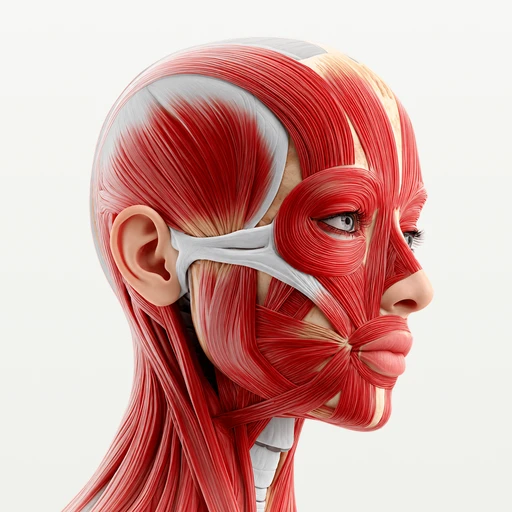
Muscle · Head and neck
Buccinator muscle: origin, insertion, action and innervation
The buccinator runs from the maxilla, mandible and pterygomandibular raphe to the mouth corner. It presses the cheek on the molars; facial nerve, buccal branch.
Quick answer
- Latin name
- Musculus buccinator
- Origin
- Outer surfaces of the alveolar processes of the maxilla (skull) and mandible opposite the molars, and the pterygomandibular raphe
- Insertion
- Modiolus at the angle of the mouth, blending with the orbicularis oris of both lips
- Action
- Presses the cheek against the molar teeth, keeps food between the teeth during chewing and pushes air out of puffed cheeks
- Innervation
- Facial nerve (CN VII), buccal branches
- Blood supply
- Branches of the facial artery and the buccal artery (from the maxillary artery)
See it on the 3D body
The buccinator lit on the 3D head, as in the head quiz. Turn the body, peel the layers, tap any structure for its name.
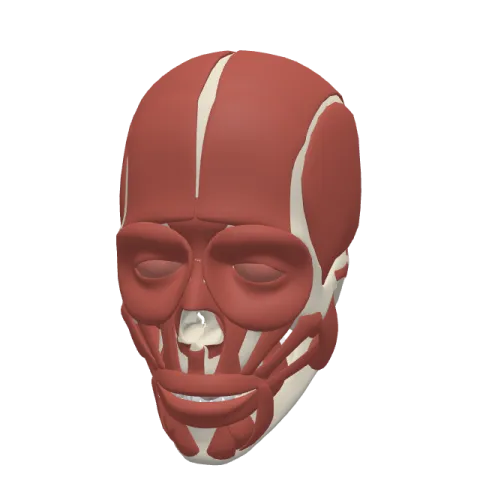
The buccinator is the flat muscle that forms the wall of the cheek. It presses the cheek against the molar teeth, which keeps food between the teeth while you chew and lets you blow air out of puffed cheeks, and it is supplied by the buccal branches of the facial nerve (CN VII).
Where it is
The buccinator lies deep in the cheek, between the skin and the lining of the mouth. Its inner surface is covered by the mucosa you feel with your tongue when you push it against the inside of your cheek. On its outer surface sit the buccal fat pad, the masseter at the back and several lip muscles at the front.
It is a rectangular sheet that runs horizontally from the back of the jaws to the corner of the mouth. At the back it meets the superior constrictor of the pharynx along a band of tissue, so the cheek wall and the throat wall form one continuous muscular tube.
The duct of the parotid gland pierces the buccinator to open into the mouth, opposite the upper second molar.
Origin and insertion
The buccinator has a U-shaped origin on three structures:
- the outer surface of the alveolar process of the maxilla, part of the skull, opposite the molars;
- the outer surface of the alveolar part of the mandible, opposite the molars;
- the pterygomandibular raphe, a fibrous band between the two jaws, behind the last molars.
The fibers run forward to the modiolus, the knot of muscle fibers just outside the corner of the mouth, and blend with the orbicularis oris. Near the corner, the middle fibers cross: the lower ones go to the upper lip and the upper ones to the lower lip. The highest and lowest fibers stay in their own lip.
What it does
- Keeps food on the teeth. When you chew, the tongue pushes food out toward the cheek. The buccinator presses the cheek back so the food returns between the molars instead of collecting in the space between cheek and gums.
- Blows air out. When the cheeks are puffed, the buccinator compresses them and pushes the air through the lips. Its name comes from the Latin buccina, a kind of trumpet: it is the trumpeter's muscle.
- Sucking and whistling. It keeps the cheeks firm so they do not balloon out or cave in, which helps a baby feed and helps you whistle or drink through a straw.
- Pulls the corner of the mouth back. Acting on the modiolus, it draws the angle of the mouth sideways, together with the other muscles that meet there.
Even though it helps chewing, the buccinator is a muscle of facial expression, not a muscle of mastication. It does not move the jaw.
Innervation and blood supply
The buccinator is supplied by the buccal branches of the facial nerve, which cross the face from the front edge of the parotid gland.
A classic trap: the buccal nerve, a branch of the mandibular division of the trigeminal nerve (V3), passes through the buccinator but does not move it. It only carries sensation from the skin of the cheek and the mucosa inside it. A weak buccinator after a facial nerve palsy is why food can collect inside the cheek on the affected side.
Its blood comes from branches of the facial artery and from the buccal artery, a branch of the maxillary artery that travels with the buccal nerve.
How to remember it
- Buccinator = trumpeter. Picture a trumpet player with round, tight cheeks.
- Buccal nerve: sensory trap. It goes through the muscle but supplies only feeling. Motor = facial nerve.
- Three origins, one target: upper jaw, lower jaw, the raphe behind them, all heading to the corner of the mouth.
- Cheek wall, throat wall: it is continuous with the superior constrictor at the raphe.
Compare it with the temporalis, a true chewing muscle, then test yourself in the head quiz.
Frequently asked questions
Is the buccinator a muscle of mastication?
No. It helps chewing by keeping food on the teeth, but it is a muscle of facial expression, supplied by the facial nerve.
Which nerve supplies the buccinator?
The buccal branches of the facial nerve (CN VII). The buccal nerve of V3 only carries sensation.
What pierces the buccinator?
The parotid duct, opposite the upper second molar, and the sensory buccal nerve.
Where does the buccinator insert?
At the modiolus, at the corner of the mouth, where its fibers blend with the orbicularis oris.
