
Muscle · Head and neck
Corrugator supercilii: origin, insertion, action and innervation
The corrugator supercilii runs from the brow ridge to the skin of the eyebrow. It draws the brows together in a frown; facial nerve, temporal branch.
Quick answer
- Latin name
- Musculus corrugator supercilii
- Origin
- Medial end of the superciliary arch of the frontal bone (skull)
- Insertion
- Deep surface of the skin of the eyebrow, above the middle of the orbital margin
- Action
- Draws the eyebrows medially and downward, producing vertical wrinkles between them (frowning)
- Innervation
- Facial nerve (CN VII), temporal branch
- Blood supply
- Supraorbital and supratrochlear arteries (from the ophthalmic artery) and the superficial temporal artery
See it on the 3D body
The corrugator supercilii lit on the 3D head, as in the head quiz. Turn the body, peel the layers, tap any structure for its name.
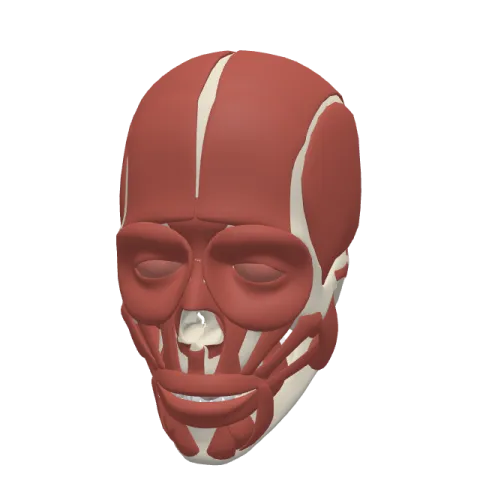
The corrugator supercilii is a small, narrow muscle hidden under the inner half of the eyebrow. It pulls the eyebrows toward each other and down, creating the vertical lines between the brows when you frown, and it is supplied by the temporal branch of the facial nerve (CN VII).
Where it is
The muscle lies above the inner corner of the eye, along the brow ridge. It is a deep muscle: the frontalis and the upper fibers of the orbicularis oculi cover it, so you only see it once those two are folded back.
From its origin near the midline it runs outward and slightly upward, roughly following the eyebrow, and its fibers pass between the bundles of the frontalis and the orbicularis oculi to reach the skin. The supraorbital and supratrochlear nerves and vessels, which carry sensation and blood to the forehead, run right beside it as they leave the orbit.
The name is a description. Corrugare means "to wrinkle" in Latin and supercilium means "eyebrow": the muscle that wrinkles the brow.
Origin and insertion
- Origin: the medial end of the superciliary arch, the brow ridge of the frontal bone, part of the skull, close to the root of the nose.
- Insertion: the deep surface of the skin of the eyebrow, above the middle of the upper orbital margin.
Like most muscles of facial expression, it starts on bone and ends in skin. When it contracts, the bone stays still and the skin is pulled toward it.
What it does
The corrugator supercilii draws the eyebrow medially and downward. Both muscles working together bring the brows closer and lower them, and the skin between them bunches into vertical wrinkles in the glabella, the smooth area between the eyebrows.
This is the core of the frown, and it appears in several expressions: concentration, worry, anger and pain. It also has a protective use. When you squint in bright sunlight, the lowered brows shade the eye like the peak of a cap.
It rarely works alone. The procerus, over the bridge of the nose, pulls the inner eyebrows down and adds horizontal lines across the top of the nose, and the depressor supercilii lowers the inner end of the brow. The frontalis does the opposite: it lifts the eyebrows and draws horizontal lines across the forehead. Try both in a mirror and you can see the two wrinkle patterns cross at right angles.
Innervation and blood supply
The muscle is supplied by the temporal branch of the facial nerve, which crosses the zygomatic arch and runs toward the forehead. Some descriptions add twigs from the zygomatic branch, which supplies the orbicularis oculi nearby.
Its blood comes from the supraorbital and supratrochlear arteries, branches of the ophthalmic artery that leave the orbit right next to the muscle, and from the superficial temporal artery, whose frontal branch spreads over the forehead.
How to remember it
- Corrugated cardboard has ridges: the corrugator makes ridges between your eyebrows.
- Vertical lines, vertical frown: corrugator lines run up and down; frontalis lines run side to side.
- Deep and hidden: it is under the frontalis and the orbicularis oculi, never on the surface.
- The "eleven" lines: the two vertical creases between the brows look like the number 11, and the corrugator draws them.
Learn its neighbors on the muscles of the face page, then test yourself in the head quiz.
Frequently asked questions
What does the corrugator supercilii do?
It pulls the eyebrows together and down, which produces the vertical wrinkles between the brows when you frown or squint.
Which nerve supplies the corrugator supercilii?
The temporal branch of the facial nerve (CN VII).
Is the corrugator supercilii deep or superficial?
Deep. It lies under the frontalis and the orbicularis oculi, and its fibers pass between them to reach the skin of the eyebrow.
Which muscle is the antagonist of the corrugator supercilii?
The frontalis, which raises the eyebrows and smooths the area between them.
