
Muscle · Head and neck
Anterior auricular muscle: origin, insertion, action and innervation
The anterior auricular muscle runs from the temporal fascia to the helix. It draws the ear forward and is supplied by the temporal branch of the facial nerve.
Quick answer
- Latin name
- Musculus auricularis anterior
- Origin
- Front part of the epicranial aponeurosis and the temporal fascia, on the side of the skull
- Insertion
- Spine of the helix, at the front of the auricle
- Action
- Draws the auricle forward and slightly upward
- Innervation
- Facial nerve (CN VII), temporal branch
- Blood supply
- Superficial temporal artery
See it on the 3D body
The anterior auricular lit on the 3D head, as in the head quiz. Turn the body, peel the layers, tap any structure for its name.
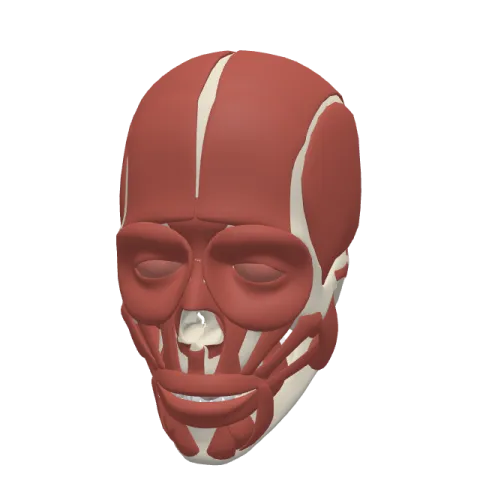
The anterior auricular muscle is a thin muscle just in front of the ear that pulls the auricle, the visible outer ear, forward and slightly upward. It is supplied by the temporal branch of the facial nerve (CN VII), and in most people it is too weak to move the ear in a way anyone would notice.
Where it is
The muscle lies on the side of the head, in front of the auricle and above the zygomatic arch. It sits on the temporal fascia, the tough sheet that covers the temporalis, so you have to look through it to see the chewing muscle underneath.
It is the smallest of the three extrinsic auricular muscles, the muscles that reach the ear from the scalp:
- the anterior auricular muscle, in front of the ear;
- the superior auricular muscle, above the ear, the largest of the three;
- the posterior auricular muscle, behind the ear.
All three belong to the muscles of facial expression, which you can compare on the muscles of the face page. Its fibers are pale, short and often mixed with loose connective tissue, which is why it is easy to miss in a dissection.
Origin and insertion
- Origin: the front part of the epicranial aponeurosis, the flat tendon of the scalp, and the temporal fascia on the side of the skull.
- Insertion: the spine of the helix, a small bump of cartilage at the front of the helix, the rolled outer rim of the auricle.
Neither end is on bone. The muscle runs from a sheet of fascia to the cartilage of the ear.
What it does
The anterior auricular muscle draws the auricle forward and a little upward. Its two partners pull in the other directions: the superior auricular muscle lifts the ear and the posterior auricular muscle pulls it back.
In many mammals, such as cats, dogs and horses, the auricular muscles are large and turn the ears toward a sound. In humans they are vestigial. They still contract, and some people learn to wiggle their ears on purpose, but the movement is small and does not change how well we hear. These extrinsic muscles are different from the tiny intrinsic muscles that lie on the cartilage of the auricle itself.
Innervation and blood supply
The muscle is supplied by the temporal branch of the facial nerve. This branch leaves the upper border of the parotid gland, crosses the zygomatic arch and runs up toward the temple and the forehead, giving twigs to the anterior and superior auricular muscles and to the frontalis on its way.
The posterior auricular muscle works differently: it is supplied by the posterior auricular nerve, a branch the facial nerve gives off just after it leaves the skull behind the ear.
Blood reaches the muscle from the superficial temporal artery, which climbs just in front of the ear and is the pulse you can feel there.
How to remember it
- The name tells the job. Anterior muscle, anterior pull: the ear goes forward.
- Three around the ear: anterior, superior, posterior, like a clock face at 9, 12 and 3 o'clock when you look at the left side of someone's head.
- Front two share a branch, the back one has its own. Anterior and superior: temporal branch. Posterior: posterior auricular nerve.
- Ear wiggling is a leftover. If a friend can wiggle their ears, this muscle and its partners are why.
Test yourself in the head quiz.
Frequently asked questions
Can humans move their ears with the anterior auricular muscle?
A little. In most people its pull is too weak to move the ear visibly, but some people learn to wiggle their ears on purpose.
Which nerve supplies the anterior auricular muscle?
The temporal branch of the facial nerve (CN VII).
What are the three auricular muscles?
The anterior, superior and posterior auricular muscles. They run from the scalp to the auricle and pull the ear forward, up and back.
Is the anterior auricular muscle a muscle of facial expression?
Yes. It develops from the second pharyngeal arch, like the other muscles of facial expression, and shares their nerve, the facial nerve.
