
Muscle · Head and neck
Anterior scalene: origin, insertion, action and innervation
The anterior scalene runs from the transverse processes of C3-C6 to the first rib. It lifts that rib in deep breathing and is supplied by cervical nerves.
Quick answer
- Latin name
- Musculus scalenus anterior
- Origin
- Anterior tubercles of the transverse processes of the third to sixth cervical vertebrae (C3–C6)
- Insertion
- Scalene tubercle on the inner border and upper surface of the first rib
- Action
- Elevates the first rib in forced (accessory) inspiration. One side: bends the neck to the same side. Both sides: help flex the neck
- Innervation
- Anterior rami of the cervical spinal nerves (C4–C6)
- Blood supply
- Ascending cervical artery, a branch of the inferior thyroid artery
See it on the 3D body
The scalenus anterior lit on the 3D neck, as in the neck quiz. Turn the body, peel the layers, tap any structure for its name.
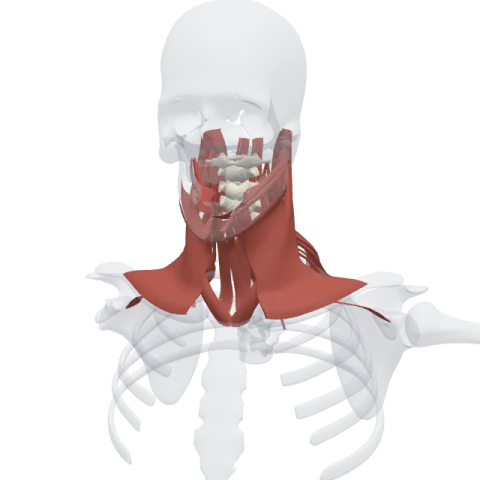
The anterior scalene is a deep muscle on the side of the neck that runs from the cervical vertebrae down to the first rib. It lifts the first rib when you breathe in hard, and it is the landmark that separates the main vein of the arm from the main artery and nerves at the root of the neck.
Where it is
The anterior scalene lies deep to the sternocleidomastoid, in the lower part of the neck. It is the front member of the three scalene muscles, with the middle scalene just behind it and the posterior scalene behind that. Together they fill the space between the side of the cervical spine and the top of the rib cage.
What makes this muscle famous in anatomy class is what lies on it and around it:
- The phrenic nerve, which supplies the diaphragm, runs straight down its front surface, crossing from its lateral edge toward its medial edge.
- The subclavian vein passes in front of the muscle, over the first rib.
- The subclavian artery and the roots of the brachial plexus pass behind it, through the narrow gap between the anterior and middle scalenes, called the interscalene triangle.
Origin and insertion
- Origin: the anterior tubercles of the transverse processes of the cervical vertebrae C3 to C6.
- Insertion: the scalene tubercle, a small bump on the inner border and upper surface of the first rib, just in front of the groove where the subclavian artery crosses the rib.
The fibers run downward and slightly forward, so the muscle forms a slanted band from the neck to the rib.
What it does
- Lifts the first rib: when the neck is held still, the anterior scalene pulls the first rib upward. This helps open the top of the chest during deep or labored breathing, which is why it counts as an accessory muscle of inspiration.
- Bends the neck sideways: when the rib is fixed and one side contracts, it tilts the cervical spine toward the same shoulder.
- Helps flex the neck: when both sides contract together, they assist the front neck muscles in bending the head and neck forward.
Textbooks class the scalenes as accessory muscles of breathing. Their pull is easiest to see when breathing is deep or labored: at the end of a sprint, the sides of the neck tighten as you gasp for air.
Innervation and blood supply
The anterior scalene is supplied directly by the anterior rami of the cervical spinal nerves, mainly C4 to C6. These small branches leave the nerve roots as they emerge between the scalenes.
Its blood comes from the ascending cervical artery, a small branch of the inferior thyroid artery that climbs up the front of the muscle, close to the phrenic nerve.
How to remember it
- "Vein in front, artery behind": at the first rib, the subclavian vein crosses in front of the anterior scalene and the subclavian artery passes behind it. The muscle sits between the two like a divider.
- Scalene means uneven: the Greek skalenos describes a triangle with three unequal sides. The three scalenes, seen together, make a lopsided triangle on the side of the neck.
- Front muscle, front rib, front tubercles: the anterior scalene starts on the anterior tubercles and ends on the front part of the first rib.
- The phrenic nerve rides on it: picture the nerve sliding down the front of the muscle on its way to the diaphragm. "C3, 4, 5 keeps the diaphragm alive" reminds you where that nerve comes from.
See the vertebrae it hangs from on the bones of the spine page, then test yourself in the neck quiz.
Frequently asked questions
What does the anterior scalene do?
It lifts the first rib during forced breathing. It also bends the neck to the same side, and both sides together help flex the neck.
Which nerve runs on the anterior scalene?
The phrenic nerve. It runs down the front of the muscle on its way to the diaphragm.
What passes between the anterior and middle scalene?
The subclavian artery and the roots of the brachial plexus. The subclavian vein passes in front of the anterior scalene instead. Narrowing of this space is one of the causes of thoracic outlet syndrome.
Where does the anterior scalene attach?
It runs from the transverse processes of C3 to C6 to the scalene tubercle of the first rib.
Is the anterior scalene a breathing muscle?
Yes, an accessory one. It helps lift the first rib when you breathe deeply or with effort, but the diaphragm does most of the work at rest.
