Muscle · Lower limb
Fibularis brevis: origin, insertion, action and innervation
The fibularis brevis runs from the lower fibula to the tuberosity of the fifth metatarsal. It everts the foot and is supplied by the superficial fibular nerve.
Quick answer
- Latin name
- Musculus fibularis brevis
- Origin
- Lower two thirds of the lateral surface of the fibula
- Insertion
- Tuberosity on the lateral side of the base of the fifth metatarsal
- Action
- Everts the foot at the subtalar and transverse tarsal joints; weakly plantarflexes the ankle
- Innervation
- Superficial fibular nerve (L5-S2)
- Blood supply
- Branches of the fibular artery and the anterior tibial artery
See it on the 3D body
The fibularis brevis lit on the 3D leg and foot, as in the leg and foot quiz. Turn the body, peel the layers, tap any structure for its name.
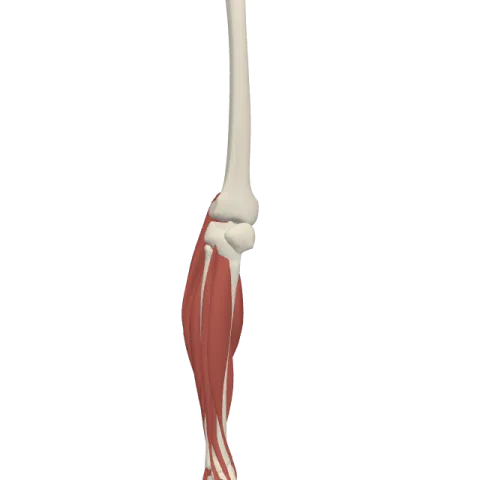
The fibularis brevis (peroneus brevis) is a muscle on the outer side of the leg that runs from the lower fibula, behind the lateral malleolus, to the base of the fifth metatarsal. It everts the foot and is supplied by the superficial fibular nerve (L5-S2).
Where it is
The fibularis brevis is one of the two muscles of the lateral compartment of the leg, with the fibularis longus. The longus starts higher and lies on the surface; the brevis starts lower and lies under the longus, directly on the fibula.
Near the ankle, both tendons curve behind the lateral malleolus, the bony bump on the outside of the ankle. Here the brevis tendon is in front, pressed into a groove on the back of the malleolus, and the longus tendon lies behind it. A band of tissue, the superior fibular retinaculum, holds both tendons in place.
Below the malleolus, the two tendons part ways. The longus dives under the foot toward the big-toe side. The brevis stays on the outer side and runs forward, above the small fibular trochlea of the calcaneus, to the base of the little toe's metatarsal. You can often feel its tendon on the outer edge of the foot when you turn the sole outward. See the compartments on muscles of the leg.
Origin and insertion
- Origin: the lower two thirds of the lateral surface of the fibula.
- Insertion: the tuberosity on the lateral side of the base of the fifth metatarsal, the bony knob you can feel halfway along the outer border of the foot.
The muscle belly continues low, almost to the ankle, which is why its tendon is short compared with that of the longus.
What it does
- Eversion of the foot: it tilts the sole outward at the subtalar and transverse tarsal joints, working with the fibularis longus.
- Weak plantarflexion: since its tendon passes behind the lateral malleolus, it gives a little help in pointing the foot down.
- Steadying the ankle: when the foot starts to roll inward on uneven ground, the fibular muscles contract to pull it back toward neutral.
It balances the invertors on the inner side of the leg, mainly the tibialis posterior and the tibialis anterior.
Innervation and blood supply
The fibularis brevis is supplied by the superficial fibular nerve (L5-S2), the nerve of the lateral compartment. The superficial fibular nerve runs down between the fibular muscles and the extensor digitorum longus, gives branches to both fibular muscles, then becomes a skin nerve on the top of the foot.
Its blood comes from branches of the fibular artery and the anterior tibial artery.
A sudden pull of this tendon during an ankle twist can break off a piece of the fifth metatarsal tuberosity, a well-known avulsion fracture.
How to remember it
- Brevis hugs the bone: behind the malleolus, the brevis tendon is closer to the bone (in front), the longus is farther out (behind). "Brevis is in the groove."
- Brevis stays lateral: the longus crosses under the foot to the first metatarsal; the brevis stops at the fifth.
- Superficial nerve, lateral compartment: superficial fibular for the lateral compartment, deep fibular for the anterior compartment.
- Peroneus is the old name: older books call it peroneus brevis; perone is Greek for fibula.
Test yourself in the leg and foot quiz.
Frequently asked questions
What does the fibularis brevis do?
It everts the foot and weakly plantarflexes the ankle. It also helps stop the ankle from rolling inward.
What nerve supplies the fibularis brevis?
The superficial fibular nerve, from roots L5 to S2.
Where does the fibularis brevis insert?
On the tuberosity at the base of the fifth metatarsal, on the outer side of the foot.
Is the peroneus brevis the same as the fibularis brevis?
Yes. Peroneus brevis is the older name. Current anatomical terminology uses fibularis brevis.
