
Compare · Best apps
The best anatomy apps for personal trainers and massage therapists in 2026
Seven anatomy apps for personal trainers and massage therapists compared from App Store listings on November 13, 2026: Muscle & Motion, AMTA, AnatomyMapp.
For personal trainers, the best anatomy app is Muscle & Motion: Strength: it animates more than 1,200 exercises in 3D and colors the muscles by role, for $89 a year. For massage therapy students, AnatomyMapp ($19.99 once) puts the Trail Guide to the Body flashcards and workbook questions in one app. Anatomy Atlas 3D (our app) is the free choice: a 3D body whose muscle cards give action, origin and insertion for most muscles, with no account or ads.
Quick answer
- Best for personal trainers: Muscle & Motion: Strength. Animated 3D lifts, an exercise library of 1,200+ entries with the working muscles color-coded and the usual form errors, and a workout builder. Free tier, then $14.99 a month or $89 a year (Professional $149 a year).
- Best for massage school: AnatomyMapp, from the publisher of Trail Guide to the Body: the 362 Trail Guide to the Body flashcards, workbook questions and quizzes on actions, origins, insertions and nerves, $19.99 once.
- Best free option: Anatomy Atlas 3D (our app). A free 3D human anatomy atlas for iPad and iPhone with 2,000 structures, English and Latin names, muscle cards with action, origin and insertion, and a quiz where you find the structure on the body. No animations: the muscles do not move.
- Best for muscles in motion without the exercise library: Muscle & Motion: Anatomy, the same team's 3D muscle and joint model with animations, $69 a year.
How we picked
Trainers and massage therapists study the same part of anatomy, the muscles, bones and joints, but use it differently. A trainer needs to know which muscles drive a movement and which ones assist or oppose it. A massage therapist needs to find a muscle under the hands: where it lies, which bony landmarks it runs between, and what it does. We kept the apps that name these users or this content in their listing, read each US App Store listing on November 13, 2026 and compared:
- Muscle detail: action, origin, insertion and nerve (the "AOIN" massage schools ask for).
- Movement: animations of exercises or muscle actions, or a static model.
- Format: 3D model, illustrations or flashcards, and how the app tests you.
- Price model and practical limits: free, one-time or subscription, as listed; devices, last update and minimum iOS version.
We did not run hands-on tests of the other apps, so this page reports what each developer lists.
The seven apps at a glance
| App | Developer | Price model (App Store, Nov 13, 2026) | Best for | Last update | Ratings |
|---|---|---|---|---|---|
| Muscle & Motion: Strength | Muscle & Motion | Free tier, Individual $14.99/month or $89/year, Professional $24.99/month or $149/year | Personal trainers, exercise anatomy | Nov 2, 2026 | 4.9 (7,787) |
| Muscle & Motion: Anatomy | Muscle & Motion | Free tier, Full Access $12/month or $69/year | Muscles and joints in motion | Nov 2, 2026 | 4.9 (678) |
| AnatomyMapp | Books of Discovery (AR Biel, Inc.) | $19.99 once | Massage school, Trail Guide to the Body | May 11, 2026 | 4.8 (2,156) |
| AMTA Massage Anatomy Guide | American Massage Therapy Association | Free, no in-app purchase listed | Massage flashcards with synergists and antagonists | May 11, 2026 | 4.9 (2,415) |
| Muscles & Kinesiology | Visible Body | $24.99 once (the description mentions a pathology add-on; no in-app purchase is listed) | 3D muscle actions, one payment | Sep 22, 2022 | 4.8 (2,651) |
| Learn Muscles: Anatomy | Real Bodywork | $4.99 once, iPhone only | Muscle images and a quiz maker | Dec 31, 2022 | 4.6 (442) |
| Anatomy Atlas 3D (our app) | Le Super Cent | Free, no in-app purchase | Free 3D atlas with muscle cards and a quiz | Nov 9, 2026 | 4.3 (6) |
Which apps show attachments, movement and a 3D body?
| App | Origin and insertion | Nerves | Animations | 3D body | Quiz |
|---|---|---|---|---|---|
| Muscle & Motion: Strength | Not stated | Not stated | Yes, 1,200+ exercises | Yes | Not stated |
| Muscle & Motion: Anatomy | Yes, in 3D | Not stated | Yes, "Muscles in Motion" | Yes | Not stated |
| AnatomyMapp | Yes | Yes | Not stated | No, illustrations | Yes |
| AMTA Massage Anatomy Guide | Yes (AOIN points) | Yes (AOIN points) | Not stated | No, illustrations | Yes |
| Muscles & Kinesiology | Yes (attachments) | Yes | Yes, dozens of muscle actions | Yes | Not stated |
| Learn Muscles: Anatomy | Yes | Not stated | Yes, 37 joint actions | 7 3D models | Yes, 480 questions |
| Anatomy Atlas 3D (our app) | Yes, on the bones | Major muscles | No | Yes, male and female | Yes, find it on the body |
"Not stated" means the US App Store listing does not mention it; the app may still have it.
What is the best anatomy app for personal trainers?
Muscle & Motion: Strength, if you can pay for it. Its listing puts personal trainers and strength coaches first in its audience. Each lift is animated in 3D, with the working muscles colored by role (prime movers, synergists, stabilizers, antagonists) and the usual form errors pointed out, and you can build workouts for clients.
These roles are the vocabulary of kinesiology: the prime mover (agonist) produces the movement, synergists assist it, and the antagonist opposes it (OpenStax, 11.1).
- Suits: trainers and coaches who explain an exercise to clients and want to see which muscles it loads.
- Limits: the free tier opens part of the content; the full library is $14.99 a month or $89 a year, and a Business plan goes up to $499 a year. The listing describes muscles, joints and bones only. Needs iOS 18; a 196 MB download.
Muscle & Motion: Anatomy
The same team's anatomy app, without the exercise library: a 3D model of the muscles and joints with animations of what each muscle does, and its attachments shown in 3D. Its audience list names personal trainers, Pilates and yoga teachers, and massage therapists.
- Suits: trainers and massage students who want to watch what a muscle does to a joint.
- Limits: full access is $12 a month or $69 a year. The listing covers only the musculoskeletal system and does not say whether it works offline. Needs iOS 18; a 199 MB download.
What is the best anatomy app for massage therapy students?
AnatomyMapp, if your school uses Trail Guide to the Body. It comes from the book's publisher, Books of Discovery, and gathers the 362 Trail Guide to the Body flashcards and questions from the student workbook, with page references back to the book and audio pronunciation. You can test yourself on the muscle cards, on finding structures, and on each muscle's AOIN. The listing says more than 2,000 manual therapy programs use Trail Guide to the Body products.
- Suits: massage and bodywork students who want their course's flashcards on their phone.
- Limits: $19.99 once. Illustrated cards, not a 3D body you turn around; the listing describes no animations. Needs iOS 15; a 255 MB download.
AMTA Massage Anatomy Guide
A musculoskeletal flashcard app from the American Massage Therapy Association, made with Books of Discovery. The listing counts 144 muscles, 61 bones and bony landmarks, 50 joints and ligaments, and 64 movements, each movement with its synergists and antagonists. The same three kinds of self-test as AnatomyMapp are there, and its latest update follows the 7th edition of Trail Guide to the Body.
- Suits: massage students and therapists who want each movement listed with the muscles that do it and the ones that oppose it.
- Limits: free to download with no in-app purchase listed, but the listing presents it as a free resource for AMTA members and does not say whether people without a membership can use all of it. Illustrations, not a 3D model. Needs iOS 15; a 256 MB download.
Muscles & Kinesiology (Visible Body)
Visible Body's musculoskeletal reference, sold once for $24.99. It has a dissectible male and female 3D body, muscle actions you can play and pause, the attachments, nerve and blood supply of each structure, and models of common conditions to compare with normal anatomy. Its listing names practitioners, athletes and yoga practitioners.
- Suits: trainers and massage therapists who want a 3D body with muscle actions for one payment.
- Limits: the App Store shows its last update in September 2022 and a minimum of iOS 13, so check that it runs on your device before buying. The condition models are for learning, not for assessing clients. A 781 MB download.
Learn Muscles: Anatomy (Real Bodywork)
A $4.99 muscle reference from Real Bodywork. Its 141 muscle images carry the action, origin and insertion of each muscle, and a quiz maker lets you build multiple-choice rounds by body region; 37 short joint animations show which muscles produce each movement.
- Suits: massage students on a tight budget who want origin, insertion and action for the major muscles and a quiz.
- Limits: iPhone only on the App Store (no iPad version), last updated in December 2022 (iOS 11 or later), and the listing does not give a nerve for each muscle. A 194 MB download.
Anatomy Atlas 3D (our app)
Anatomy Atlas 3D is a free 3D human anatomy atlas for iPad and iPhone: 2,000 structures, no account, no ads, works offline once the female body has downloaded, English and Latin names (Terminologia Anatomica 2) and a tap-the-structure quiz. Tap a muscle and its card shows the action, the origin and insertion bones (origin in red, insertion in blue) and, for the major muscles, the innervation, while the muscle stays highlighted on the body. Six layers go from the superficial muscles down to the skeleton, so you can see which muscle lies over which, the question a massage therapist asks before touching a client.
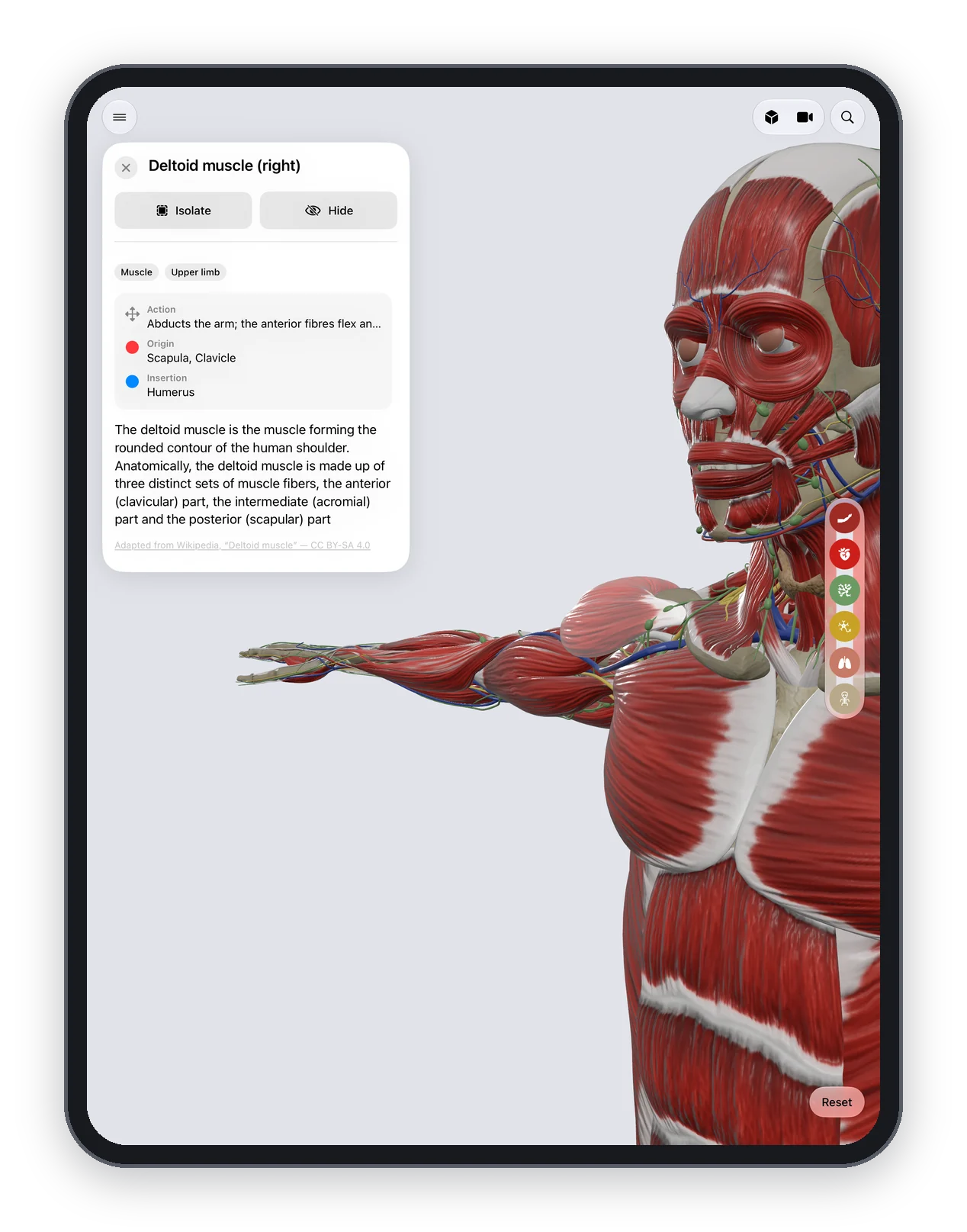
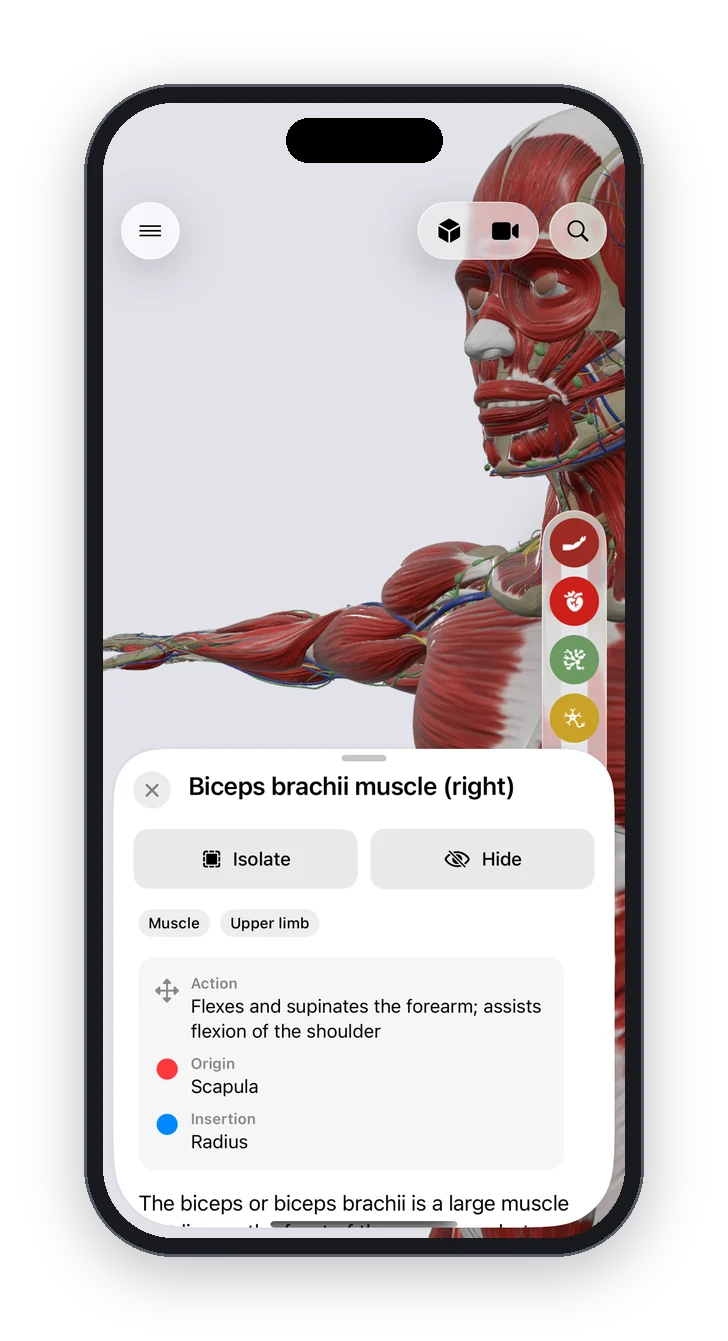
- Suits: trainers and massage students who want origin, insertion and action on a 3D body, free. The tables on our area pages list them for every muscle of a region: start with the muscles of the shoulder, the muscles of the hip or the muscles of the thigh.
- Limits: the muscles do not move: no exercise or joint animations, no palpation guide, no workout tools, no synergist or antagonist lists. Six App Store ratings so far, a 199 MB download (the female body downloads once, the first time you open the female body), and it needs iOS 18 or later on iPad or iPhone (no Android).
How to choose
- You coach clients in the gym: an exercise app first (Muscle & Motion: Strength), because it answers "which muscles does this lift work?" directly. Add a free atlas if you want the attachments behind it.
- You are in massage school: check which books your course uses. With Trail Guide to the Body, AnatomyMapp has its flashcards and workbook questions, and AMTA members can use the AMTA guide. A 3D atlas helps you see how deep each muscle sits.
- You want to pay once: AnatomyMapp at $19.99, Muscles & Kinesiology at $24.99 or Learn Muscles at $4.99; check the last update dates of the two older apps first.
- You are on a budget: start with Anatomy Atlas 3D and our free anatomy quiz. Our list of the best apps to learn muscles and bones compares more muscle apps, and the best free anatomy apps separates fully free apps from free downloads.
- You are a physiotherapy student: our list of anatomy apps for physiotherapy students weighs clinical content and courses as well.
Frequently asked questions
What is the best anatomy app for personal trainers?
Muscle & Motion: Strength, which animates 1,200+ exercises in 3D and colors the prime movers, synergists, stabilizers and antagonists ($89 a year). For a free 3D body with origin, insertion and action on the muscle cards, Anatomy Atlas 3D.
What is the best anatomy app for massage therapists?
For massage school, AnatomyMapp ($19.99 once) brings the Trail Guide to the Body flashcards and workbook questions into one app, with quizzes on actions, origins, insertions and nerves. The AMTA Massage Anatomy Guide offers similar cards with synergists and antagonists as a resource for AMTA members. Anatomy Atlas 3D is a free 3D atlas to see where each muscle lies.
Is there a free anatomy app for personal trainers?
Yes. Anatomy Atlas 3D is free with no in-app purchase and gives action, origin and insertion for most muscles on a 3D body. Muscle & Motion's apps are free downloads with a free tier, but their full content is a subscription.
Which app shows the muscles used in an exercise?
Muscle & Motion: Strength, according to its listing: each exercise has a 3D animation with the muscles involved color-coded by role. Anatomy apps such as Anatomy Atlas 3D show the muscle and its attachments, which explain its action, but not the exercise itself.
What does AOIN mean in massage anatomy?
Action, origin, insertion and innervation: the four facts massage schools ask about each muscle, and the ones AnatomyMapp and the AMTA guide quiz you on. The muscle card in Anatomy Atlas 3D shows the first three for the muscles students are asked about most and the nerve for the major ones; see the gluteus maximus or the trapezius for an example.
Do these apps teach massage techniques or exercise programming?
Not the anatomy apps. Muscle & Motion: Strength includes workout plans; the others teach anatomy only. Anatomy Atlas 3D is for education and is not medical advice.
Sources
- Muscle & Motion: Strength on the App Store
- Muscle & Motion: Anatomy on the App Store
- AMTA Massage Anatomy Guide on the App Store
- AnatomyMapp on the App Store
- Muscles & Kinesiology on the App Store
- Learn Muscles: Anatomy on the App Store
- Anatomy Atlas 3D: Human Body on the App Store
- OpenStax Anatomy and Physiology 2e, 11.1 Interactions of Skeletal Muscles
