Compare · Best apps
The best anatomy apps for physiotherapy students in 2026
Seven anatomy apps for physiotherapy students compared from App Store listings, October 28, 2026: Muscle & Motion, Complete Anatomy, Visible Body, free atlas.
For physiotherapy students (physical therapy students in the US), Muscle & Motion: Anatomy is the app on this list built around movement: its listing names physiotherapists, animates muscles in motion and shows the origin, insertion and action of each muscle in 3D, on a subscription of $69 a year. Anatomy Atlas 3D (our app) is a free 3D atlas whose muscle cards give action, origin and insertion for each muscle and the innervation of the major ones, with no account or ads. Visible Body's Human Anatomy Atlas 2027 is the strongest one-time purchase at $24.99, and Complete Anatomy for iPad is the most complete platform if your school pays its yearly license.
Quick answer
- Best for muscles in motion: Muscle & Motion: Anatomy. A full musculoskeletal 3D model, "Muscles in Motion" animations, joint movements explained, and the origin, insertion and action of each muscle in 3D; free tier, then $12 a month or $69 a year.
- Best free option: Anatomy Atlas 3D (our app). 2,000 structures with English and Latin names, a card with action, origin and insertion for each muscle (and the innervation of the major ones), six layers and a tap-the-structure quiz, with no in-app purchase. No animations: the muscles do not move.
- Best one-time purchase: Human Anatomy Atlas 2027 by Visible Body, $24.99 once, with movable muscle and bone models, attachments, innervation, blood supply and fascia compartments.
- Most complete, if your school pays: Complete Anatomy for iPad, with real-time muscle motion, nerve tracing, bone landmarks, courses and clinical videos, Student License $74.99 a year.
How we picked
Physiotherapy programs lean on musculoskeletal anatomy: which bones a muscle joins, what movement it produces, which nerve supplies it, and how joints move. We kept the iPhone and iPad apps a physiotherapy student is likely to meet, read each US App Store listing on October 28, 2026 and compared:
- Muscle detail: origin, insertion, action and innervation on the model.
- Movement: animations of muscle actions and joint mechanics, or a static model.
- Price model: free, one-time or subscription, as listed, with the student price when there is one.
- Practical limits: offline use, minimum iOS version, download size, date of the last update.
We did not run hands-on tests of the other apps, so this page reports what each developer lists.
The seven apps at a glance
| App | Developer | Price model (App Store, Oct 28, 2026) | Best for | Last update | Ratings shown |
|---|---|---|---|---|---|
| Muscle & Motion: Anatomy | Muscle & Motion | Free tier, Full Access $12/month or $69/year | Muscles and joints in motion | Aug 31, 2026 | 4.9 (669) |
| Complete Anatomy for iPad | 3D4Medical from Elsevier | Free download, 3-day trial, then yearly licenses $59.99 to $119.99 (Student License $74.99) | The whole curriculum | Oct 12, 2026 | 4.5 (5,054) |
| Human Anatomy Atlas 2027 | Visible Body | $24.99 once, optional add-ons $7.99 to $19.99 | Gross anatomy, one payment | Oct 5, 2026 | 4.8 (20,862) |
| Muscles & Kinesiology | Visible Body | $24.99 once (the description mentions a pathology add-on; none listed) | Muscle actions and common conditions | Sep 22, 2022 | 4.8 (2,637) |
| Anatomy Learning - 3D Atlas | 3DMedical | Free download, Definitive Edition $16.99 once (Muscles pack $9.99) | Atlas in ten languages, offline | Sep 6, 2026 | 4.7 (1,429) |
| Anatomy Atlas 3D (our app) | Le Super Cent | Free, no in-app purchase | Free atlas with muscle cards and a quiz | Oct 14, 2026 | Too new to show |
| Daily Anatomy Flashcards | Kenhub GmbH Mobile | Free, no in-app purchase listed | A daily review of 500 structures | Oct 12, 2026 | 4.8 (7,630) |
Which apps show origin and insertion, movement and offline use?
| App | Origin and insertion | Muscle or joint animations | Works offline | Quiz |
|---|---|---|---|---|
| Muscle & Motion: Anatomy | Yes, origin, insertion and action in 3D | Yes, "Muscles in Motion" | Not stated | Not stated |
| Complete Anatomy for iPad | Yes | Yes, real-time muscle motion | Not stated | Exam tools listed |
| Human Anatomy Atlas 2027 | Yes (attachments) | Yes, movable muscles and bones | Not stated | Yes, 3D dissection quizzes |
| Muscles & Kinesiology | Yes (attachments) | Yes, dozens of muscle actions | Not stated | Not stated |
| Anatomy Learning - 3D Atlas | Not stated | Yes, muscle and joint animations | Yes | Yes, 500+ quizzes |
| Anatomy Atlas 3D (our app) | Yes, with action (innervation for the major muscles) | No | Yes | Yes, tap the structure |
| Daily Anatomy Flashcards | Not stated | Not stated | Not stated | Flashcards with spaced repetition |
"Not stated" means the US App Store listing does not mention it; the app may still have it.
Muscle & Motion: Anatomy
A 3D learning app focused on muscles, joints and movement mechanics. Its listing describes an interactive 3D model of the full musculoskeletal system, "Muscles in Motion" animations, visual explanations of joint movements, and the origin, insertion and action of each muscle shown in 3D. The audience list names anatomy and kinesiology students, sports science students, physiotherapists, chiropractors and rehab professionals, trainers and movement teachers.
- Suits: physiotherapy students who learn a muscle by watching what it does to a joint, and who will explain movement to patients later.
- Limits: the free tier opens a portion of the content; the full library is a subscription listed at $12 a month or $69 a year. The listing describes only the musculoskeletal system and does not say whether it works offline. Needs iOS 17; a 189 MB download.
Complete Anatomy for iPad
The listing describes it as built for medical students, teachers and clinicians: full female and male models you rotate, isolate and dissect layer by layer, 12 body systems with cross sections, real-time muscle motion, nerve tracing, blood supply, insertion and origin, bone landmarks (parts, surfaces and landmarks tools), guided courses, 150+ hours of lectures and 1,500+ clinical videos, including orthopaedics and fitness.
- Suits: students whose program already pays for it, or who want anatomy, imaging and clinical content in one place.
- Limits: after the 3-day trial it needs a license, charged yearly: Student and Student Plus at $74.99, Individual at $59.99, Professional licenses at $99.99 to $119.99. A 1.5 GB download, iPadOS 18, and the iPhone version is a separate app. If the price is the problem, see our Complete Anatomy alternatives.
Human Anatomy Atlas 2027 (Visible Body)
A gross anatomy atlas sold once. Its listing includes full female and male 3D models shown next to cadaver and diagnostic images, muscle and bone models you can move to learn actions, landmarks, attachments, innervation and blood supply, fascia models that divide the limbs into compartments, dissection in AR and in cross sections, 3D dissection quizzes and presentation tools.
- Suits: students who prefer paying $24.99 once and want the whole body, not only the musculoskeletal system.
- Limits: physiology animations and dental anatomy are separate purchases ($7.99 to $19.99); a 1.3 GB download, iOS 15. See also Visible Body alternatives.
Muscles & Kinesiology (Visible Body)
Visible Body's musculoskeletal reference: thousands of 3D models of muscles, bones, ligaments, bursae, nerves and vessels, dozens of muscle action animations you can pause mid-motion, attachments, bony landmarks, innervation and blood supply, plus 3D models of common conditions next to the normal anatomy. The listing names practitioners, athletes and students.
- Suits: students who want muscle actions and kinesiology in one $24.99 purchase and do not need the rest of the body.
- Limits: the App Store shows its last update in September 2022 and a minimum of iOS 13, so check that it runs on your current device before buying. The description mentions an optional in-app purchase for pathology animations without a price on the store page. The conditions are teaching models, not clinical guidance.
Anatomy Learning - 3D Atlas
An atlas whose listing names students of medicine, nursing, physiotherapy and dentistry: more than 6,000 labeled points on a 3D model, layer-by-layer dissection, interactive muscle and joint animations, cross sections and over 500 quizzes, offline and in ten languages.
- Suits: students who study in a language other than English, or who want a deep atlas for a one-time $16.99.
- Limits: the full content needs the Definitive Edition ($16.99; a separate Muscles pack is listed at $9.99), and the listing does not describe origin and insertion data for each muscle. A 141 MB download, iOS 15.
Anatomy Atlas 3D (our app)
Anatomy Atlas 3D is a free 3D human anatomy atlas for iPad and iPhone: 2,000 structures, no account, no ads, works offline, English and Latin names (Terminologia Anatomica 2) and a tap-the-structure quiz. Tap a muscle and its card shows the action, the origin and insertion bones (origin in red, insertion in blue on the card) and, for the major muscles, the innervation, while the muscle stays highlighted on the 3D body. Six layers go from the superficial muscles to the skeleton, and section planes cut the body in three directions.
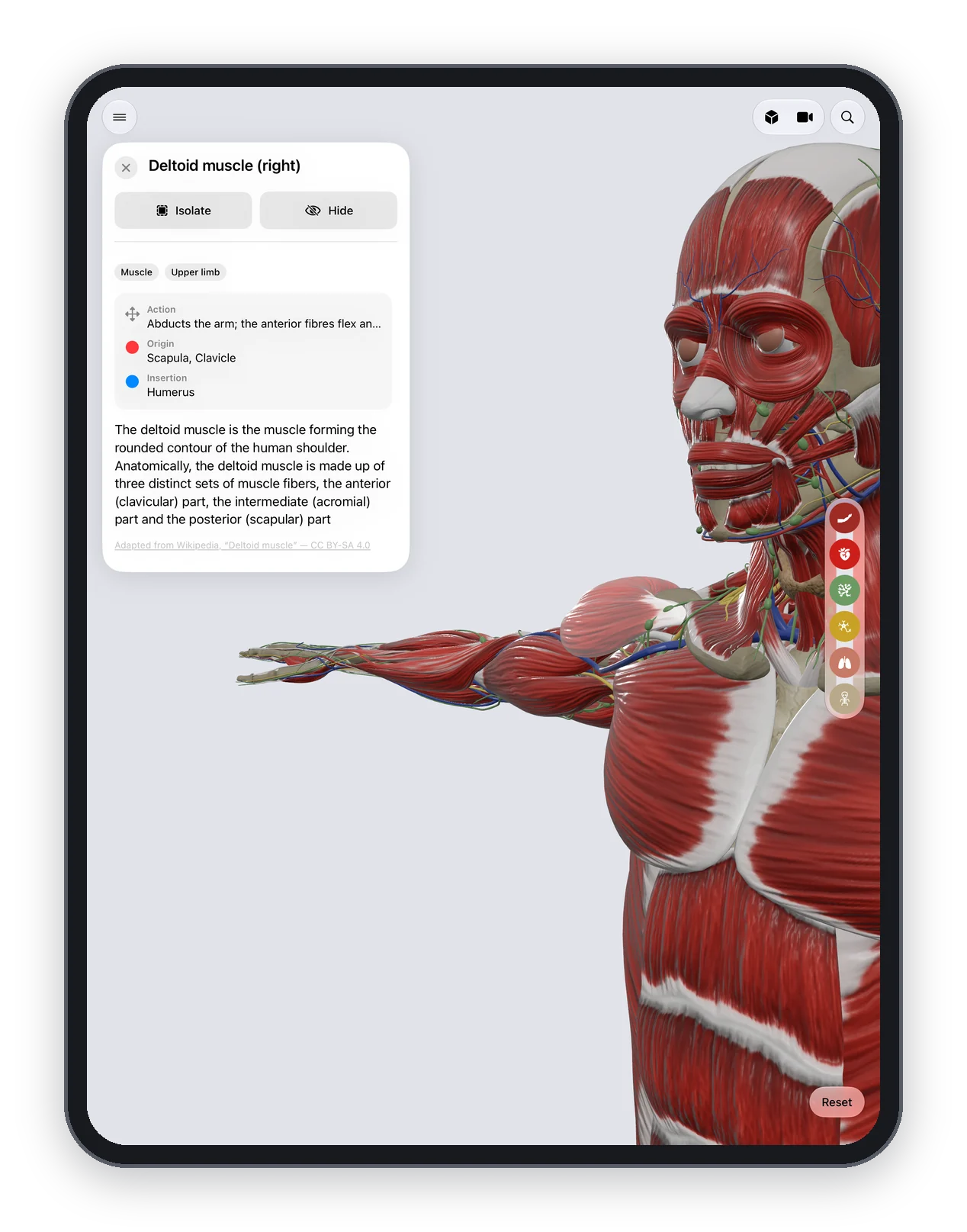
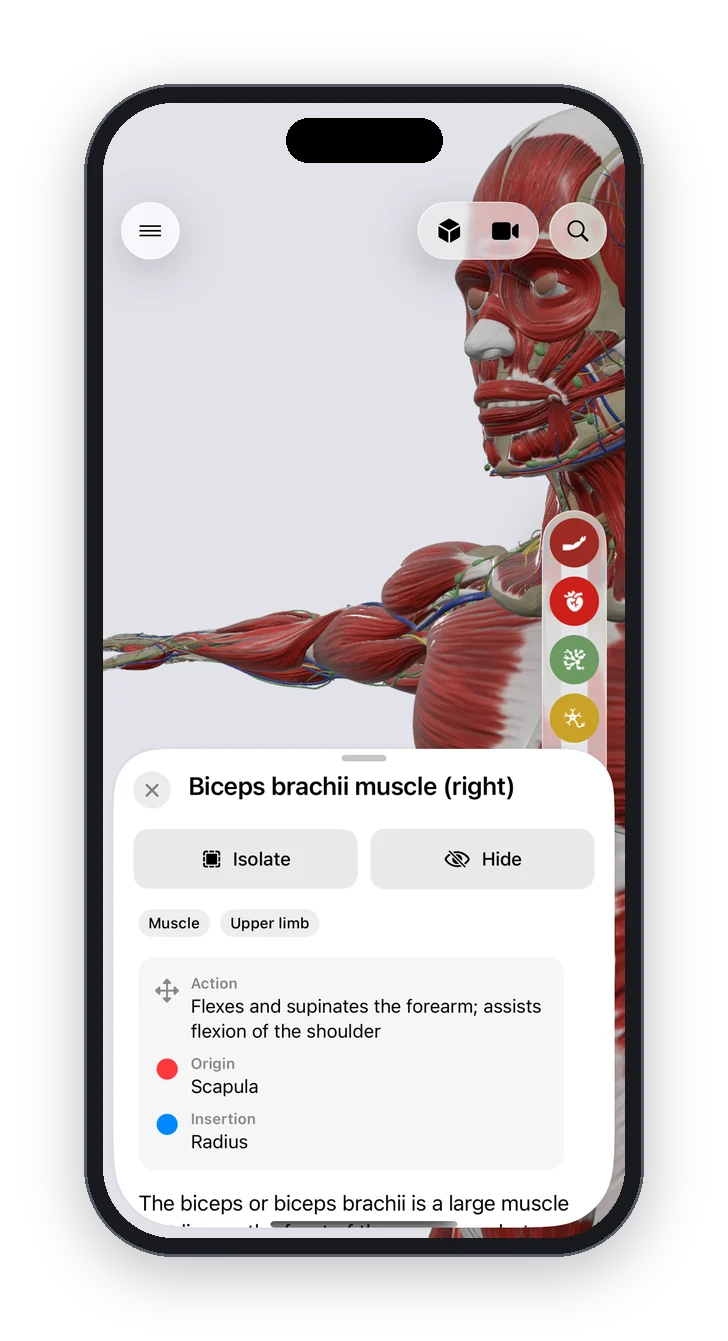
- Suits: physiotherapy students who want origin, insertion and action for each muscle on a 3D body, free, from the first week of the program. The quiz names a structure and you find it by region, which trains the same recognition as a practical. Start with the muscles of the shoulder or the muscles of the hip, the tables list origin, insertion and action for each one.
- Limits: the muscles do not move: no animations of actions or joint mechanics, no palpation guide, no pathology, no physiology. No App Store ratings yet, a 376 MB download, and it needs iOS 18 or later on iPad or iPhone (no Android, no web 3D).
Daily Anatomy Flashcards (Kenhub)
A free flashcard trainer for healthcare students, covering the 500 most important structures (bones, muscles, nerves, vessels and points on the bones) with spaced repetition. Each structure is highlighted in full on the image.
- Suits: first-year students who want a short daily review on their phone next to an atlas. Needs iOS 16.4; a 105 MB download.
- Limits: flashcards only, as listed: the listing describes no 3D model, animations or attachments.
How to choose
- Your course is in the musculoskeletal block: a movement app (Muscle & Motion) or a static atlas with attachments (Human Anatomy Atlas, Muscles & Kinesiology or our free atlas), plus a quiz for the practical. Our list of the best apps to learn muscles and bones compares them on origins, insertions and quizzes.
- You need to explain movement to patients one day: animations matter more than structure counts. Muscle & Motion and Complete Anatomy animate muscles; Visible Body's apps let you move muscle and bone models.
- You want to pay once: Human Anatomy Atlas 2027 or Muscles & Kinesiology at $24.99, Anatomy Learning at $16.99.
- You are on a budget: start with Anatomy Atlas 3D, Daily Anatomy Flashcards and our free anatomy quiz. Our best free anatomy apps page separates fully free apps from free downloads.
- You are a medical or nursing student: the lists for medical students and nursing students weigh imaging, courses and physiology instead.
Frequently asked questions
What is the best anatomy app for physiotherapy students?
For movement, Muscle & Motion: Anatomy, which animates muscles in motion, shows the origin, insertion and action of each muscle in 3D and names physiotherapists in its listing ($69 a year). For a free 3D atlas with action, origin and insertion on each muscle card, Anatomy Atlas 3D. For one payment, Human Anatomy Atlas 2027 at $24.99.
Is there a free anatomy app for physiotherapy students?
Yes. Anatomy Atlas 3D is free with no in-app purchase and covers 2,000 structures with a card for each muscle. Kenhub's Daily Anatomy Flashcards is free for names and locations. Muscle & Motion and Anatomy Learning are free downloads whose full content is paid.
Which app shows the origin and insertion of muscles in 3D?
Anatomy Atlas 3D names the origin and insertion bones on each muscle card (origin in red, insertion in blue) while the muscle is highlighted on the 3D body, free. Muscle & Motion shows origin, insertion and action in 3D and animates the muscles. Complete Anatomy, Human Anatomy Atlas and Muscles & Kinesiology list attachments on the model. See the supraspinatus or the gluteus medius for what one card contains.
Which anatomy app shows muscles moving?
Muscle & Motion: Anatomy, Complete Anatomy (real-time muscle motion), Human Anatomy Atlas 2027 and Muscles & Kinesiology (muscle action animations) and Anatomy Learning (muscle and joint animations), according to their listings. Anatomy Atlas 3D does not animate muscles.
Do physiotherapy students need Latin anatomy terms?
It depends on the program and the country. Anatomy Atlas 3D shows the English and the Latin name of every structure, so you can learn the one your exams use.
Which app helps for a physiotherapy anatomy practical?
One that makes you find structures on a body rather than read a list. The tap-the-structure quiz in Anatomy Atlas 3D asks for 15 structures by region and system; our shoulder muscles quiz runs in the browser. Flashcards with spaced repetition (Daily Anatomy) help with the names.
