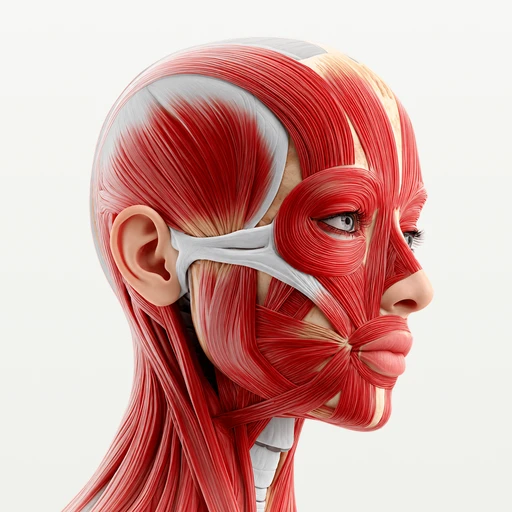
Muscle · Head and neck
Frontalis muscle: origin, insertion, action and innervation
The frontalis runs from the epicranial aponeurosis to the skin of the eyebrows. It raises the brows and wrinkles the forehead; facial nerve, temporal branch.
Quick answer
- Latin name
- Venter frontalis musculi occipitofrontalis
- Origin
- Epicranial aponeurosis (galea aponeurotica), the flat tendon over the top of the skull
- Insertion
- Skin of the eyebrows and forehead, blending with the procerus, corrugator supercilii and orbicularis oculi
- Action
- Raises the eyebrows and wrinkles the forehead horizontally; draws the scalp forward
- Innervation
- Facial nerve (CN VII), temporal branch
- Blood supply
- Supraorbital and supratrochlear arteries, and the frontal branch of the superficial temporal artery
See it on the 3D body
The frontalis lit on the 3D head, as in the head quiz. Turn the body, peel the layers, tap any structure for its name.
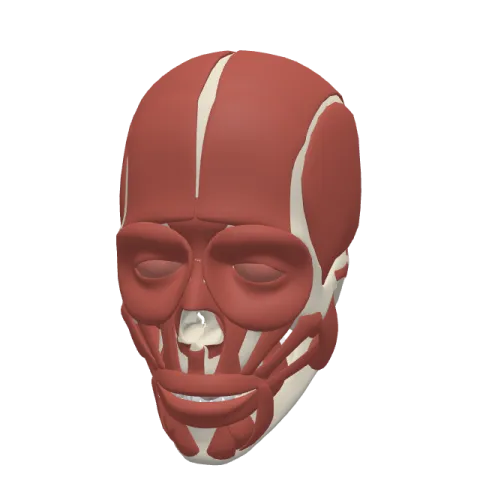
The frontalis is the broad, thin muscle of the forehead that raises the eyebrows and draws horizontal wrinkles across the forehead. It is the front belly of the occipitofrontalis muscle of the scalp, it has no attachment to bone, and it is supplied by the temporal branch of the facial nerve (CN VII).
Where it is
The frontalis covers the forehead, from the hairline down to the eyebrows. There is one on each side, and the two are often separated by a narrow gap in the midline above the nose. It lies directly under the skin, over the frontal bone of the skull, but it is not attached to that bone: a layer of loose tissue lets the muscle and the skin slide over it.
It belongs to a larger muscle, the occipitofrontalis (also called the epicranius), which has two bellies linked by a tendon:
- the frontal belly, the frontalis, over the forehead;
- the occipital belly, the occipitalis, at the back of the head, which arises from the occipital bone;
- between them, the epicranial aponeurosis (galea aponeurotica), a tough flat tendon that covers the top of the head like a cap.
Origin and insertion
- Origin: the epicranial aponeurosis, at the front, just in front of the coronal suture.
- Insertion: the skin of the eyebrows and the lower forehead. Its fibers have no bony insertion; they interlace with the procerus, the corrugator supercilii and the orbicularis oculi around the eyes.
This makes the frontalis a good example of a typical muscle of facial expression: it moves skin, not bone.
What it does
- Raises the eyebrows. Because its fixed point is the aponeurosis above, the frontalis lifts the skin of the brows when it contracts. You use it to look surprised, to look up without tilting your head, and when you open your eyes wide.
- Wrinkles the forehead. The skin bunches into horizontal lines at right angles to the muscle fibers.
- Moves the scalp. When the occipitalis holds the aponeurosis from behind, the frontalis can pull the scalp forward. Working in turns, the two bellies can slide the scalp back and forth, a movement some people can do on purpose.
Its antagonists are the muscles that pull the brows down and together: the corrugator supercilii, the procerus, the depressor supercilii and the orbicularis oculi. A raised brow and a frown are the same skin moved in opposite directions.
Innervation and blood supply
The frontalis is supplied by the temporal branch of the facial nerve, which crosses the zygomatic arch and runs up toward the forehead. The same branch supplies the anterior auricular muscle on its way. The occipital belly has a different nerve: the posterior auricular branch of the facial nerve.
A facial nerve palsy such as Bell's palsy leaves the forehead smooth on that side, while a stroke usually spares the forehead because the upper face receives signals from both sides of the brain.
Its blood comes from the supraorbital and supratrochlear arteries, branches of the ophthalmic artery that leave the orbit above the eye, and from the frontal branch of the superficial temporal artery, which curves forward over the temple.
How to remember it
- Front = forehead: the frontal belly of the occipitofrontalis.
- Two bellies, one tendon: front belly, galea, back belly, like a strap over the head.
- Horizontal lines, upward pull: forehead lines run across because the fibers run up and down.
- No bone at either end: from tendon to skin.
- Galea means helmet: the aponeurosis sits on the head like a helmet, and the frontalis hangs from its front edge.
See the frontalis with the other face muscles on the muscles of the face page and test yourself in the head quiz.
Frequently asked questions
What is the action of the frontalis?
It raises the eyebrows and wrinkles the forehead horizontally. It can also pull the scalp forward.
What is the origin and insertion of the frontalis?
It arises from the epicranial aponeurosis and inserts into the skin of the eyebrows and forehead. It has no bony attachment.
Which nerve supplies the frontalis?
The temporal branch of the facial nerve (CN VII).
Is the frontalis part of the occipitofrontalis?
Yes. It is the front belly of the occipitofrontalis. The occipitalis is the back belly, and the epicranial aponeurosis joins the two.
