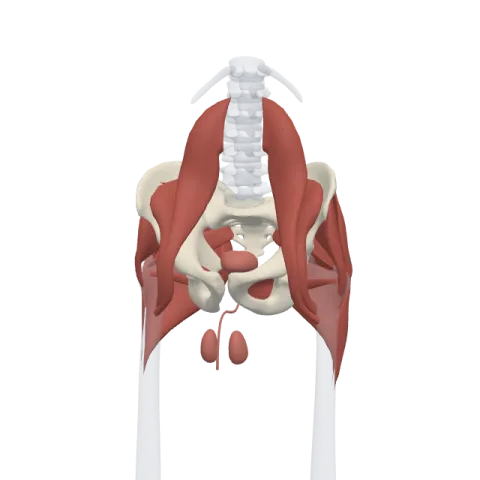
See it on the 3D body
The prostate lit on the 3D pelvis, as in the pelvis quiz. Turn the body, peel the layers, tap any structure for its name.
Quick answer
- Latin name
- Prostata
- System
- Male reproductive system
- Location
- Pelvis, below the neck of the bladder, behind the pubic symphysis and in front of the rectum, around the first part of the urethra
- Function
- Secretes a thin, milky fluid that becomes part of semen; its smooth muscle helps expel this fluid
The prostate is a gland about the size of a walnut that sits just below the bladder and wraps around the first part of the urethra. It belongs to the male reproductive system and produces a fluid that becomes part of semen.
Where it is
The prostate lies deep in the pelvis, inside the ring formed by the two hip bones and the sacrum. Its neighbors are:
- above: the neck of the bladder, which rests on the prostate's upper surface;
- below: the muscles of the pelvic floor;
- in front: the pubic symphysis, the joint between the two pubic bones, with a cushion of fat and veins between them;
- behind: the rectum, separated from it only by the rectal wall and a thin layer of connective tissue.
The urethra runs straight down through it, from the bladder toward the penis. This segment is called the prostatic urethra. The bladder itself is on the kidneys and bladder page.
Structure
Shape and surfaces
The prostate is shaped like an upside-down cone:
- the base at the top, broad, against the bladder;
- the apex at the bottom, pointing down onto the pelvic floor;
- a front surface, a back surface that faces the rectum, and two side surfaces.
A fibrous capsule surrounds the gland, and a dense network of veins, the prostatic venous plexus, lies around it.
Tissue
The prostate is made of two kinds of tissue mixed together:
- glandular tissue: many small branching glands that produce the prostatic fluid and empty through tiny ducts into the urethra;
- fibromuscular tissue: connective tissue and smooth muscle around the glands.
Lobes and zones
Older descriptions divide the prostate into lobes: two lateral lobes, a middle lobe between the urethra and the ejaculatory ducts, and a front band. Modern anatomy describes zones instead, which match how the tissue behaves:
- the peripheral zone, the largest, at the back and sides;
- the central zone, around the ejaculatory ducts;
- the transition zone, a small area around the urethra;
- an anterior fibromuscular zone at the front, with little glandular tissue.
Ducts that cross it
The two ejaculatory ducts, each formed by the duct from the testis (the ductus deferens) joining the duct of a seminal vesicle, pass through the back of the prostate. They open into the prostatic urethra on a small mound, the seminal colliculus. The prostatic ducts open on each side of it.
Vessels and nerves
Blood reaches the prostate mainly from branches of the internal iliac arteries, such as the inferior vesical artery. Veins drain into the prostatic venous plexus. Its nerves come from the autonomic plexuses of the pelvis.
What it does
- Adds fluid to semen. The prostate secretes a thin, milky fluid. It contains enzymes, citrate and zinc. The enzymes first help semen clot, then help it liquefy again. The seminal vesicles provide most of the volume of semen, and the prostate a smaller share.
- Pushes the fluid out. Its smooth muscle contracts during ejaculation and squeezes the fluid into the urethra.
The prostate grows during puberty under the influence of testosterone. It often enlarges again with age, a change called benign prostatic hyperplasia, which can narrow the prostatic urethra.
How to study it
- Bladder on top, rectum behind. Place the prostate first by its neighbors, then by what passes through it.
- Two tubes cross it. The urethra runs down through it; the two ejaculatory ducts run in from behind and join the urethra inside it.
- Base up, apex down. The broad base presses up against the bladder, and the apex points down to the pelvic floor.
In Anatomy Atlas 3D, turn the pelvis to look at it from the side and find the prostate just below the bladder, or use a cross section to see the gland around the urethra. Practice naming it in the pelvis quiz. The app is free on iPad and iPhone.
Frequently asked questions
Where is the prostate located?
In the pelvis, just below the bladder and in front of the rectum, surrounding the first part of the urethra.
How big is the prostate?
About the size of a walnut in adults. It grows during puberty and often enlarges again with age.
What does the prostate produce?
A thin, milky fluid containing enzymes, citrate and zinc, which becomes part of semen.
