
Muscle · Upper limb
Abductor pollicis brevis: origin, insertion, action and innervation
The abductor pollicis brevis runs from the flexor retinaculum, scaphoid and trapezium to the thumb. It abducts the thumb and is supplied by the median nerve.
Quick answer
- Latin name
- Musculus abductor pollicis brevis
- Origin
- Flexor retinaculum and the tubercles of the scaphoid and the trapezium (carpal bones)
- Insertion
- Radial side of the base of the proximal phalanx of the thumb, and the extensor expansion of the thumb
- Action
- Abducts the thumb at the carpometacarpal and metacarpophalangeal joints, moving it forward, at a right angle to the palm
- Innervation
- Recurrent (thenar) branch of the median nerve (C8-T1)
- Blood supply
- Superficial palmar branch of the radial artery
See it on the 3D body
The abductor pollicis brevis lit on the 3D forearm and hand, as in the forearm and hand quiz. Turn the body, peel the layers, tap any structure for its name.
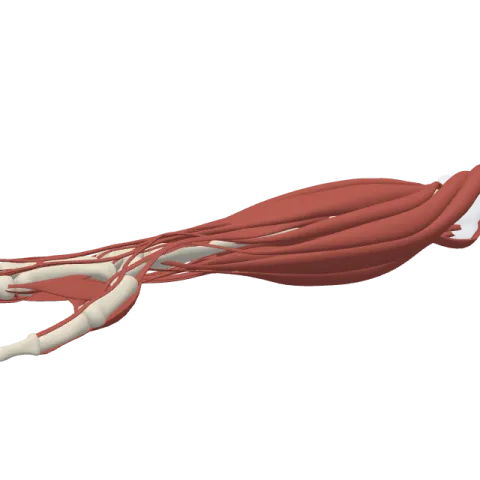
The abductor pollicis brevis is the most superficial muscle of the thenar eminence, the fleshy pad at the base of the thumb. It lifts the thumb forward, away from the palm, and is supplied by the recurrent branch of the median nerve.
Where it is
Run a finger over the ball of your thumb: the outer, surface part of that pad is the abductor pollicis brevis. The thenar eminence contains three short thumb muscles:
- the abductor pollicis brevis, superficial and on the outer (radial) side;
- the flexor pollicis brevis, also superficial, closer to the middle of the palm;
- the opponens pollicis, the deepest, lying under the abductor.
Pollicis means "of the thumb" (from the Latin pollex), and brevis means "short". The short abductor lies entirely in the hand, while its partner, the abductor pollicis longus, starts in the forearm.
A point that confuses many students: the thumb sits rotated about a quarter turn compared with the fingers. Its nail faces sideways, not backward. Because of this, thumb abduction means moving the thumb forward, out of the plane of the palm, as if pointing it at the ceiling when the hand lies palm up. Anatomists call this palmar abduction.
Origin and insertion
- Origin: the flexor retinaculum, the thick band that forms the roof of the carpal tunnel, and the tubercles of the scaphoid and the trapezium, two wrist bones on the thumb side (see the carpal bones).
- Insertion: the radial side of the base of the proximal phalanx of the thumb. Some fibers continue into the extensor expansion on the back of the thumb.
The phalanges of the hand page shows where the proximal phalanx of the thumb sits.
What it does
- Palmar abduction of the thumb: at the carpometacarpal joint, at the base of the thumb, it carries the thumb forward and away from the index finger. It also acts at the metacarpophalangeal joint.
- The first step of opposition: before the thumb can touch the tip of the little finger, it has to swing away from the palm. The abductor does this, then the opponens pollicis rotates the thumb across.
- A wide grasp: it opens the space between the thumb and the fingers so the hand can close around a bottle, a mug or a ball.
You can feel it work on yourself: lay your hand palm up, put a fingertip on the outer side of the thenar pad and lift the thumb toward the ceiling. The muscle hardens under your finger.
Innervation and blood supply
The abductor pollicis brevis is supplied by the recurrent branch of the median nerve (roots C8 and T1, mainly T1), also called the thenar branch. The median nerve enters the hand through the carpal tunnel. Just past the lower edge of the flexor retinaculum, this short branch curls back up into the thenar muscles. Carpal tunnel syndrome, a compression of the median nerve at the wrist, can weaken this muscle and flatten the thenar pad.
The superficial palmar branch of the radial artery, which runs over or through the thenar muscles, supplies its blood.
How to remember it
- LOAF lists the hand muscles of the median nerve: Lateral two lumbricals, Opponens pollicis, Abductor pollicis brevis, Flexor pollicis brevis.
- Point the thumb at the ceiling: with the palm facing up, thumb abduction is the move straight up, not sideways.
- Brevis stays in the hand, longus comes from the forearm: two abductors, one thumb.
- A OF A OF A names the short hand muscles from the thumb side to the little-finger side: Abductor pollicis brevis, Opponens pollicis, Flexor pollicis brevis, Adductor pollicis, Opponens digiti minimi, Flexor digiti minimi brevis, Abductor digiti minimi.
Test yourself in the forearm and hand quiz. The adductor pollicis does the opposite job, and the bones of the hand page shows the scaphoid and the trapezium.
Frequently asked questions
What does the abductor pollicis brevis do?
It abducts the thumb at the carpometacarpal and metacarpophalangeal joints, carrying it forward, at a right angle to the palm. It also starts the movement of opposition.
Which nerve supplies the abductor pollicis brevis?
The recurrent (thenar) branch of the median nerve, from roots C8 and T1.
What is the difference between the abductor pollicis brevis and longus?
The brevis is a short thenar muscle inside the hand that moves the thumb forward. The longus starts on the back of the forearm, inserts on the first metacarpal and moves the thumb more to the side.
How can you feel the abductor pollicis brevis?
Rest your hand palm up and lift the thumb toward the ceiling. The outer part of the thenar pad firms up: that is the abductor pollicis brevis contracting.
