Muscle · Upper limb
Brachialis muscle: origin, insertion, action and innervation
The brachialis runs from the lower front of the humerus to the coronoid process of the ulna. It flexes the elbow in every position; musculocutaneous nerve.
Quick answer
- Latin name
- Musculus brachialis
- Origin
- Lower half of the front surface of the humerus and the intermuscular septa on each side
- Insertion
- Coronoid process and tuberosity of the ulna
- Action
- Flexes the elbow, whatever the position of the forearm
- Innervation
- Musculocutaneous nerve (C5–C6); a small lateral part often also receives a branch of the radial nerve
- Blood supply
- Muscular branches of the brachial artery and the radial recurrent artery
See it on the 3D body
The brachialis lit on the 3D arm and elbow, as in the arm and elbow quiz. Turn the body, peel the layers, tap any structure for its name.
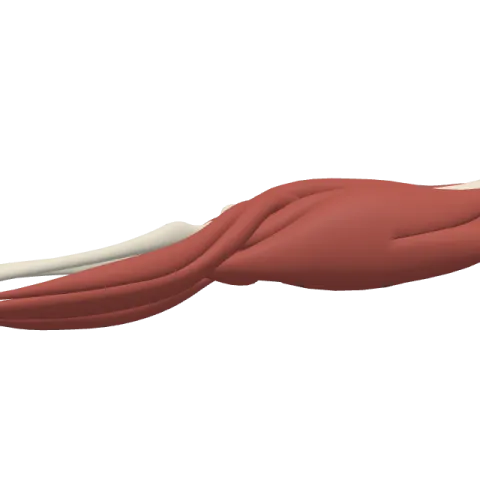
The brachialis is a broad, flat muscle on the front of the lower arm, lying under the biceps, that runs from the humerus to the ulna. It is the main flexor of the elbow in every position of the forearm, and it is supplied by the musculocutaneous nerve.
Where it is
The brachialis lies in the anterior compartment of the arm, deep to the biceps brachii. If you remove the biceps, the brachialis is what you see covering the lower half of the front of the humerus.
It wraps the front of the elbow joint and forms the floor of the cubital fossa, the hollow at the front of the elbow. The brachial artery and the median nerve lie on it there. On its lateral side, the brachioradialis starts just next to it, and the radial nerve runs in the groove between the two.
Origin and insertion
- Origin: the lower half of the front surface of the humerus, and the medial and lateral intermuscular septa that separate the front and back compartments of the arm. At the top, its fibers wrap around the insertion of the deltoid.
- Insertion: the coronoid process and the tuberosity of the ulna, on the front of the upper ulna, just below the elbow joint.
The insertion is the key to understanding the muscle. The biceps ends on the radius, a bone that rotates. The brachialis ends on the ulna, a bone that does not rotate at all.
What it does
The brachialis has one action: flexion of the elbow.
Because the ulna does not turn when you rotate your forearm, the pull of the brachialis is the same whether your palm faces up, down or sideways. That is why it is called the workhorse of elbow flexion. The biceps, by contrast, also turns the palm up (supination) and loses part of its pull when the forearm is turned palm down.
You use it whenever you bend your elbow: lifting a cup to your mouth, holding a bag with the elbow bent, doing a pull-up with your palms facing away. It also controls the elbow when the arm straightens slowly under a load, as when you lower a box onto a table.
Innervation and blood supply
The brachialis is supplied by the musculocutaneous nerve (roots C5 and C6), which runs down the arm between the biceps and the brachialis after passing through the coracobrachialis. In many people, a small lateral part of the muscle also receives a branch from the radial nerve, a frequent exam detail.
Its blood comes from muscular branches of the brachial artery and from the radial recurrent artery.
How to remember it
- Biceps is the show, brachialis is the work. The biceps is on top and gets the attention; the brachialis underneath does most of the flexing.
- Ulna doesn't twist. Brachialis to the ulna, biceps to the radius. Only the biceps cares where the palm faces.
- Floor of the elbow. The brachialis forms the floor of the cubital fossa, with the brachial artery and median nerve resting on it.
- Three elbow flexors: biceps, brachialis and brachioradialis. The brachialis is the only one whose single job is flexing the elbow.
Compare it with the other elbow flexors, then test yourself in the arm and elbow quiz.
Frequently asked questions
What is the main action of the brachialis?
It flexes the elbow. It is the main elbow flexor and works in every position of the forearm, palm up, down or sideways.
Is the brachialis stronger than the biceps?
For elbow flexion it does more of the everyday work, because its pull does not depend on forearm rotation. The biceps adds strong flexion with the palm up and is the most powerful supinator.
Where does the brachialis insert?
On the coronoid process and the tuberosity of the ulna, just below the elbow joint.
What nerve supplies the brachialis?
The musculocutaneous nerve (C5 and C6). A small lateral part often also receives a branch of the radial nerve.
Where is the brachialis located?
On the front of the lower half of the arm, under the biceps, covering the front of the elbow joint.
