
Muscle · Upper limb
Abductor digiti minimi of the hand: origin, insertion, action and innervation
The abductor digiti minimi of the hand runs from the pisiform to the little finger. It abducts the little finger and is supplied by the deep ulnar nerve.
Quick answer
- Latin name
- Musculus abductor digiti minimi manus
- Origin
- Pisiform (carpal bones), the tendon of the flexor carpi ulnaris and the pisohamate ligament
- Insertion
- Ulnar side of the base of the proximal phalanx of the little finger, with a slip to its extensor expansion
- Action
- Abducts the little finger at the metacarpophalangeal joint; helps flex that joint
- Innervation
- Deep branch of the ulnar nerve (C8-T1)
- Blood supply
- Ulnar artery, mainly its deep palmar branch
See it on the 3D body
The abductor digiti minimi muscle of hand lit on the 3D forearm and hand, as in the forearm and hand quiz. Turn the body, peel the layers, tap any structure for its name.
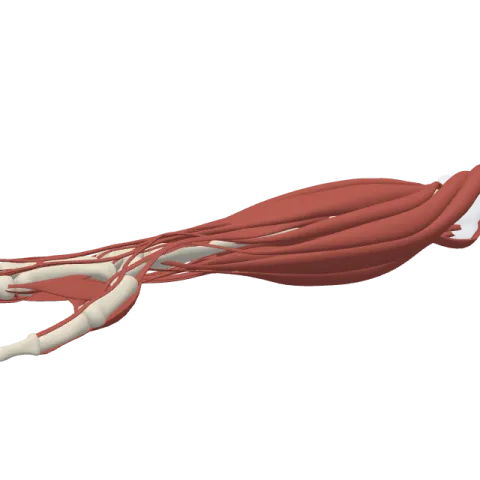
The abductor digiti minimi of the hand is the small muscle along the outer edge of the palm that pulls the little finger away from the ring finger. It runs from the pisiform bone of the wrist to the base of the little finger and is supplied by the deep branch of the ulnar nerve.
Where it is
The abductor digiti minimi forms the outer edge of the hypothenar eminence, the soft bulge of the palm below the little finger. You press on it each time you rest the side of your hand on a desk to write. Its name describes it: abductor (moves away from the middle of the hand) and digiti minimi (of the smallest finger). The words "of the hand" set it apart from a muscle with the same name on the outer edge of the foot.
The hypothenar eminence holds three muscles, all aimed at the little finger:
- the abductor digiti minimi, the most medial and the most superficial of the three;
- the flexor digiti minimi brevis, just lateral to it;
- the opponens digiti minimi, the deepest, under the other two.
This group mirrors the three thenar muscles of the thumb on the other side of the palm, such as the abductor pollicis brevis. A thin sheet of muscle in the skin, the palmaris brevis, lies over the hypothenar group near the wrist.
Origin and insertion
- Origin: the pisiform, the pea-shaped bone on the palm side of the wrist (see the carpal bones), together with the tendon of the flexor carpi ulnaris and the pisohamate ligament.
- Insertion: the ulnar side of the base of the proximal phalanx of the little finger, with a slip into the extensor expansion on the back of the finger. The phalanges of the hand page shows this bone.
Because it starts on the pisiform, it relies on the flexor carpi ulnaris, which holds that small bone steady while the abductor pulls on it.
What it does
- Abduction of the little finger: at the metacarpophalangeal joint (the knuckle), it swings the little finger away from the ring finger.
- Help with flexion: it also bends the little finger a little at the knuckle, together with the flexor digiti minimi brevis.
- A wider grip: by spreading the little finger, it lets the hand wrap around a large object, such as a ball or the lid of a big jar.
The little finger has no dorsal interosseous muscle of its own. The abductor digiti minimi does for it what the dorsal interossei do for the index, middle and ring fingers.
Innervation and blood supply
Its nerve is the deep branch of the ulnar nerve, carrying fibers from C8 and T1. The ulnar nerve enters the hand beside the pisiform, through a short passage called the ulnar canal (Guyon's canal), and splits into a superficial branch, mostly for the skin, and a deep branch for muscles. The deep branch gives its first motor twigs to the hypothenar muscles before it curves across the palm.
Its blood comes from the ulnar artery, mainly its deep palmar branch, which travels with the deep branch of the nerve.
How to remember it
- Pea to pinky: it runs from the pisiform (the pea) to the little finger (the pinky).
- Same name, two places: the hand and the foot each have an abductor digiti minimi on their outer edge. Write "of the hand" in an exam answer.
- Abductor on the edge, flexor beside it, opponens underneath: this order works on both the thumb side and the little-finger side of the palm.
- The ulnar nerve owns the little-finger side: every hypothenar muscle gets the deep branch of the ulnar nerve.
Test yourself in the forearm and hand quiz, and see the bones of the hand for the pisiform and the phalanges.
Frequently asked questions
What does the abductor digiti minimi of the hand do?
It abducts the little finger at the metacarpophalangeal joint, moving it away from the ring finger, and helps flex that joint.
Where does the abductor digiti minimi of the hand originate?
From the pisiform bone, the tendon of the flexor carpi ulnaris and the pisohamate ligament.
Which nerve supplies the abductor digiti minimi of the hand?
The ulnar nerve, through its deep (motor) branch. The fibers come from C8 and T1.
Is the abductor digiti minimi part of the hypothenar eminence?
Yes. It is the most superficial and most medial of the three hypothenar muscles, with the flexor digiti minimi brevis and the opponens digiti minimi.
