
Muscle · Upper limb
Adductor pollicis: origin, insertion, action and innervation
The adductor pollicis runs from the capitate and the 2nd and 3rd metacarpals to the thumb. It adducts the thumb and is supplied by the deep ulnar nerve.
Quick answer
- Latin name
- Musculus adductor pollicis
- Origin
- Oblique head: capitate and bases of the second and third metacarpals. Transverse head: palm side of the shaft of the third metacarpal
- Insertion
- Ulnar side of the base of the proximal phalanx of the thumb, through the ulnar sesamoid bone
- Action
- Adducts the thumb at the carpometacarpal joint, pulling it toward the palm; gives force to pinch and grip
- Innervation
- Deep branch of the ulnar nerve (C8-T1)
- Blood supply
- Deep palmar arch, from the radial artery
See it on the 3D body
The adductor pollicis lit on the 3D forearm and hand, as in the forearm and hand quiz. Turn the body, peel the layers, tap any structure for its name.
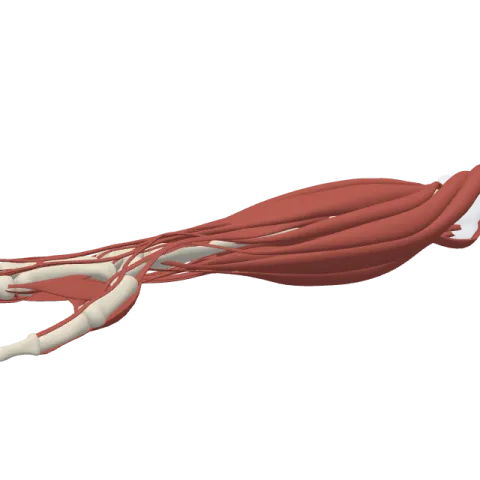
The adductor pollicis is a triangular muscle deep in the palm that pulls the thumb back toward the index finger. It has two heads, inserts on the base of the thumb's first phalanx and is supplied by the deep branch of the ulnar nerve, not the median nerve.
Where it is
The adductor pollicis lies in the web between the thumb and the index finger, deep in the palm. Pinch that web with the other hand: the part toward the palm is mostly adductor pollicis, and the part toward the back of the hand is the first dorsal interosseous muscle.
It is often grouped with the thumb muscles, but it is not part of the thenar eminence. The three thenar muscles, such as the abductor pollicis brevis, sit in the fleshy pad at the base of the thumb and are supplied by the median nerve. The adductor lies deeper and closer to the middle of the palm, under the long flexor tendons and the lumbricals, and it has a different nerve.
Origin and insertion
The muscle has two heads:
- Oblique head: from the capitate (see the carpal bones) and the bases of the second and third metacarpals. Its fibers run diagonally toward the thumb.
- Transverse head: from the palm side of the shaft of the third metacarpal. Its fibers run straight across the palm, almost horizontally.
Both heads join and insert on the ulnar side of the base of the proximal phalanx of the thumb. A small sesamoid bone sits in the tendon at the metacarpophalangeal joint. The metacarpals and phalanges of the hand pages show these bones.
What it does
- Adduction of the thumb: at the carpometacarpal joint, it brings the thumb back toward the palm and the index finger, closing the gap that the abductors opened.
- Power for pinch: it presses the thumb hard against the side of the index finger. This is the "key pinch" you use to turn a key, hold a card or grip a sheet of paper.
- Strength in a fist: in a power grip, it pulls the thumb in tightly over the fingers.
It is the counterpart of the two abductors: the abductor pollicis brevis and the abductor pollicis longus open the thumb away from the hand, and the adductor brings it back.
Innervation and blood supply
The adductor pollicis is supplied by the deep branch of the ulnar nerve (roots C8 and T1). This branch runs across the palm from the little-finger side toward the thumb, supplying muscles along the way. The adductor pollicis is one of the last muscles it reaches.
In Froment's sign, a person with a weak adductor pollicis bends the thumb tip to grip a sheet of paper, because the flexor pollicis longus takes over.
Its blood comes from the deep palmar arch, formed mainly by the radial artery, which curves across the palm close to the muscle.
How to remember it
- Add it back: abduction takes the thumb away, adduction adds it back to the hand.
- The odd one out: most short thumb muscles get the median nerve. The adductor pollicis gets the ulnar nerve.
- Oblique from the wrist, transverse from the third: the oblique head starts on the capitate and metacarpal bases; the transverse head starts on the third metacarpal shaft.
- Not in the pad: the thenar eminence has three muscles, and the adductor is not one of them.
Test yourself in the forearm and hand quiz, and locate the capitate and the third metacarpal on the bones of the hand page.
Frequently asked questions
What does the adductor pollicis do?
It adducts the thumb at the carpometacarpal joint, bringing it toward the palm and the index finger. It gives force to pinch and grip.
Which nerve supplies the adductor pollicis?
The deep branch of the ulnar nerve (C8-T1), the same branch that supplies the interossei.
Is the adductor pollicis a thenar muscle?
No. It lies deeper in the palm and is supplied by the ulnar nerve. The thenar muscles are the abductor pollicis brevis, the flexor pollicis brevis and the opponens pollicis.
What are the two heads of the adductor pollicis?
The oblique head, from the capitate and the bases of the second and third metacarpals, and the transverse head, from the shaft of the third metacarpal.
