Muscle · Upper limb
Coracobrachialis muscle: origin, insertion, action and innervation
The coracobrachialis runs from the coracoid process to the middle of the humerus. It flexes and adducts the arm; musculocutaneous nerve (C5–C7).
Quick answer
- Latin name
- Musculus coracobrachialis
- Origin
- Tip of the coracoid process of the scapula, with the short head of the biceps
- Insertion
- Middle third of the medial surface of the humerus
- Action
- Flexes and adducts the arm at the shoulder; helps hold the head of the humerus in the glenoid cavity
- Innervation
- Musculocutaneous nerve (C5–C7)
- Blood supply
- Muscular branches of the brachial artery
See it on the 3D body
The coracobrachialis lit on the 3D shoulder, as in the shoulder quiz. Turn the body, peel the layers, tap any structure for its name.
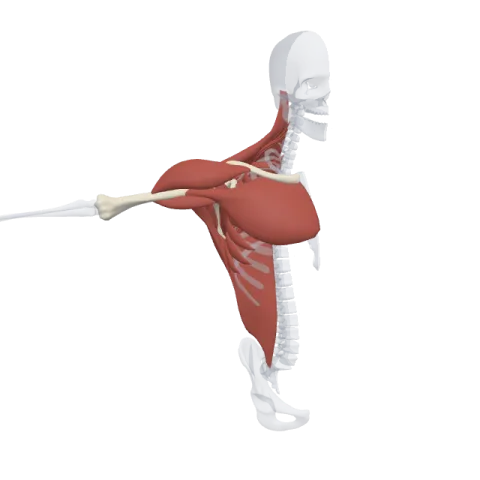
The coracobrachialis is a slim muscle on the inner side of the upper arm, running from the coracoid process of the scapula to the middle of the humerus. It flexes and adducts the arm at the shoulder and is supplied by the musculocutaneous nerve, which passes straight through it.
Where it is
The coracobrachialis lies high on the inner (medial) side of the arm, in the anterior compartment of the arm with the biceps brachii and the brachialis. Of the three, it is the only one that crosses the shoulder joint alone and does not reach the elbow.
At the top, it starts from the tip of the coracoid process, the hook-shaped bump that sticks forward from the scapula under the clavicle. It shares that starting point with the short head of the biceps, and the two are fused for a few centimeters. It then runs down along the medial side of the biceps and attaches halfway down the shaft of the humerus.
In the armpit, it is a useful landmark. The axillary artery, which becomes the brachial artery, and the nerves around it run along its medial edge. When you abduct the arm, you can feel the coracobrachialis as a soft cord on the inner side of the arm, just behind the short head of the biceps.
Origin and insertion
- Origin: the tip of the coracoid process of the scapula, by a tendon shared with the short head of the biceps.
- Insertion: the middle third of the medial surface of the shaft of the humerus, roughly opposite the deltoid tuberosity on the other side of the bone.
What it does
The coracobrachialis crosses only the shoulder joint, so it moves the arm, not the forearm.
- Flexion of the arm. It helps lift the arm forward, working with the anterior fibers of the deltoid and the clavicular head of the pectoralis major.
- Adduction of the arm. It pulls the arm toward the side of the body, as when you press a newspaper under your armpit.
- Holding the shoulder together. Its fibers run almost parallel to the humerus, so it helps keep the head of the humerus pressed into the glenoid cavity when the arm hangs or carries a load.
It is a weak muscle compared with its neighbors, and its actions are shared with larger muscles.
Innervation and blood supply
The coracobrachialis is supplied by the musculocutaneous nerve (roots C5, C6 and C7), from the lateral cord of the brachial plexus. The nerve pierces the coracobrachialis a few centimeters below the coracoid, gives it a branch, then continues down between the biceps and the brachialis to supply them both. Piercing this muscle is one of the most quoted facts about the musculocutaneous nerve.
Its blood comes from muscular branches of the brachial artery.
How to remember it
- Read the name. Coraco- = coracoid process, -brachialis = arm. The name gives the origin and tells you it ends on the arm bone.
- Three muscles, one nerve. The musculocutaneous nerve supplies all three anterior arm muscles. A handy mnemonic is BBC: Biceps, Brachialis, Coracobrachialis.
- The nerve goes through it. The musculocutaneous nerve threads through the coracobrachialis like a needle through cloth.
- Halfway is enough. It stops at the middle of the humerus, so it never acts on the elbow.
Place it among the other shoulder muscles on the muscles of the shoulder page, then pick it out on the 3D arm in the shoulder quiz.
Frequently asked questions
What does the coracobrachialis do?
It lifts the arm forward (flexion) and pulls it toward the body (adduction). It also helps keep the shoulder joint closed when the arm carries a load.
Where does the coracobrachialis attach?
From the tip of the coracoid process of the scapula to the middle of the medial surface of the humerus.
What nerve pierces the coracobrachialis?
The musculocutaneous nerve. It passes through the muscle, supplies it, and then runs on between the biceps and the brachialis.
Does the coracobrachialis act on the elbow?
No. It ends halfway down the humerus, so it crosses only the shoulder joint.
