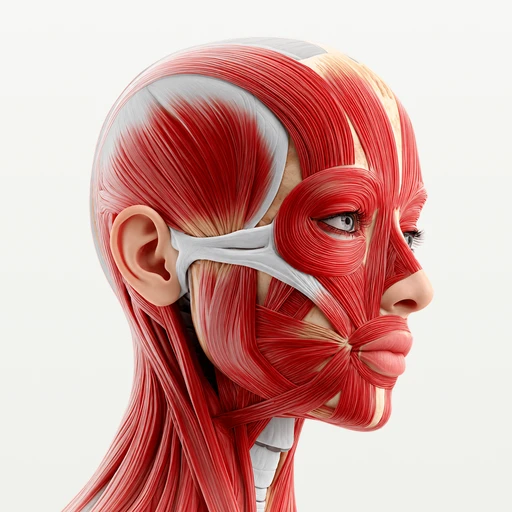
Muscle · Head and neck
Levator labii superioris alaeque nasi: origin, insertion, action and innervation
The levator labii superioris alaeque nasi runs from the maxilla to the nostril and upper lip. It lifts the lip and flares the nostril; facial nerve.
Quick answer
- Latin name
- Musculus levator labii superioris alaeque nasi
- Origin
- Upper part of the frontal process of the maxilla, beside the nose (skull)
- Insertion
- Medial slip: alar cartilage and skin of the nose; lateral slip: upper lip, blending with the levator labii superioris and orbicularis oris
- Action
- Elevates the upper lip and dilates the nostril by raising the ala of the nose
- Innervation
- Facial nerve (CN VII), zygomatic and buccal branches
- Blood supply
- Angular artery (end of the facial artery) and the infraorbital artery
See it on the 3D body
The levator labii superioris alaeque nasi lit on the 3D head, as in the head quiz. Turn the body, peel the layers, tap any structure for its name.
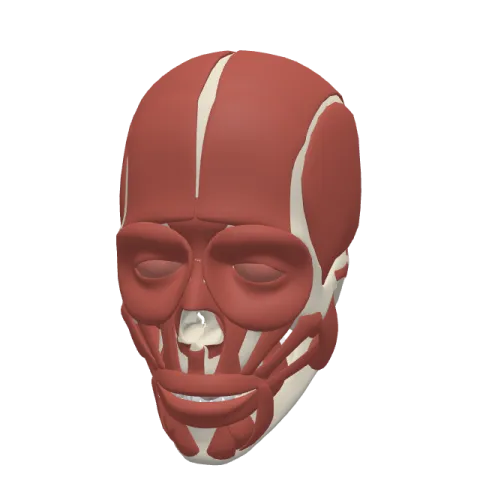
The levator labii superioris alaeque nasi is a narrow muscle along the side of the nose that lifts the upper lip and flares the nostril. It runs from the frontal process of the maxilla to the wing of the nose and the upper lip, and it is supplied by the zygomatic and buccal branches of the facial nerve (CN VII).
Where it is
The muscle runs down the side of the nose, in the groove between the nose and the cheek, from near the inner corner of the eye to the nostril and the upper lip. It is superficial, just under the skin, and lies medial to the levator labii superioris, the next muscle in the fan of upper lip lifters.
Its name is often quoted as one of the longest of any muscle, and it simply lists what the muscle does in Latin:
- levator (lifter)
- labii superioris (of the upper lip)
- alaeque nasi (and of the wing of the nose; -que means "and", ala is "wing" and nasi is "of the nose").
Older books called it the angular head of the quadratus labii superioris, because it begins near the inner angle of the eye.
Origin and insertion
- Origin: the upper part of the frontal process of the maxilla, the strip of the upper jaw that climbs beside the nose to meet the frontal bone. The maxilla is described on the skull page.
- Insertion, medial slip: the muscle splits in two as it descends. The medial slip ends on the alar cartilage and skin of the nose, the wing at the side of the nostril.
- Insertion, lateral slip: the lateral slip ends in the upper lip, where it blends with the levator labii superioris and the orbicularis oris.
The two slips explain its two actions.
What it does
- Dilates the nostril. The medial slip pulls the wing of the nose up and outward, opening the nostril. This is the flare you see when someone breathes in hard after running, or when they are angry.
- Elevates the upper lip. The lateral slip lifts the upper lip, together with the levator labii superioris, and helps deepen the nasolabial fold.
Used together, the two actions make the sneer: the upper lip curls up on one side, the nostril flares and the skin beside the nose wrinkles.
Its opposite at the nose is the depressor septi nasi, which pulls the tip of the nose and the septum down.
Innervation and blood supply
The muscle is supplied by the zygomatic and buccal branches of the facial nerve, the same supply as the other upper lip lifters.
Its blood comes mainly from the angular artery, the last part of the facial artery, which runs up along the side of the nose right beside the muscle toward the inner corner of the eye. The infraorbital artery adds a supply from the side.
How to remember it
- Read the name like a sentence: lifter of the upper lip and of the wing of the nose. Two jobs, two slips.
- The sneer muscle: curl one side of your upper lip in a mirror and watch the nostril follow.
- Closest to the nose: it is the first in the fan of lifters, starting at the side of the nose; the levator labii superioris is next, starting below the eye.
- Angular head, angular artery: it begins near the inner angle of the eye, and the angular artery runs beside it.
Place it among the nose and lip muscles on the muscles of the face page, then test yourself in the head quiz.
Frequently asked questions
What does the levator labii superioris alaeque nasi do?
It lifts the upper lip and flares the nostril by raising the wing of the nose, as in a sneer.
Which nerve supplies the levator labii superioris alaeque nasi?
The zygomatic and buccal branches of the facial nerve (CN VII).
What does the name levator labii superioris alaeque nasi mean?
It is Latin for "lifter of the upper lip and of the wing of the nose", a list of its two actions.
Where does the levator labii superioris alaeque nasi attach?
It arises from the upper part of the frontal process of the maxilla and inserts on the alar cartilage of the nose and on the upper lip.
