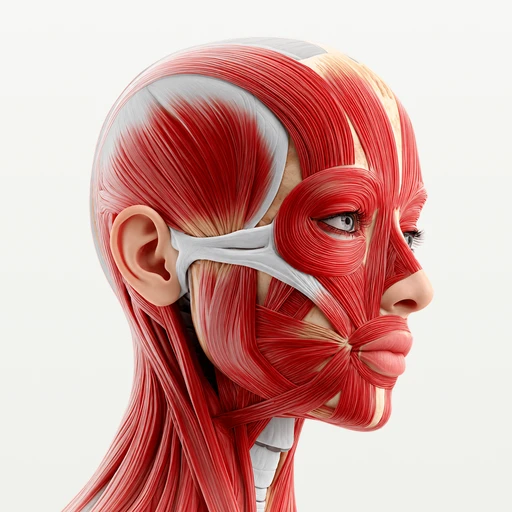
Muscle · Head and neck
Levator labii superioris: origin, insertion, action and innervation
The levator labii superioris runs from the infraorbital margin to the upper lip. It lifts the upper lip; facial nerve (CN VII), zygomatic and buccal branches.
Quick answer
- Latin name
- Musculus levator labii superioris
- Origin
- Infraorbital margin of the maxilla and zygomatic bone, just above the infraorbital foramen (skull)
- Insertion
- Muscle and skin of the upper lip, blending with the orbicularis oris
- Action
- Elevates and everts the upper lip; helps deepen the nasolabial fold
- Innervation
- Facial nerve (CN VII), zygomatic and buccal branches
- Blood supply
- Superior labial branch of the facial artery and the infraorbital artery
See it on the 3D body
The levator labii superioris lit on the 3D head, as in the head quiz. Turn the body, peel the layers, tap any structure for its name.
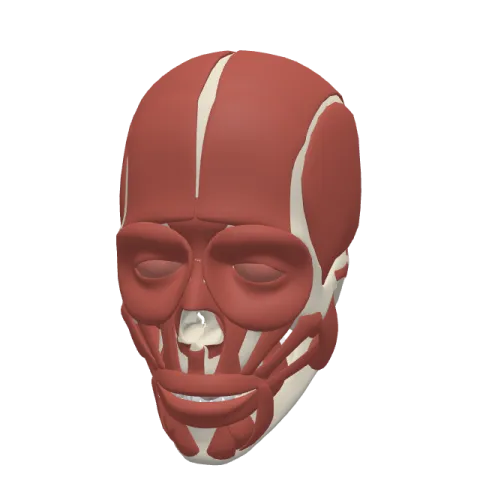
The levator labii superioris is a flat muscle of the cheek that lifts the upper lip. It runs from the lower rim of the orbit, just below the eye, down into the upper lip, and it is supplied by the zygomatic and buccal branches of the facial nerve (CN VII).
Where it is
The muscle lies in the cheek between the nose and the cheekbone, under the skin and the lower part of the orbicularis oculi. It is a thin, roughly rectangular sheet whose fibers run downward and slightly inward to the upper lip.
It is one of five muscles that fan out above the mouth. From the nose toward the cheekbone they are:
- the levator labii superioris alaeque nasi, along the side of the nose;
- the levator labii superioris, this muscle;
- the zygomaticus minor;
- the zygomaticus major, from the cheekbone to the corner of the mouth;
- and deeper, the levator anguli oris.
The levator labii superioris covers the infraorbital foramen, the opening below the eye where the infraorbital nerve and vessels come out onto the face. Those nerves and vessels then run down between this muscle and the levator anguli oris behind it.
In older texts, this muscle, the levator labii superioris alaeque nasi and the zygomaticus minor were described as three heads of a single quadratus labii superioris. This muscle was the infraorbital head.
Origin and insertion
- Origin: the infraorbital margin, the lower rim of the orbit, on the maxilla and the neighboring zygomatic bone, just above the infraorbital foramen. Both bones are described on the skull page.
- Insertion: the muscle and skin of the upper lip, between the insertions of its neighbors, where its fibers blend with the orbicularis oris.
What it does
The levator labii superioris elevates the upper lip, and because it pulls on the lip from above and slightly in front, it also everts it a little, turning the red part of the lip outward. It helps to deepen the nasolabial fold, the crease from the side of the nose to the corner of the mouth.
You use it to show the upper teeth: in a broad smile, in a look of disgust or contempt, or when you raise the upper lip on purpose. In a smile, it works with the zygomaticus major and the levator anguli oris; in a sneer, the levator labii superioris alaeque nasi joins in and the nose wrinkles at the same time.
The upper lip is lowered and closed mainly by the orbicularis oris, the ring muscle inside both lips.
Innervation and blood supply
The muscle is supplied by the zygomatic and buccal branches of the facial nerve. The skin over it gets its sensation from a different nerve, the infraorbital nerve of the maxillary division of the trigeminal nerve, which emerges right under the muscle. This split is a good example of the rule for the face: facial nerve for movement, trigeminal nerve for feeling.
Its blood comes from the superior labial branch of the facial artery, which runs inside the upper lip, and the infraorbital artery, which comes out of the infraorbital foramen with the nerve.
How to remember it
- Levator labii superioris = lifter of the upper lip. Labii is "of the lip", superioris is "upper".
- Second in the fan from the nose: alaeque nasi, then labii superioris, then the two zygomatici.
- Lid over the foramen: it covers the infraorbital foramen like a flap.
- Old name, three heads: angular, infraorbital, zygomatic. This one is the infraorbital head.
The muscles of the face page shows all five lifters together. Test yourself in the head quiz.
Frequently asked questions
What is the action of the levator labii superioris?
It lifts the upper lip and turns it slightly outward, showing the upper teeth.
Which nerve supplies the levator labii superioris?
The zygomatic and buccal branches of the facial nerve (CN VII).
Where does the levator labii superioris originate?
From the infraorbital margin of the maxilla and zygomatic bone, just above the infraorbital foramen.
What is the difference between the levator labii superioris and the levator labii superioris alaeque nasi?
The levator labii superioris starts below the eye and only lifts the upper lip. The levator labii superioris alaeque nasi starts beside the nose and lifts both the upper lip and the wing of the nose.
