Muscle · Head and neck
Sternothyroid muscle: origin, insertion, action and innervation
The sternothyroid runs from the manubrium to the thyroid cartilage. It pulls the larynx down after swallowing and is supplied by the ansa cervicalis.
Quick answer
- Latin name
- Musculus sternothyroideus
- Origin
- Back of the manubrium of the sternum and the edge of the first costal cartilage
- Insertion
- Oblique line on the outer surface of the thyroid cartilage of the larynx
- Action
- Depresses the larynx (thyroid cartilage) after it has been raised in swallowing or speech
- Innervation
- Ansa cervicalis (C1–C3), from the cervical plexus
- Blood supply
- Superior thyroid artery
See it on the 3D body
The sternothyroid lit on the 3D neck, as in the neck quiz. Turn the body, peel the layers, tap any structure for its name.
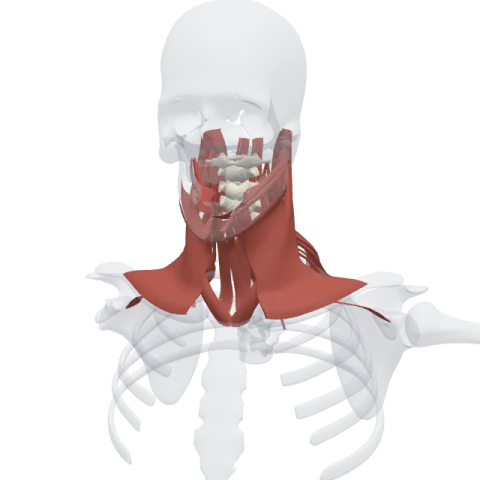
The sternothyroid is a broad strap muscle in the front of the neck that runs from the back of the sternum to the thyroid cartilage of the larynx. It pulls the larynx down after it has risen for swallowing or speech, and it is supplied by the ansa cervicalis.
Where it is
The sternothyroid lies deep to the sternohyoid, in the lower front of the neck. It is one of the four infrahyoid muscles, and with the thyrohyoid above it forms the deep layer of these strap muscles.
It is shorter and wider than the sternohyoid, and it lies directly on the thyroid gland, the windpipe and the lower part of the larynx. The left and right muscles are close together at the bottom, behind the manubrium, and spread apart as they climb. Because it covers the front of the thyroid gland, surgeons meet the sternothyroid during thyroid operations. You can read more about the gland on the endocrine glands page.
The line where the sternothyroid stops on the thyroid cartilage is the same line where the thyrohyoid starts. Seen from the side, the two muscles look like one strap broken in the middle by the larynx.
Origin and insertion
- Origin: the back surface of the manubrium of the sternum, lower than the origin of the sternohyoid, plus the edge of the first costal cartilage.
- Insertion: the oblique line of the thyroid cartilage, a ridge that runs diagonally across the outer surface of each plate of the cartilage.
The thyroid cartilage is the largest cartilage of the larynx, the one that forms the Adam's apple.
What it does
- Pulls the larynx down: during swallowing the larynx rises so the epiglottis can fold over its entrance. Afterward, the sternothyroid draws the thyroid cartilage, and the whole larynx with it, back to its resting level.
- Lowers the larynx in voice use: the larynx moves up and down slightly with changes in pitch. The sternothyroid helps lower it, for example when singing low notes.
Unlike the sternohyoid, it does not reach the hyoid bone, so it acts on the larynx directly.
Innervation and blood supply
The sternothyroid is supplied by the ansa cervicalis, the nerve loop formed by fibers from C1 to C3. The branch to this muscle usually comes off the lower part of the loop.
Its blood comes from the superior thyroid artery, which also supplies the upper part of the thyroid gland and the neighboring strap muscles.
How to remember it
- Sternum to thyroid cartilage: the name stops at the thyroid, not at the hyoid. "Thyroid" here means the cartilage of the larynx, not the gland.
- Deeper, shorter, wider: three words that separate it from the sternohyoid.
- One strap in two pieces: sternothyroid below, thyrohyoid above, both meeting at the oblique line.
- Blanket over the gland: picture the sternothyroid lying over the thyroid gland like a blanket.
Test yourself in the neck quiz.
Frequently asked questions
What does the sternothyroid muscle do?
It depresses the larynx by pulling the thyroid cartilage down, usually after it has been raised in swallowing or speech.
What nerve supplies the sternothyroid?
The ansa cervicalis, which carries fibers from C1 to C3.
Where does the sternothyroid insert?
On the oblique line of the thyroid cartilage.
Is the sternothyroid deep to the sternohyoid?
Yes. It lies directly behind the sternohyoid and in front of the thyroid gland.
