
Quick answer
- System
- Endocrine system
- Location
- Spread through the body, from the base of the brain to the neck, chest and abdomen
- Function
- Release hormones into the blood to regulate growth, metabolism and many other processes
- Parts in the app
- 6
Endocrine glands are ductless glands: instead of releasing their products through a tube, they send hormones straight into the blood. Hormones travel throughout the body but act only on cells that carry the right receptors, which is how a small gland in the neck can change the metabolism of almost every tissue. Unlike the other organ groups in the app, these glands are not side by side; they are spread from the base of the brain to the abdomen.
Where it is
- The pituitary gland hangs from the underside of the brain by a thin stalk, in a small hollow of the sphenoid bone called the sella turcica. It is connected to the hypothalamus just above it.
- The thyroid gland lies in the front of the neck, just below the larynx. Its two lobes sit on either side of the trachea, joined across the front by a narrow isthmus.
- The thymus lies in the upper chest, behind the sternum and in front of the heart and great vessels. It is large in children and shrinks after puberty, when much of it is replaced by fat.
- The pancreas lies across the back of the abdomen, behind the stomach.
- The adrenal glands sit on top of the kidneys, one on each side.
Parts you can explore in the app
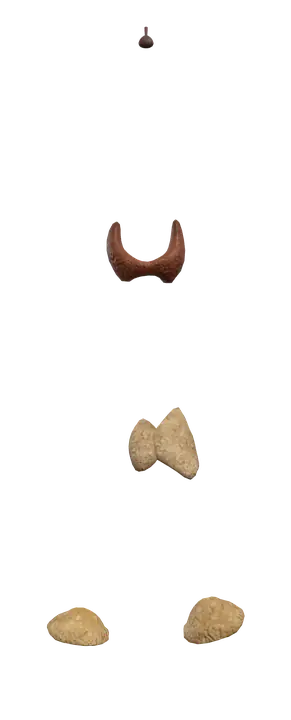
In the app you can open the endocrine glands on their own and study them part by part:
- Thyroid gland: a butterfly-shaped gland in the neck that makes hormones controlling the body's metabolic rate.
- Thymus: a gland in the upper chest where T lymphocytes, a type of white blood cell, mature.
- Pancreas: a gland behind the stomach whose islets release insulin and glucagon to control blood glucose.
- Pituitary gland: a pea-sized gland under the brain that controls several other endocrine glands.
- Left adrenal gland: a small gland on top of the left kidney that makes stress and salt-balance hormones.
- Right adrenal gland: the matching gland on top of the right kidney.
Cross sections (sagittal, coronal and axial) let you see each gland in place among the organs around it.
What it does
The pituitary has two parts. The anterior pituitary is true glandular tissue. Under the control of releasing hormones from the hypothalamus, it makes growth hormone, thyroid-stimulating hormone (TSH), adrenocorticotropic hormone (ACTH), follicle-stimulating hormone (FSH), luteinizing hormone (LH) and prolactin. The posterior pituitary does not make hormones; it stores and releases two hormones made by the hypothalamus: antidiuretic hormone (ADH), which helps the kidneys save water, and oxytocin.
The thyroid is built of small follicles that use iodine to make thyroxine (T4) and triiodothyronine (T3). These hormones raise the metabolic rate and are essential for normal growth and development. Other cells in the thyroid, the parafollicular cells, make calcitonin, which can lower blood calcium.
The thymus provides the environment in which T lymphocytes mature and learn to tell the body's own cells from foreign ones. It releases hormones called thymosins that support this process.
The pancreas contains small clusters of cells, the pancreatic islets. Beta cells release insulin, which lowers blood glucose by helping cells take it up. Alpha cells release glucagon, which raises blood glucose by prompting the liver to release it.
The adrenal glands each have two layers. The cortex makes aldosterone (salt and water balance), cortisol (stress response and blood glucose) and small amounts of androgens. The medulla releases epinephrine and norepinephrine, the fight-or-flight hormones that raise heart rate and blood glucose.
Most of these glands are controlled by negative feedback. For example, the hypothalamus releases a hormone that tells the pituitary to release TSH; TSH tells the thyroid to release T3 and T4; and rising T3 and T4 then signal the hypothalamus and pituitary to slow down.
How to study it
- Make a table. For each gland, write down its location, its hormones, their target and their effect. Most exam questions are drawn from exactly this table.
- Anterior pituitary: "FLAT PiG." FSH, LH, ACTH, TSH, Prolactin, (i), Growth hormone.
- Posterior pituitary stores, it does not make. ADH and oxytocin are made in the hypothalamus.
- Insulin lowers, glucagon raises. Insulin lets glucose in to cells.
- Adrenal cortex from outside in: "salt, sugar, sex." Aldosterone, cortisol, androgens.
- Trace one feedback loop from start to finish. The hypothalamus, pituitary and thyroid axis is the classic example, and once you understand it the others follow the same pattern.
- Expect the parathyroid glands too. Exams often ask about these small glands on the back of the thyroid, which raise blood calcium with parathyroid hormone.
Frequently asked questions
What is the difference between endocrine and exocrine glands?
Endocrine glands release hormones directly into the blood. Exocrine glands release their secretions through ducts onto a surface or into a cavity, like sweat glands or the digestive part of the pancreas.
Why is the pituitary called the master gland?
Because its anterior part releases hormones that control other endocrine glands, including the thyroid, the adrenal cortex and the gonads. It is itself controlled by the hypothalamus.
What does the thyroid gland do?
It makes T3 and T4, which set the body's metabolic rate and support growth and development, and calcitonin, which can lower blood calcium.
What happens to the thymus with age?
It is largest and most active in childhood. After puberty it gradually shrinks, and much of its tissue is replaced by fat.
Sources
- OpenStax, Anatomy and Physiology 2e, 17.1 An overview of the endocrine system
- OpenStax, Anatomy and Physiology 2e, 17.3 The pituitary gland and hypothalamus
- OpenStax, Anatomy and Physiology 2e, 17.4 The thyroid gland
- OpenStax, Anatomy and Physiology 2e, 17.6 The adrenal glands
- Z-Anatomy, the libre 3D atlas of anatomy