Muscle · Trunk
Transversus abdominis: origin, insertion, action and innervation
The transversus abdominis runs from the lower ribs, lumbar fascia, iliac crest and inguinal ligament to the linea alba. It compresses the abdomen; T7–L1.
Quick answer
- Latin name
- Musculus transversus abdominis
- Origin
- Inner surfaces of costal cartilages 7–12, thoracolumbar fascia, anterior two thirds of the iliac crest of the hip bone, lateral third of the inguinal ligament
- Insertion
- Linea alba (through its aponeurosis), pubic crest and pecten pubis (through the conjoint tendon)
- Action
- Compresses and supports the abdominal viscera; raises intra-abdominal pressure
- Innervation
- Thoraco-abdominal nerves (T7–T11), subcostal nerve (T12), iliohypogastric and ilioinguinal nerves (L1)
- Blood supply
- Lower posterior intercostal and subcostal arteries, superior and inferior epigastric arteries, deep circumflex iliac artery
See it on the 3D body
The transversus abdominis lit on the 3D abdomen, as in the abdomen quiz. Turn the body, peel the layers, tap any structure for its name.
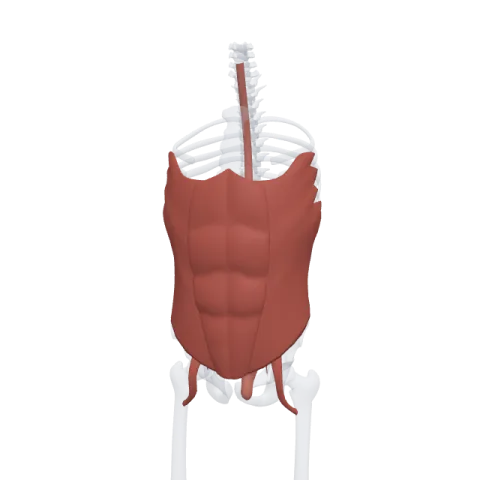
The transversus abdominis is the deepest of the three flat muscles of the abdominal wall, with fibers that run horizontally around the belly like a wide belt. It compresses and supports the abdominal organs, and it shares its nerve supply (T7 to L1) with the internal oblique.
Where it is
The transversus abdominis lies under the internal oblique, which itself lies under the external oblique. Deep to it there is only a layer of fascia (the transversalis fascia), fat and then the peritoneum that lines the abdominal cavity.
It starts at the back, from the thick thoracolumbar fascia beside the lumbar spine, wraps around the side of the trunk and becomes a flat aponeurosis toward the front. Its fibers run across, almost exactly horizontally: that is what transversus means. At the top, its slips attach to the inside of the lower costal cartilages, where they interlock with the slips of the diaphragm.
At the front, its aponeurosis joins the rectus sheath. Above the arcuate line, a curved line about a third of the way from the navel to the pubis, it passes behind the rectus abdominis. Below that line, it passes in front of it, leaving only fascia behind the lower rectus.
Origin and insertion
- Origin: the inner surfaces of the costal cartilages of ribs 7 to 12, the thoracolumbar fascia, the front two thirds of the iliac crest of the hip bone, and the lateral third of the inguinal ligament.
- Insertion: its aponeurosis ends in the linea alba. Its lowest fibers join those of the internal oblique to form the conjoint tendon, which attaches to the pubic crest and pecten pubis.
What it does
Because its fibers run around the trunk rather than up and down, the transversus abdominis does not bend or twist the spine much. Its job is pressure:
- Compresses the abdomen. When it contracts, it pulls the abdominal wall in and flattens it, which squeezes the organs inside and raises the pressure in the abdominal cavity.
- Supports the organs. At rest its tone helps hold the viscera in place.
- Helps forced breathing out. Raising abdominal pressure pushes the diaphragm up, which drives air out of the lungs. You feel it at the end of a long, hard breath out, or when you cough.
- Bracing the trunk. Before you lift something heavy, it tightens with the other abdominal muscles. The raised pressure stiffens the trunk around the lumbar spine.
Innervation and blood supply
Its nerves come from spinal levels T7 to L1: the lower intercostal nerves, which continue into the abdominal wall as the thoraco-abdominal nerves (T7 to T11), the subcostal nerve (T12), and the iliohypogastric and ilioinguinal nerves (L1). They travel forward on the outer surface of the transversus, between it and the internal oblique. That layer is the neurovascular plane of the abdominal wall, the same plane where the intercostal nerves run in the chest.
Arteries reach it from above, behind and below: the superior epigastric, the lower posterior intercostal and subcostal arteries, the inferior epigastric and the deep circumflex iliac.
How to remember it
- Transverse = belt. The fibers go around you horizontally, like a belt buckled at the linea alba.
- Deepest layer, no twist. It sits under both obliques and mainly squeezes; the obliques do the twisting.
- Inside the ribs. Its upper slips attach to the inner surface of the costal cartilages and interlock with the diaphragm, which tells you it belongs to the deep layer.
- Same nerves as its neighbor. The internal oblique and transversus share both their nerves and the conjoint tendon.
See how the three flat layers stack on the abdominal muscles page, then name them on the 3D body in the abdomen quiz.
Frequently asked questions
What is the function of the transversus abdominis?
It compresses and supports the abdominal organs and raises the pressure inside the abdomen, which helps forced breathing out, coughing and bracing the trunk.
Which way do the transversus abdominis fibers run?
Horizontally, around the side of the abdomen, from back to front.
What nerves supply the transversus abdominis?
Nerves from T7 to L1: the lower six thoracic anterior rami (thoraco-abdominal and subcostal nerves) and, from L1, the iliohypogastric and ilioinguinal nerves.
Does the transversus abdominis rotate the trunk?
Very little. Its horizontal fibers are built to squeeze the abdomen. Rotation is the job of the external and internal obliques.
