External oblique: origin, insertion, action and innervation
The external abdominal oblique arises from the outer surfaces of ribs 5–12 and inserts on the linea alba, pubic tubercle and iliac crest. It flexes and rotates the trunk, compresses the abdomen and is supplied by T7–T12.
Quick answer
- Latin name
- Musculus obliquus externus abdominis
- Origin
- Outer surfaces of ribs 5–12
- Insertion
- Linea alba, pubic tubercle and the anterior half of the iliac crest of the hip bone
- Action
- Flexes the trunk, bends it to the same side, rotates it to the opposite side, compresses the abdomen
- Innervation
- Thoraco-abdominal nerves (T7–T11) and the subcostal nerve (T12)
- Blood supply
- Lower posterior intercostal and subcostal arteries, superior and inferior epigastric arteries
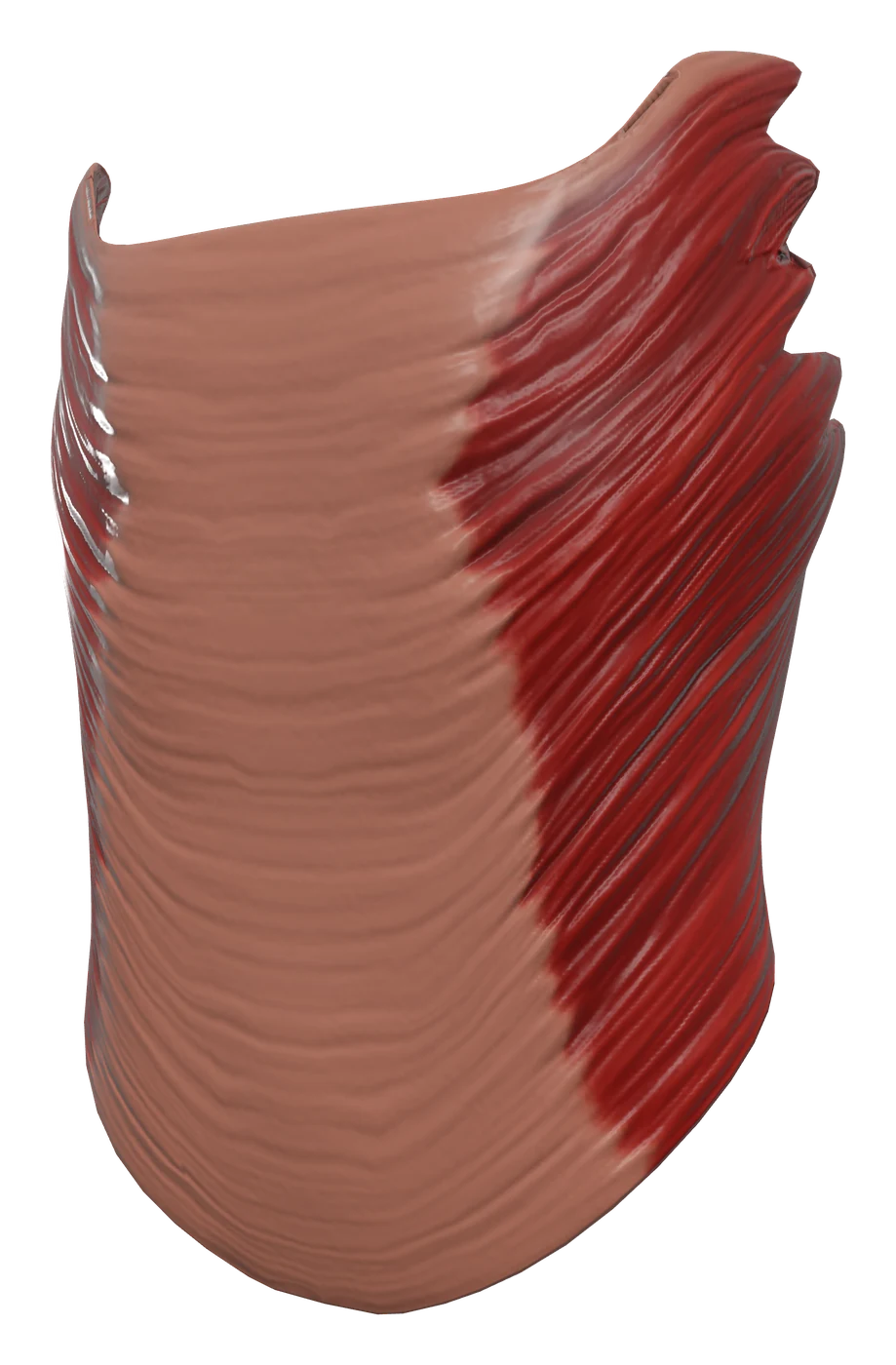
The external oblique is the largest and most superficial of the three flat muscles of the abdominal wall. Its fibres run down and forward, the direction of your fingers when you slide your hands into your front pockets.
Where it is
It covers the side and front of the abdomen. At the top, its fleshy slips interlock with those of the serratus anterior and the latissimus dorsi on the lower ribs. Towards the front, it becomes a broad aponeurosis that passes in front of the rectus abdominis to the midline. Its lower free edge, rolled between the anterior superior iliac spine and the pubic tubercle, is the inguinal ligament.
Origin and insertion
- Origin: the outer surfaces of the lower eight ribs (5 to 12).
- Insertion: the linea alba (through its aponeurosis), the pubic tubercle and the anterior half of the iliac crest.
What it does
- Flexes the trunk when both sides contract.
- Bends the trunk to the same side when one side contracts.
- Rotates the trunk to the opposite side: the right external oblique turns the chest to the left, working with the left internal oblique.
- Compresses the abdomen, for forced breathing out, coughing and straining.
Innervation and blood supply
Like the rectus, it's supplied by the thoraco-abdominal nerves (T7–T11) and the subcostal nerve (T12). Its blood comes from the lower intercostal and subcostal arteries and the epigastric arteries.
How to remember it
- External = hands in pockets; internal oblique fibres run at right angles to it.
- The inguinal ligament is simply the folded lower edge of the external oblique aponeurosis.
Frequently asked questions
Which way do the external oblique fibres run?
Down and forward (inferomedially), like hands sliding into front pockets.
What does the external oblique do?
It flexes the trunk, bends it to the same side, rotates it to the opposite side and compresses the abdomen.
Is the inguinal ligament part of the external oblique?
Yes. It's the thickened lower border of the external oblique aponeurosis.