Muscle · Trunk
Iliocostalis muscle: origin, insertion, action and innervation
The iliocostalis runs from the sacrum and iliac crest up the rib angles to C4-C6. It extends and side-bends the spine, supplied by posterior rami.
Quick answer
- Latin name
- Musculus iliocostalis
- Origin
- Common tendon of the erector spinae on the sacrum, the iliac crest of the hip bone and the lumbar spinous processes; higher parts arise from the angles of the ribs
- Insertion
- Angles of the ribs and the posterior tubercles of the transverse processes of C4–C6 (cervical vertebrae)
- Action
- Both sides: extend the vertebral column. One side: bends the trunk laterally to the same side
- Innervation
- Lateral branches of the posterior (dorsal) rami of the cervical, thoracic and lumbar spinal nerves
- Blood supply
- Posterior intercostal, subcostal and lumbar arteries; deep cervical branches in the neck
See it on the 3D body
The iliocostalis lit on the 3D back, as in the back quiz. Turn the body, peel the layers, tap any structure for its name.
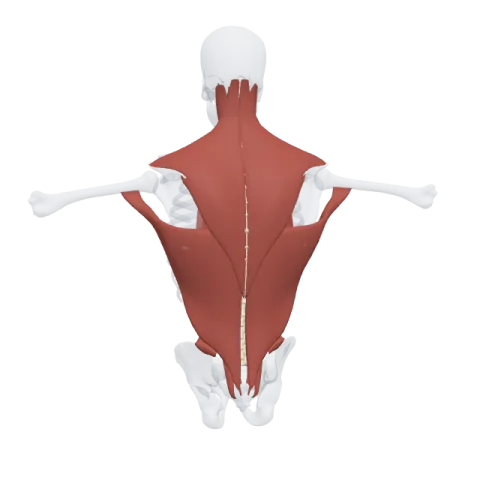
The iliocostalis is the outermost of the three columns of the erector spinae, the long muscles that hold the back upright. It runs from the pelvis up along the angles of the ribs to the neck, and it extends the spine and bends it to the side.
Where it is
The erector spinae lies in the groove on each side of the spinous processes, from the pelvis to the skull, under the latissimus dorsi, the trapezius and the rhomboids. It splits into three columns, side by side:
- Iliocostalis, the lateral column, over the angles of the ribs.
- Longissimus, the intermediate column, the largest.
- Spinalis, the medial column, against the spinous processes.
The iliocostalis is the column farthest from the midline. In the lower back it forms part of the thick muscle mass you feel on either side of the spine. Higher up it thins into a series of slips that hop from rib to rib.
Origin and insertion
The iliocostalis has three regional parts, each with its own attachments:
- Iliocostalis lumborum: from the common tendon of the erector spinae on the sacrum, the iliac crest of the hip bone and the lumbar spinous processes, to the angles of the lower six or seven ribs.
- Iliocostalis thoracis: from the angles of the lower six ribs to the angles of the upper six ribs and the transverse process of C7.
- Iliocostalis cervicis: from the angles of the third to sixth ribs to the posterior tubercles of the transverse processes of C4 to C6.
Each part overlaps the next, so the muscle forms one continuous column from the pelvis to the neck.
What it does
- Extends the vertebral column: when both sides contract, they pull the spine straight from a forward bend and hold it upright when standing.
- Bends the trunk to the side: when one side contracts, it tilts the trunk toward that side. Because it sits far from the midline and pulls on the ribs, the iliocostalis is the erector spinae column with the best leverage for side bending.
- Controls bending forward: when you lean over to pick something up, the erector spinae lengthens under tension to lower the trunk slowly, then shortens to bring it back.
Innervation and blood supply
Like the rest of the erector spinae, the iliocostalis is supplied by the posterior (dorsal) rami of the spinal nerves, through their lateral branches. The cervical part gets cervical nerves, the thoracic part thoracic nerves and the lumbar part lumbar nerves. This segmental supply marks the deep back muscles as the true (intrinsic) back muscles. The trapezius and the latissimus dorsi lie on the back too, but they move the upper limb and are supplied by other nerves.
Blood comes in segments too: posterior intercostal, subcostal and lumbar arteries along the trunk, and branches of the deep cervical and vertebral arteries in the neck.
How to remember it
- "I Love Spaghetti": Iliocostalis, Longissimus, Spinalis, from lateral to medial.
- Ilio-costal = ilium to ribs: the name gives you its lower origin (iliac crest) and its main insertion (ribs, costae in Latin).
- Rib-hopper: above the lumbar region, each slip starts on one rib angle and ends on a higher one.
- Lumborum, thoracis, cervicis: three parts, lower back, chest, neck. No capitis part: the iliocostalis never reaches the skull.
See the vertebrae it climbs on the bones of the spine page and the rib angles on the bones of the rib cage page. Test yourself in the back quiz.
Frequently asked questions
What does the iliocostalis do?
Both sides together extend the vertebral column. One side alone bends the trunk to the same side.
What are the three columns of the erector spinae?
From lateral to medial: iliocostalis, longissimus and spinalis.
What are the parts of the iliocostalis?
The iliocostalis lumborum, thoracis and cervicis, named for the lower back, the chest and the neck.
Which nerves supply the iliocostalis?
The lateral branches of the posterior rami of the cervical, thoracic and lumbar spinal nerves.
Does the iliocostalis attach to the skull?
No. Its highest fibers stop on the transverse processes of C4 to C6. The erector spinae column that clearly reaches the skull is the longissimus, through its capitis part.
