
Quick answer
- Latin name
- Ossicula auditus (malleus, incus, stapes)
- Type
- Three small bones in each middle ear, linked by synovial joints
- Location
- Middle ear (tympanic cavity), inside the temporal bone of the skull, between the eardrum and the oval window
- Joints
- Incudomallear joint (malleus-incus); incudostapedial joint (incus-stapes); tympanostapedial syndesmosis (base of the stapes in the oval window)
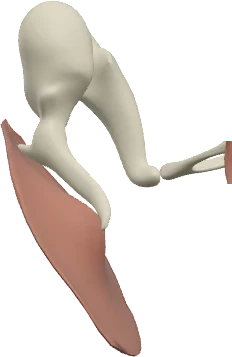
The ear has three bones on each side: the malleus, the incus and the stapes, together called the auditory ossicles. They sit in the middle ear, inside the temporal bone, and form a chain that carries vibrations from the eardrum to the inner ear. The stapes is the smallest bone in the human body.
Where the ear bones are
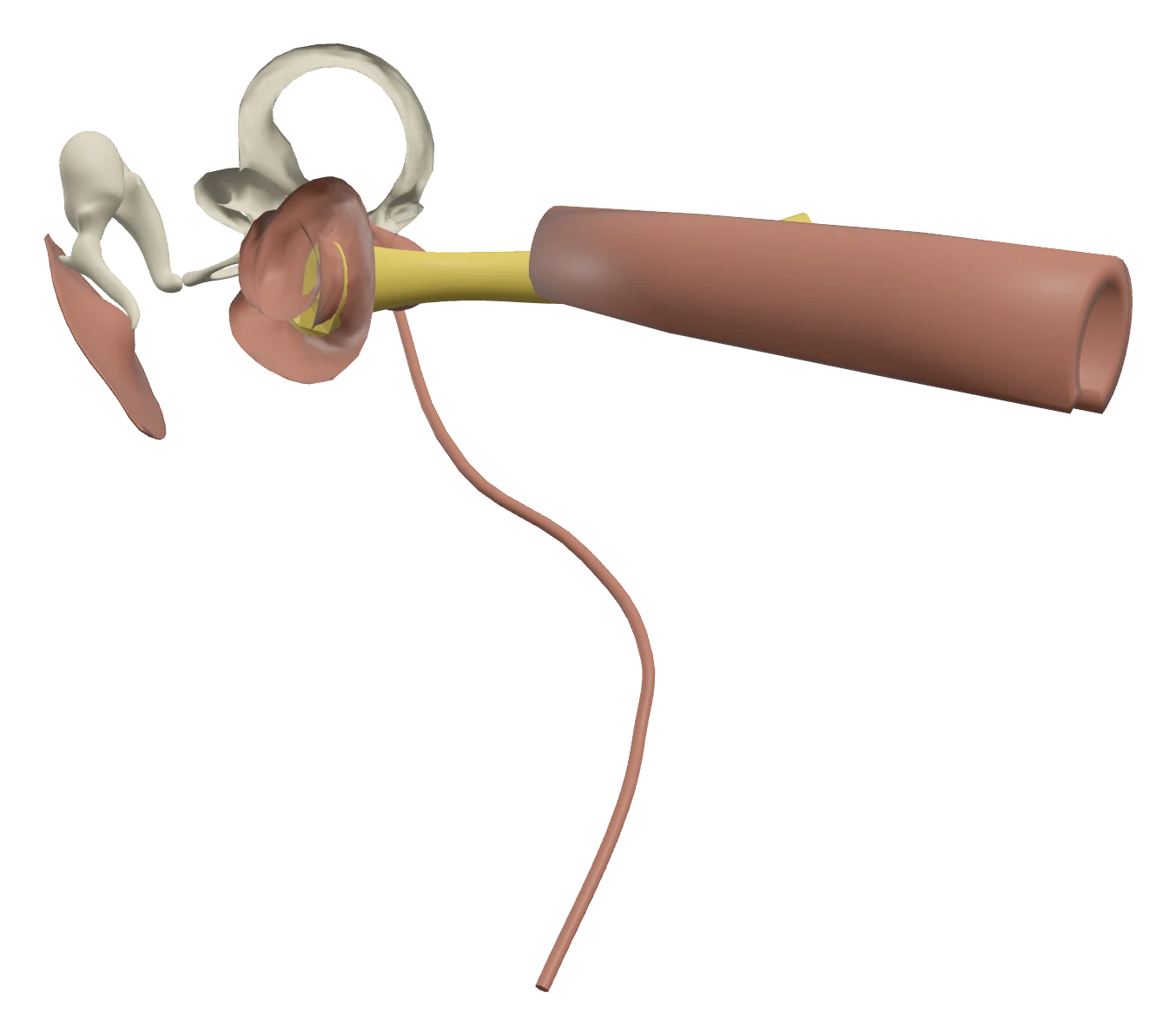
The middle ear is a small air-filled space in the temporal bone of the skull, between the eardrum on the outside and the inner ear on the inside. The three ossicles cross this space in a fixed order, from outside in:
- The malleus touches the eardrum.
- The incus sits in the middle, joined to the other two.
- The stapes ends in the oval window, the opening into the inner ear.
Small ligaments hang the chain from the walls and roof of the middle ear, so the bones can move with each sound wave. The rest of the ear, from the ear canal to the cochlea and the balance organs, is on the ear anatomy page.
| Bone | Common name | Position in the chain | Connects to |
|---|---|---|---|
| Malleus | Hammer | First, the outermost and the largest | Eardrum and incus |
| Incus | Anvil | Middle | Malleus and stapes |
| Stapes | Stirrup | Last, the innermost and the smallest | Incus and oval window |
Malleus
The malleus is named for its shape: a hammer. It is the outermost of the three bones.
- The handle (manubrium) is set into the eardrum, so the malleus moves each time the eardrum vibrates.
- Above the handle are two small projections, the lateral process and the longer anterior process, then a narrow neck.
- At the top, the malleus forms a joint with the incus. That end is the rounded head, which reaches up into a pocket above the main cavity called the epitympanic recess.
Incus
The incus, the anvil, is the middle link.
- Its body sits next to the head of the malleus, in the upper part of the middle ear.
- The short limb points backward and is tied to the back wall of the middle ear by a ligament.
- The long limb is the link to the stapes. Its tip carries a small knob, the lenticular process, bent inward to meet the stapes; from there the limb rises to the body alongside the handle of the malleus.
Stapes
The stapes looks like a stirrup and is the last bone of the chain.
- Its head meets the lenticular process of the incus. Just below it is a short neck, where the stapedius muscle attaches.
- Two limbs, anterior and posterior, run inward from the head, leaving a gap between them.
- They join the flat base, or footplate, which fills the oval window of the inner ear. A ring of fibers, the annular ligament, holds the base in the window while letting it move in and out.
When the base of the stapes pushes on the oval window, it moves the fluid inside the cochlea, which is where sound becomes a nerve signal for the brain.
Joints between the ossicles
Each link in the chain is a real joint. The malleus and the incus meet at the incudomallear joint, high in the middle ear; lower down, the tip of the incus's long limb and the head of the stapes meet at the incudostapedial joint. Both are synovial joints, with a small cavity between the bones, like the larger joints of the limbs.
The base of the stapes is not held by a synovial joint. Fibers of the annular ligament tie it to the rim of the oval window, a fibrous link called the tympanostapedial syndesmosis.
What the ear bones do
Sound makes the eardrum vibrate. The malleus moves with it, and the incus and stapes pass the motion along to the oval window. The eardrum is much larger than the oval window, so the chain gathers the force from a wide surface and delivers it onto a small one. This raises the pressure enough to set the fluid of the cochlea in motion.
Muscles of the middle ear
Two tiny muscles act on the chain. Both contract in response to loud sounds and limit how far the bones can move, a protective response called the acoustic reflex.
| Muscle | Attaches to | Nerve |
|---|---|---|
| Tensor tympani | Handle of the malleus | Branch of the mandibular nerve (trigeminal, V3), the nerve that also supplies the chewing muscles of the jaw |
| Stapedius | Neck of the stapes | Facial nerve (VII) |
When the tensor tympani shortens, the eardrum is drawn in and stiffens, so it vibrates less; the stapedius holds back the stapes so its base moves less in the oval window.
How to remember them
- Outside in: M-I-S. Malleus, Incus, Stapes, from the eardrum to the oval window.
- Hammer, anvil, stirrup. The hammer strikes the anvil, and the stirrup is the foot that steps on the oval window.
- Biggest to smallest. The malleus is the largest of the three, the stapes the smallest.
- Each muscle borrows a neighbor's nerve. The tensor tympani shares the mandibular nerve (V3) with the chewing muscles, the stapedius shares the facial nerve (VII) with the muscles of the face.
In Anatomy Atlas 3D
The app shows the malleus, incus and stapes as three separate structures on each side, with their English and Latin names. They belong to the ear: open the ear in the organ explorer, where the three bones are listed with the eardrum, the cochlea, the vestibule and canals and the nerves of hearing and balance, then turn it to follow the chain from the eardrum inward. The middle ear muscles and the ligaments are not modeled. The app is free on iPad and iPhone, with no account and no ads, and works offline.
Frequently asked questions
How many bones are in the ear?
Three in each ear, so six in total: the malleus, the incus and the stapes on each side. They are usually counted apart from the 22 bones of the skull.
What is the smallest bone in the human body?
The stapes, the innermost of the three ear bones. Its base fits into the oval window of the inner ear.
What are the ear bones called in plain English?
The hammer (malleus), the anvil (incus) and the stirrup (stapes), after their shapes.
Which ear bone is attached to the eardrum?
The malleus. Its handle is set into the eardrum and moves with it.
Which bone of the skull holds the ear bones?
The temporal bone. The middle ear, and the inner ear deeper in, sit inside its petrous part.
