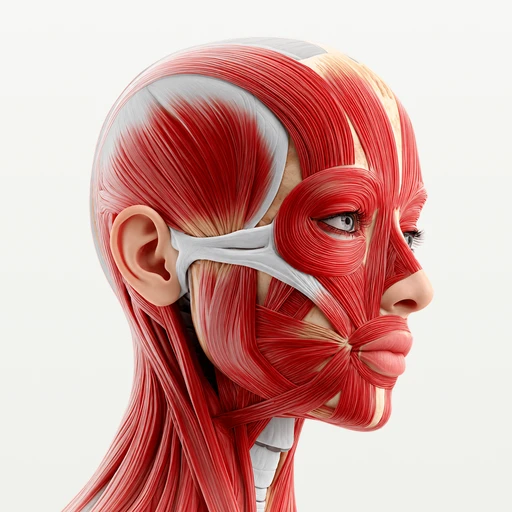
Muscle · Head and neck
Nasalis muscle: origin, insertion, action and innervation
The nasalis arises from the maxilla and spreads over the nose. Its transverse part narrows the nostril, its alar part flares it; the facial nerve supplies it.
Quick answer
- Latin name
- Musculus nasalis
- Origin
- Maxilla, beside the nasal notch, above the canine and lateral incisor teeth (part of the skull)
- Insertion
- Transverse part: an aponeurosis over the bridge of the nose, shared with the opposite muscle; alar part: the alar cartilage of the nose
- Action
- Transverse part compresses the nasal aperture; alar part draws the wing of the nose down and out, flaring the nostril
- Innervation
- Buccal branch of the facial nerve (VII)
- Blood supply
- Branches of the facial artery (superior labial and lateral nasal arteries)
See it on the 3D body
The nasalis lit on the 3D head, as in the head quiz. Turn the body, peel the layers, tap any structure for its name.
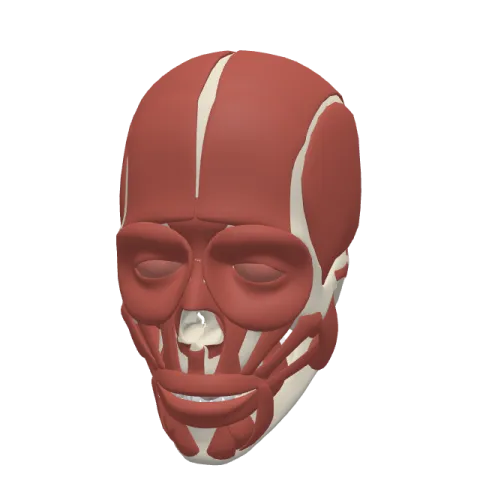
The nasalis is the main muscle of the nose, a thin muscle with two parts that start on the maxilla beside the nostril. Its transverse part narrows the opening of the nose and its alar part flares the nostril; it is supplied by the buccal branch of the facial nerve.
Where it is
The nasalis lies on the side of the nose, between the cheek and the nostril. It starts low, on the upper jaw just beside the opening of the nasal cavity, and then splits into two parts that go in different directions:
- The transverse part (sometimes called the compressor naris) sweeps upward and inward over the side of the nose. It meets the transverse part of the other side over the bridge of the nose in a thin sheet of tendon.
- The alar part (sometimes called the dilator naris) is shorter. It runs up and forward to the ala, the curved wing of the nostril.
Above the nasalis, the bridge of the nose is covered by the procerus. Lateral to it, the levator muscles of the upper lip, such as the zygomaticus minor, fan out from the cheek toward the mouth.
Origin and insertion
- Origin: the maxilla, the bone of the upper jaw, next to the nasal notch. The transverse part starts a little above and lateral to the alar part, roughly over the canine tooth; the alar part starts over the lateral incisor.
- Insertion: the transverse part ends in an aponeurosis (a flat tendon) across the bridge of the nose, continuous with the muscle of the other side. The alar part ends on the alar cartilage, the flexible cartilage that shapes the nostril.
The maxillae are facial bones of the skull. The nose itself has no bones below the nasal bones, only cartilage, which is why a small muscle like the nasalis can move it.
What it does
The two parts work against each other:
- Transverse part, compressing: it pulls the side of the nose toward the bridge, which narrows the nasal opening. You see it when someone wrinkles the side of the nose at a bad smell.
- Alar part, flaring: it pulls the ala down and outward, which widens the nostril. This happens during deep or hard breathing, for example after running, and with anger.
The flaring action helps keep the nostrils open when air is drawn in quickly. The levator labii superioris alaeque nasi also lifts the ala and adds to the flare.
Innervation and blood supply
The nasalis is supplied by the buccal branch of the facial nerve (cranial nerve VII). The buccal branches run forward across the cheek and supply the muscles around the nose and upper lip. Some textbooks add a contribution from the zygomatic branch, since the two branches often join on the face.
Its blood comes from branches of the facial artery, mainly the superior labial artery and the lateral nasal artery, which run along the side of the nose.
How to remember it
- One muscle, two jobs: the transverse part closes the door, the alar part opens it.
- Transverse goes across: its fibers cross over the bridge of the nose to meet the other side.
- Alar goes to the ala: the alar part ends on the wing of the nostril, and ala is Latin for "wing".
- Mirror test: sniff hard, then flare your nostrils. You use both parts of the nasalis in a few seconds.
See how the nasalis fits among the forehead and nose muscles on the muscles of the face page. Test yourself in the head quiz.
Frequently asked questions
What are the two parts of the nasalis?
The transverse part, which compresses the nasal opening, and the alar part, which flares the nostril.
What is the action of the nasalis muscle?
The transverse part narrows the nasal aperture and the alar part widens the nostril by pulling the ala down and out.
Which nerve supplies the nasalis?
The buccal branch of the facial nerve (VII).
Where does the nasalis originate?
On the maxilla, beside the nasal notch, above the canine and lateral incisor teeth.
Which muscle flares the nostrils?
The alar part of the nasalis, with help from the levator labii superioris alaeque nasi.
