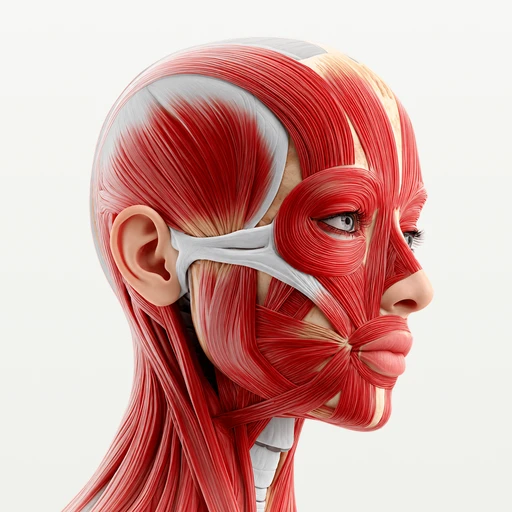
Muscle · Head and neck
Procerus muscle: origin, insertion, action and innervation
The procerus runs from the nasal bone to the skin between the eyebrows. It pulls the inner eyebrows down and creases the nose; the facial nerve supplies it.
Quick answer
- Latin name
- Musculus procerus
- Origin
- Fascia over the lower part of the nasal bone and the upper lateral nasal cartilage (nasal bones of the skull)
- Insertion
- Skin of the glabella, between the eyebrows, blending with the frontalis
- Action
- Draws the medial ends of the eyebrows downward, making transverse wrinkles over the bridge of the nose
- Innervation
- Temporal and zygomatic branches of the facial nerve (VII)
- Blood supply
- Branches of the facial artery (angular artery) and of the ophthalmic artery (dorsal nasal artery)
See it on the 3D body
The procerus lit on the 3D head, as in the head quiz. Turn the body, peel the layers, tap any structure for its name.
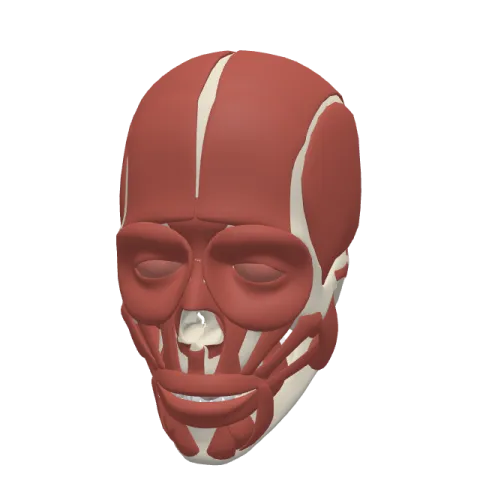
The procerus is a small, flat muscle of facial expression on the bridge of the nose, running from the nasal bone up to the skin between the eyebrows. It pulls the inner ends of the eyebrows down and makes horizontal creases across the top of the nose, and it is supplied by branches of the facial nerve.
Where it is
Look at the space between your eyebrows, just above the bridge of the nose. That smooth patch of skin is the glabella, and the procerus lies just under it. It is a thin, roughly rectangular sheet that runs vertically from the top of the nose to the lower forehead.
The procerus is usually paired, one slip on each side of the midline, although the two slips often look like a single muscle. Its neighbors are:
- the frontalis, the muscle of the forehead, which it blends with above;
- the corrugator supercilii, which lies deeper and slightly lateral, under the inner part of the eyebrow;
- the orbicularis oculi, the ring around each eye, at its sides;
- the transverse part of the nasalis, on the side of the nose below it.
Origin and insertion
- Origin: the fascia covering the lower part of the nasal bone and the upper part of the lateral nasal cartilage. The nasal bones are the two small facial bones of the skull that form the bony bridge of the nose.
- Insertion: the skin of the glabella, the area between the eyebrows, where some of its fibers merge with the frontalis.
Because it ends in skin, it moves the skin of the forehead rather than a bone. Its fibers run upward, so when they shorten they pull the skin of the lower forehead down toward the nose.
What it does
- Lowering the inner eyebrows: it draws the medial ends of the eyebrows downward.
- Wrinkling the nose bridge: as it pulls the skin down, it folds it into horizontal lines across the root of the nose.
These movements are part of frowning, of a look of concentration or disgust, and of squinting against bright sunlight. Lowering the eyebrows also shades the eyes a little.
The procerus usually works with the corrugator supercilii. The corrugators pull the eyebrows toward each other and make the vertical frown lines between them, while the procerus makes the horizontal line across the bridge. Together they form the frown between the eyes. The frontalis has the opposite effect: it lifts the eyebrows and smooths this area.
Innervation and blood supply
The procerus is supplied by the facial nerve (cranial nerve VII). Its supply is usually taught as coming from the temporal and zygomatic branches, which also reach the upper face and the orbicularis oculi. Some textbooks credit the buccal branches, which often join the zygomatic branches near the nose. In any case, it is a facial nerve muscle, like all the muscles of facial expression.
Its blood comes from small branches of the facial artery, mainly the angular artery at the side of the nose, and of the ophthalmic artery, mainly the dorsal nasal artery, which leaves the orbit at its inner corner.
How to remember it
- Procerus on the nose, corrugator on the brow: the procerus sits lower, on the bridge of the nose; the corrugator sits higher, under the eyebrow.
- Horizontal versus vertical: the procerus makes the horizontal crease across the bridge of the nose, the corrugators the vertical "11" lines between the brows.
- The opposite of the frontalis: frontalis up, procerus down.
- Squint test: face a bright window and squint. The fold that appears across the top of your nose is the procerus.
Learn the forehead and nose group on the muscles of the face page. Test yourself in the head quiz.
Frequently asked questions
What does the procerus muscle do?
It pulls the inner ends of the eyebrows down and makes horizontal wrinkles across the bridge of the nose, as in frowning or squinting.
Where is the procerus muscle?
On the bridge of the nose, between the eyebrows, running from the nasal bone to the skin of the glabella.
Which nerve supplies the procerus?
The facial nerve (VII), usually described as its temporal and zygomatic branches.
What is the difference between the procerus and the corrugator supercilii?
The procerus pulls the inner eyebrows down and creases the bridge of the nose. The corrugator supercilii pulls the eyebrows together and makes the vertical lines between them.
