
Muscle · Upper limb
Palmaris longus: origin, insertion, action and innervation
The palmaris longus runs from the humerus to the palmar aponeurosis. It flexes the wrist, is supplied by the median nerve and is missing in some people.
Quick answer
- Latin name
- Musculus palmaris longus
- Origin
- Medial epicondyle of the humerus (common flexor origin)
- Insertion
- Distal part of the flexor retinaculum and the apex of the palmar aponeurosis
- Action
- Flexes the wrist; tenses the palmar aponeurosis
- Innervation
- Median nerve (C7-C8)
- Blood supply
- Branches of the ulnar artery
See it on the 3D body
The palmaris longus lit on the 3D forearm and hand, as in the forearm and hand quiz. Turn the body, peel the layers, tap any structure for its name.
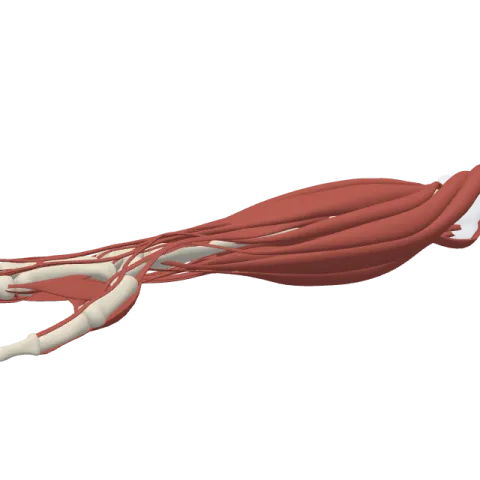
The palmaris longus is a slender superficial muscle of the front of the forearm with a short belly and a long, thin tendon that ends in the palm. It helps flex the wrist and tightens the palmar aponeurosis, it is supplied by the median nerve, and it is missing on one or both sides in some people.
Where it is
The palmaris longus belongs to the superficial layer of the anterior forearm. It lies between the flexor carpi radialis on the thumb side and the flexor carpi ulnaris on the little-finger side, on top of the flexor digitorum superficialis.
Its belly is small and stays in the upper forearm, near the elbow. From about the middle of the forearm it continues as a long, flat tendon that runs down the center of the front of the wrist. This tendon passes in front of the flexor retinaculum, not through the carpal tunnel, and fans out into the palmar aponeurosis, the tough triangular sheet under the skin of the palm.
At the wrist, the median nerve lies just behind the palmaris longus tendon and slightly toward the thumb side. This makes the tendon a useful surface landmark for locating the nerve.
It is the best-known variable muscle of the upper limb. Some people lack it on one side, some on both, and in others it has an unusual shape, for example a belly near the wrist instead of near the elbow.
Origin and insertion
- Origin: the medial epicondyle of the humerus, through the common flexor tendon it shares with the other superficial flexors.
- Insertion: the distal part of the flexor retinaculum and the apex of the palmar aponeurosis.
Unlike the other wrist flexors, it does not reach any bone of the hand. It pulls on the fibrous tissue of the palm instead.
What it does
- Flexes the wrist: it is a weak wrist flexor, helping the flexor carpi radialis and flexor carpi ulnaris.
- Tenses the palmar aponeurosis: by pulling on the sheet of fascia in the palm, it firms up the skin of the palm for gripping.
Its contribution is small, and people without it flex their wrists normally because the other flexors do the job. For the same reason, surgeons often use its tendon as a graft when another tendon needs to be rebuilt.
To check whether you have one, touch the tip of your thumb to the tip of your little finger and flex your wrist slightly. If the muscle is present, a thin tendon stands out in the middle of the front of the wrist.
Innervation and blood supply
The palmaris longus is supplied by the median nerve (C7-C8), which gives it a branch near the elbow. Its blood comes from branches of the ulnar artery.
How to remember it
- Palmaris goes to the palm: it is the one wrist flexor that ends in the palmar aponeurosis rather than on a bone.
- The optional muscle: if a forearm muscle is missing, it is usually the palmaris longus.
- Over the tunnel, nerve underneath: the tendon runs over the flexor retinaculum, with the median nerve just under it.
- Thumb to little finger: the pinch-and-flex test makes the tendon pop up in the middle of the wrist.
See how it fits between the other superficial flexors on muscles of the forearm, then test yourself in the forearm and hand quiz.
Frequently asked questions
Does everyone have a palmaris longus?
No. It is absent on one or both sides in some people. Its absence does not change normal wrist movement.
What does the palmaris longus do?
It weakly flexes the wrist and tenses the palmar aponeurosis.
How can I tell if I have a palmaris longus?
Touch your thumb tip to your little finger tip and bend your wrist slightly. A thin tendon in the middle of the wrist means the muscle is there.
Which nerve supplies the palmaris longus?
The median nerve.
Does the palmaris longus pass through the carpal tunnel?
No. Its tendon passes in front of the flexor retinaculum, outside the tunnel, while the median nerve runs inside it.
