
Muscle · Head and neck
Posterior auricular muscle: origin, insertion, action and innervation
The posterior auricular muscle runs from the mastoid process to the back of the ear. It pulls the auricle backward and is supplied by the facial nerve.
Quick answer
- Latin name
- Musculus auricularis posterior
- Origin
- Mastoid part of the temporal bone, on the outer surface of the mastoid process of the skull
- Insertion
- Back (cranial surface) of the auricle, over the concha
- Action
- Draws the auricle backward
- Innervation
- Posterior auricular branch of the facial nerve (VII)
- Blood supply
- Posterior auricular artery (from the external carotid artery)
See it on the 3D body
The posterior auricular lit on the 3D head, as in the head quiz. Turn the body, peel the layers, tap any structure for its name.
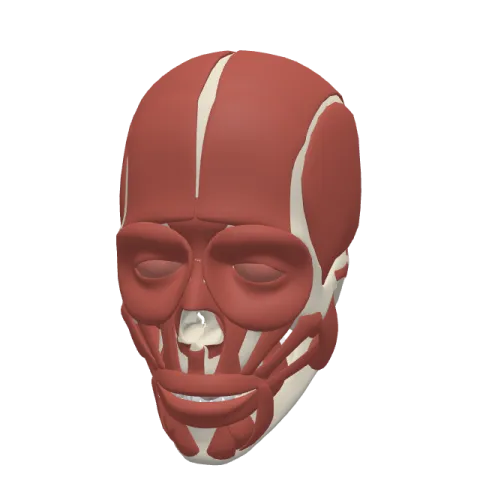
The posterior auricular muscle is a small strip of muscle behind the ear that runs from the mastoid process of the temporal bone to the back of the auricle. It draws the ear backward, a movement most people can barely make, and it is supplied by the posterior auricular branch of the facial nerve.
Where it is
Run a finger behind your earlobe and up the back of the ear. The bony bump behind it is the mastoid process, part of the temporal bone of the skull. The posterior auricular muscle lies just under the skin between that bump and the back of the ear. It is short and usually split into two or three thin bundles running side by side.
It is one of three extrinsic muscles of the auricle, the muscles that move the ear as a whole. The other two are the superior auricular muscle above the ear, the largest of the set, and the anterior auricular muscle in front of it. Of the three, only the posterior one starts on bone.
The auricle is the visible, cartilage-supported part of the outer ear. The ear page covers the parts deeper in the head.
Origin and insertion
- Origin: the outer surface of the mastoid process, on the mastoid part of the temporal bone.
- Insertion: the back of the auricle (its cranial surface, the side that faces the head), over the bulge made by the concha, the bowl of the ear.
Its fibers run almost horizontally, forward from the mastoid process to the ear. This direction explains its action: when it shortens, it pulls the ear toward the back of the head.
What it does
The posterior auricular muscle draws the auricle backward. A dog or a horse swings its ears toward a noise with muscles like this one. In humans the ear muscles are small and weak, so the movement is tiny or absent.
Some people can wiggle their ears on purpose. They do it mainly with the auricular muscles, including this one, often with the help of the scalp muscles. Even in people who cannot move their ears at all, the muscle is usually present and can be seen on dissection and in 3D models.
Like the other auricular muscles, it counts as a muscle of facial expression, because it develops from the same embryonic tissue and is supplied by the same nerve. It does not move a joint: it moves the cartilage of the ear and the skin around it.
Innervation and blood supply
The posterior auricular muscle is supplied by the posterior auricular branch of the facial nerve (cranial nerve VII). This is one of the first branches the facial nerve gives off after it leaves the skull through the stylomastoid foramen, just below the ear. It runs upward behind the ear, supplies this muscle, then continues to the occipital belly of the occipitofrontalis at the back of the scalp.
Its blood comes from the posterior auricular artery, a branch of the external carotid artery that climbs behind the ear alongside the nerve.
How to remember it
- The name gives its job: posterior auricular, behind the ear, pulls the ear back.
- Bone to ear: mastoid process behind, back of the auricle in front.
- Same name for muscle, nerve and artery: the posterior auricular muscle gets the posterior auricular branch of the facial nerve and the posterior auricular artery.
- Three around the ear: anterior pulls forward, superior pulls up, posterior pulls back.
The muscles of the face page groups the other muscles of facial expression. Test yourself in the head quiz.
Frequently asked questions
What does the posterior auricular muscle do?
It draws the auricle (the outer ear) backward. In most people the movement is very small.
Which nerve supplies the posterior auricular muscle?
The posterior auricular branch of the facial nerve (VII).
Where is the posterior auricular muscle?
Behind the ear, between the mastoid process of the temporal bone and the back of the auricle.
Why can some people wiggle their ears?
Because they can contract their auricular muscles on purpose. Almost everyone has these muscles, but in most people they are too weak or too poorly controlled to move the ear visibly.
