Muscle · Upper limb
Pronator teres: origin, insertion, action and innervation
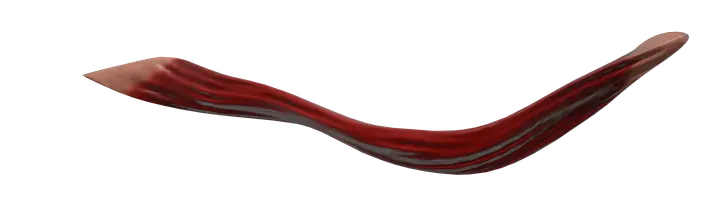
The pronator teres is a forearm muscle from the medial epicondyle and ulna coronoid process to the radius. It pronates the forearm (median nerve).
Quick answer
- Latin name
- Musculus pronator teres
- Origin
- Humeral head: medial epicondyle of the humerus (common flexor origin). Ulnar head: coronoid process of the ulna
- Insertion
- Middle of the lateral surface of the radius (pronator tuberosity)
- Action
- Pronates the forearm (turns the palm down); assists flexion of the elbow
- Innervation
- Median nerve (C6–C7)
- Blood supply
- Branches of the ulnar artery (including the anterior ulnar recurrent artery) and of the radial artery
See it on the 3D body
The pronator teres lit on the 3D arm and elbow, as in the arm and elbow quiz. Turn the body, peel the layers, tap any structure for its name.
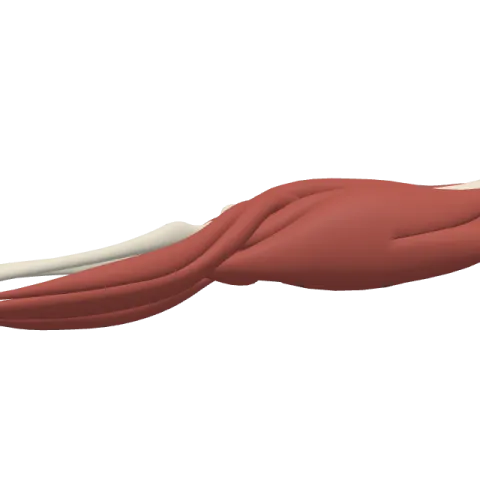
The pronator teres is a short, rounded muscle at the front of the elbow that runs obliquely from the medial epicondyle of the humerus to the middle of the radius. It turns the palm to face down (pronation), helps bend the elbow and is supplied by the median nerve.
Where it is
The pronator teres is the most lateral muscle of the superficial layer of the anterior forearm, the one closest to the thumb side. It starts on the inner side of the elbow and crosses the front of the forearm diagonally, downward and outward, to reach the radius about halfway down. Its name describes it: pronator (turns the palm down) and teres (Latin for "rounded").
It forms the medial border of the cubital fossa, the triangular hollow at the front of the elbow. The brachioradialis forms the lateral border, and a line between the two epicondyles of the humerus forms the top. The tendon of the biceps brachii, the brachial artery and the median nerve all lie inside this hollow.
The muscle has two heads. The median nerve passes between them to enter the forearm, and the ulnar artery passes deep to the smaller ulnar head. This makes the pronator teres a landmark for finding both structures.
Origin and insertion
- Humeral head: the medial epicondyle of the humerus through the common flexor tendon, and the ridge just above it (the medial supracondylar ridge).
- Ulnar head: the medial side of the coronoid process of the ulna, the hook of bone at the front of the elbow.
- Insertion: the middle of the lateral surface of the radius, at a rough area called the pronator tuberosity. This is the point where the radius curves out the most, which gives the muscle good leverage to rotate the bone.
What it does
- Pronation of the forearm: it pulls the radius across the front of the ulna, turning the palm to face backward (in the anatomical position) or down (with the elbow bent). The ulna stays almost still while the radius rolls around it at the elbow and swings over it at the wrist.
- Weak flexion of the elbow: because it crosses the front of the elbow joint, it helps bend the elbow, especially against resistance.
The forearm has two pronators. The pronator quadratus, a small square muscle deep at the wrist, is the main pronator in everyday, unhurried movements. The pronator teres joins in when the movement is fast or meets resistance, as when you turn a screwdriver to undo a screw (for a right-handed person), pour water out of a jug or dribble a basketball.
Its antagonists are the supinator and the biceps brachii, which turn the palm back up. The biceps is a powerful supinator when the elbow is bent, which is why it is easier to tighten a screw than to undo it with the right hand.
Innervation and blood supply
The pronator teres is supplied by the median nerve (roots C6 and C7). The nerve gives its branch to the muscle near the elbow, just before passing between the two heads. The median nerve supplies most of the muscles of the anterior forearm; only the flexor carpi ulnaris and the medial half of the flexor digitorum profundus are supplied by the ulnar nerve.
Its blood comes from branches of the ulnar artery, including the anterior ulnar recurrent artery, and from branches of the radial artery.
How to remember it
- Pronation = "pouring soup": turning a bowl over to pour it out is pronation. Supination is holding the soup in your palm.
- Teres = round, like the teres major and teres minor at the shoulder.
- First in line: from the thumb side, the superficial flexors are pronator teres, flexor carpi radialis, palmaris longus and flexor carpi ulnaris (P, F, P, F). See the flexor carpi ulnaris at the other end of the row.
- Median nerve through the middle: the median nerve passes through the middle of the pronator teres, between its two heads.
The muscles of the forearm page covers both pronators and the rest of the anterior compartment.
Frequently asked questions
What is the action of the pronator teres?
It pronates the forearm, turning the palm down, and weakly helps flex the elbow.
Where does the pronator teres insert?
On the middle of the lateral surface of the radius, at the pronator tuberosity.
Which nerve supplies the pronator teres?
The median nerve, from roots C6 and C7. The nerve passes between the two heads of the muscle.
What is the difference between the pronator teres and the pronator quadratus?
The pronator teres is a long, oblique muscle near the elbow that also flexes the elbow. The pronator quadratus is a small square muscle near the wrist and is the main pronator in most everyday movements.
What forms the borders of the cubital fossa?
The pronator teres on the medial side, the brachioradialis on the lateral side and a line between the two epicondyles of the humerus at the top.
