Radius: anatomy, landmarks and muscle attachments
The radius is the lateral bone of the forearm, on the thumb side. Learn its head, radial tuberosity and styloid process, how it rotates around the ulna in pronation and supination, and its muscle attachments.
Quick answer
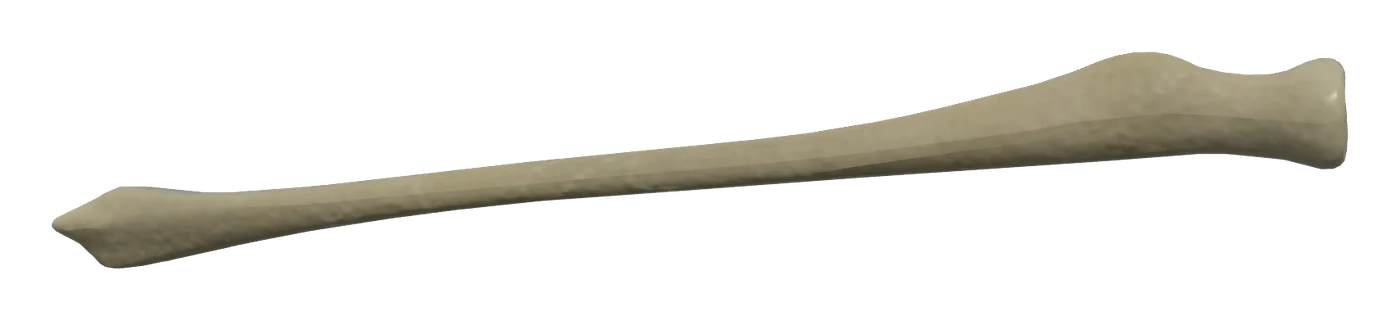
The radius is the forearm bone on the thumb side. It's narrow at the elbow and wide at the wrist, the opposite of the ulna, and it's the bone that turns when you rotate your forearm.
Upper end
- The disc-shaped head spins against the capitulum of the humerus and within the ring of the annular ligament, against the radial notch of the ulna.
- Below the neck, the radial tuberosity receives the tendon of the biceps brachii, which is why the biceps supinates the forearm.
Shaft
The sharp interosseous border faces the ulna and anchors the interosseous membrane, which links the two bones and transmits force from the hand to the elbow.
Lower end
- The wide lower end forms most of the wrist joint with the carpal bones.
- The styloid process projects on the lateral side; the brachioradialis inserts just above it.
- The ulnar notch on the medial side articulates with the head of the ulna.
Pronation and supination
In supination (palm up), the radius and ulna lie side by side. In pronation (palm down), the radius crosses over the ulna, rotating at both radio-ulnar joints while the ulna stays still.
Frequently asked questions
Which side of the forearm is the radius on?
The lateral side, in line with the thumb.
What attaches to the radial tuberosity?
The tendon of the biceps brachii.
What is the most common radius fracture?
A fracture of the lower end of the radius after a fall on an outstretched hand, often called a Colles fracture when the fragment tilts backward.