
Muscle · Head and neck
Risorius muscle: origin, insertion, action and innervation
The risorius runs from the fascia over the parotid gland and masseter to the corner of the mouth. It pulls the mouth sideways; the facial nerve supplies it.
Quick answer
- Latin name
- Musculus risorius
- Origin
- Fascia over the parotid gland and the masseter; sometimes slips from the platysma
- Insertion
- Skin and muscle at the angle of the mouth (the modiolus)
- Action
- Draws the angle of the mouth laterally
- Innervation
- Buccal branch of the facial nerve (VII)
- Blood supply
- Branches of the facial artery, mainly the superior labial artery
See it on the 3D body
The risorius lit on the 3D head, as in the head quiz. Turn the body, peel the layers, tap any structure for its name.
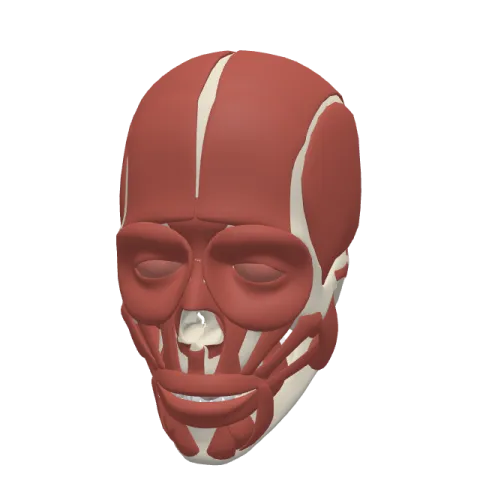
The risorius is a thin, narrow muscle of facial expression that runs across the cheek from the fascia over the parotid gland to the corner of the mouth. It pulls the corner of the mouth straight out to the side, as in a tight-lipped grin, and it is supplied by the buccal branch of the facial nerve.
Where it is
The risorius lies just under the skin of the lower cheek, at about the level of the corner of the mouth. It runs almost horizontally, from the side of the face, over the masseter, forward to the angle of the mouth.
It is one of the most variable muscles of the face. In some people it is a clear band of fibers; in others it is a few thin strands, and in some it is missing on one or both sides. It is often hard to separate from the platysma, the broad sheet of muscle in the neck, whose upper fibers reach the same area.
Its neighbors at the corner of the mouth:
- the zygomaticus major, coming down from the cheekbone above it;
- the depressor anguli oris, coming up from the jaw below it;
- the buccinator, deeper, in the wall of the cheek;
- the orbicularis oris, the ring of the lips, which all of these join.
Origin and insertion
- Origin: the fascia over the parotid gland and over the masseter, on the side of the face in front of the ear. Some fibers may come from the platysma or from the fascia over the zygomatic arch.
- Insertion: the skin and muscle at the angle of the mouth, in the knot of fibers called the modiolus.
Unlike most of the facial muscles, the risorius does not usually start on bone. It runs from one soft layer, the fascia, to another, the skin, and it moves only the skin and the corner of the mouth.
What it does
The risorius pulls the angle of the mouth laterally, straight toward the ear. This stretches the lips and flattens them against the teeth.
On its own, this movement does not make a real smile. A smile lifts the corners of the mouth upward, which is the work of the zygomaticus major. The risorius makes the mouth wider instead of higher: the strained, closed-lip grin of an awkward photo, the grimace of effort or pain, or the face of someone gritting their teeth. When both actions combine, the corners go both up and out.
Innervation and blood supply
The risorius is supplied by the buccal branch of the facial nerve (cranial nerve VII). The buccal branches run forward across the masseter and the cheek, right along the path of the risorius, and supply the muscles around the mouth.
Small branches of the facial artery supply it, chiefly the superior labial artery, which starts near the corner of the mouth where the risorius ends.
How to remember it
- ***Risus* = laughter**: the name comes from the Latin word for laughter, even though the risorius makes a grimace more than a laugh.
- Out, not up: risorius pulls the corner of the mouth sideways; zygomaticus major pulls it up and out.
- The muscle that may not be there: if a dissection or an atlas shows no risorius, it is not necessarily an error. The muscle is often small or absent.
- Grit-your-teeth test: clench your teeth and stretch your lips wide without smiling. The pull toward your ears is the risorius.
See how the mouth muscles converge on the modiolus on the muscles of the face page. Test yourself in the head quiz.
Frequently asked questions
What does the risorius muscle do?
It draws the corner of the mouth laterally, toward the ear, widening the mouth without lifting it.
Which nerve supplies the risorius?
The buccal branch of the facial nerve (VII).
Does everyone have a risorius muscle?
No. It is one of the most variable face muscles. It can be well developed, thin or absent on one or both sides.
Is the risorius the smiling muscle?
Not really. The main smiling muscle is the zygomaticus major, which lifts the corners of the mouth. The risorius only pulls them sideways.
