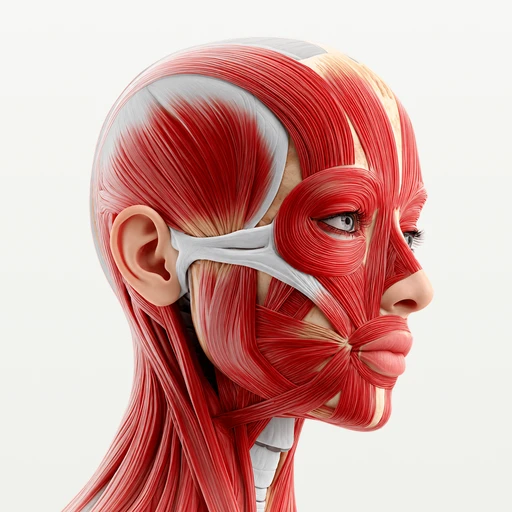
Muscle · Head and neck
Zygomaticus major: origin, insertion, action and innervation
The zygomaticus major runs from the zygomatic bone to the corner of the mouth. It pulls the mouth up and out to smile and is supplied by the facial nerve.
Quick answer
- Latin name
- Musculus zygomaticus major
- Origin
- Lateral surface of the zygomatic bone, in front of the zygomaticotemporal suture (part of the skull)
- Insertion
- Angle of the mouth (the modiolus), blending with the orbicularis oris
- Action
- Draws the angle of the mouth upward and laterally, as in smiling and laughing
- Innervation
- Zygomatic and buccal branches of the facial nerve (VII)
- Blood supply
- Branches of the facial artery, mainly the superior labial artery
See it on the 3D body
The zygomaticus major lit on the 3D head and neck muscles, as in the head and neck muscles quiz. Turn the body, peel the layers, tap any structure for its name.
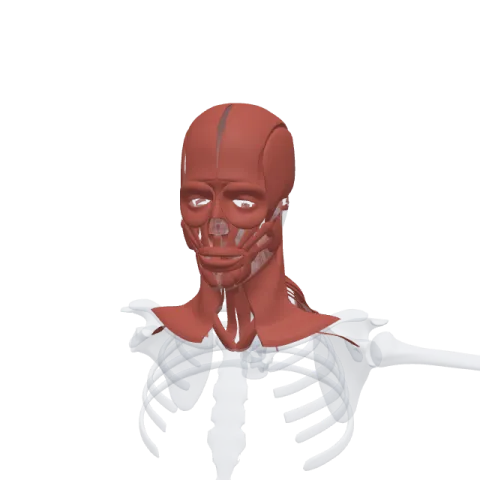
The zygomaticus major is the main smiling muscle, a slender band that runs diagonally across the cheek from the cheekbone to the corner of the mouth. It pulls the corner of the mouth upward and outward, and it is supplied by the zygomatic and buccal branches of the facial nerve.
Where it is
Put a finger on the most prominent point of your cheekbone, then draw a line down and forward to the corner of your mouth. That line follows the zygomaticus major. It is a narrow, ribbon-like muscle lying in the fat of the cheek just under the skin.
On its way, it crosses over several deeper structures: the masseter, the buccinator and the facial vessels. It sits lateral to its smaller partner, the zygomaticus minor, which starts just in front of it on the same bone but runs to the upper lip instead of the corner of the mouth.
Around the corner of the mouth, it meets:
- the levator anguli oris, deeper, which also lifts the corner;
- the risorius, coming in horizontally from the side;
- the orbicularis oris, the ring of the lips, which they all blend into at the modiolus.
Origin and insertion
- Origin: the lateral surface of the zygomatic bone, the cheekbone, just in front of the suture where it joins the zygomatic process of the temporal bone. The zygomatic bones are facial bones of the skull.
- Insertion: the angle of the mouth, where its fibers join the modiolus and blend with the orbicularis oris and the levator anguli oris.
So it runs from bone above to skin and muscle below, which lets it lift the corner of the mouth toward the cheekbone.
What it does
The zygomaticus major draws the angle of the mouth upward and laterally. This is the core movement of a smile and of laughter. Pulling on the corner of the mouth also lifts the cheek and deepens the nasolabial fold, the crease from the side of the nose to the corner of the mouth.
A smile involves more than this one muscle. The levators of the upper lip and the zygomaticus minor raise the upper lip and show the upper teeth. In a spontaneous, felt smile, the orbital part of the orbicularis oculi also contracts, lifting the cheeks and narrowing the eyes. This combination is known as the Duchenne smile, after Guillaume Duchenne de Boulogne, a 19th-century French neurologist who studied facial expressions by stimulating the face muscles with electricity. A polite smile often uses the zygomaticus major with little or no help from the eye.
Innervation and blood supply
The zygomaticus major is supplied by the zygomatic and buccal branches of the facial nerve (cranial nerve VII). Both branches cross the cheek from the parotid gland toward the nose and mouth, and they often connect with each other along the way. When the facial nerve is weak on one side, that corner of the mouth droops and the smile becomes lopsided.
Its blood comes from branches of the facial artery, mainly the superior labial artery, which runs along the upper lip from the corner of the mouth.
How to remember it
- Zygoma = cheekbone: the zygomaticus major starts on the zygomatic bone.
- Major goes to the corner, minor goes to the lip: the bigger muscle lifts the corner of the mouth, the smaller one lifts the upper lip.
- Draw the line: cheekbone to mouth corner, down and forward. That diagonal is the direction of pull.
- Smile in a mirror: the corners of your mouth move toward your cheekbones. You are pulling them along the zygomaticus major.
The muscles of the face page maps the fan of muscles above the mouth. Test yourself in the head quiz.
Frequently asked questions
What is the action of the zygomaticus major?
It draws the angle of the mouth upward and laterally, the main movement of smiling.
Which nerve supplies the zygomaticus major?
The zygomatic and buccal branches of the facial nerve (VII).
Where does the zygomaticus major originate and insert?
It starts on the lateral surface of the zygomatic bone and inserts at the angle of the mouth.
What is the difference between the zygomaticus major and minor?
The major is larger and lateral, and it lifts the corner of the mouth. The minor is smaller and medial, and it lifts the upper lip.
Which muscles make a real smile?
Mainly the zygomaticus major, with the muscles that lift the upper lip and, in a genuine smile, the orbicularis oculi around the eyes.
