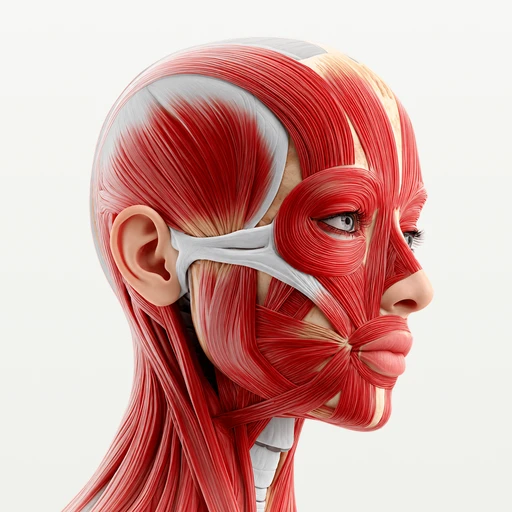
Muscle · Head and neck
Orbicularis oris: origin, insertion, action and innervation
The orbicularis oris is the ring of muscle in the lips, anchored on the maxilla and mandible. It closes and purses the lips and is supplied by the facial nerve.
Quick answer
- Latin name
- Musculus orbicularis oris
- Origin
- Maxilla and mandible near the midline, and fibers from the other muscles that converge on the corners of the mouth
- Insertion
- Skin and mucous membrane of the lips
- Action
- Closes the lips, presses them against the teeth and protrudes (purses) them
- Innervation
- Buccal and marginal mandibular branches of the facial nerve (VII)
- Blood supply
- Superior and inferior labial arteries (from the facial artery)
See it on the 3D body
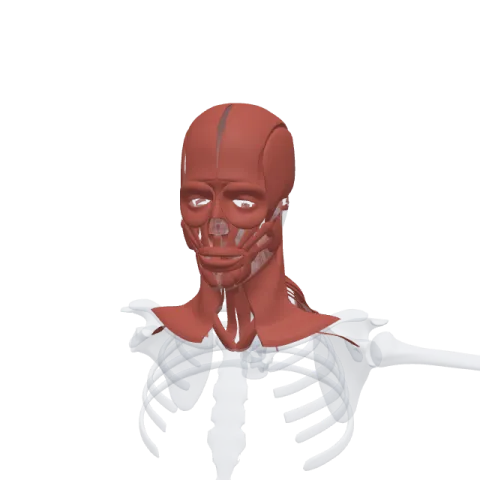
The orbicularis oris lit on the 3D head and neck muscles, as in the head and neck muscles quiz. Turn the body, peel the layers, tap any structure for its name.
The orbicularis oris is the ring of muscle that forms most of the substance of the lips and encircles the mouth. It closes the lips and purses them, for speaking, kissing, whistling or drinking through a straw, and it is supplied by the buccal and marginal mandibular branches of the facial nerve.
Where it is
If you could peel away the skin of the lips, you would find a thick band of muscle running around the mouth opening, between the skin on the outside and the mucous membrane on the inside. That band is the orbicularis oris. It reaches from the base of the nose down to the groove above the chin.
It is not a simple closed ring. Many of the muscles that move the lips run into it:
- From above, the levator muscles of the upper lip and the zygomaticus major and zygomaticus minor.
- From the side, the buccinator, the muscle of the cheek, and the risorius.
- From below, the depressor muscles of the lower lip and corner of the mouth.
Many of these fibers meet just outside each corner of the mouth, in a firm knot called the modiolus. You can feel it by pinching the skin beside the corner of your mouth. Below the lower lip, the mentalis lifts the chin and pushes the lip forward.
Origin and insertion
Because it is a sphincter, the orbicularis oris has no single origin and insertion in the usual sense. Textbooks describe it this way:
- Origin: small slips attached to the maxilla and the mandible near the midline, close to the incisor teeth, plus fibers that come in from the buccinator and the other muscles at the modiolus.
- Insertion: the skin and mucous membrane of the lips, with some fibers crossing the midline to the other side.
Anatomists divide it into a marginal part, under the red edge of the lips, and a labial part, which spreads outward toward the nose and the chin.
What it does
- Closing the mouth: it brings the upper and lower lips together and keeps them sealed, holding food and saliva in the mouth.
- Pressing the lips on the teeth: with the buccinator, it keeps food on the chewing surfaces of the teeth.
- Pursing and protruding: it pushes the lips forward into a rounded shape, as when you kiss, whistle, blow out a candle or play a wind instrument.
- Shaping speech: it forms the sounds made with the lips, such as "p", "b", "m" and the rounded vowels.
A baby uses it to seal the lips around the nipple or bottle while feeding.
Innervation and blood supply
The orbicularis oris is supplied by the buccal branches of the facial nerve (cranial nerve VII), which reach mainly the upper lip, and the marginal mandibular branch, which reaches the lower lip. Damage to the marginal mandibular branch weakens the lower lip on that side.
Its blood comes from the superior and inferior labial arteries, branches of the facial artery. The labial arteries of the two sides join in the midline and form a ring of arteries within the lips.
How to remember it
- Two rings on the face: orbicularis oculi goes around the eye, orbicularis oris around the mouth (os, oris = mouth).
- The rim of the wheel: picture a bicycle wheel. The orbicularis oris is the rim, and the other lip muscles are the spokes that pull it up, down and sideways.
- Two branches for two lips: buccal for the upper lip, marginal mandibular for the lower.
- Straw test: suck through a straw or blow out a candle. The firm ring around your mouth is the orbicularis oris.
See all the lip muscles together on the muscles of the face page, and test yourself in the head quiz.
Frequently asked questions
What is the action of the orbicularis oris?
It closes the lips, presses them against the teeth and protrudes them, as in pursing the lips.
Which nerve supplies the orbicularis oris?
The facial nerve (VII), through its buccal and marginal mandibular branches.
Is the orbicularis oris a sphincter?
Yes. It encircles the mouth and closes it, so it works as the sphincter of the mouth.
What is the modiolus?
A small knot of muscle fibers just outside each corner of the mouth, where the orbicularis oris meets the buccinator and several other face muscles.
