
Muscle · Upper limb
Teres minor: origin, insertion, action and innervation
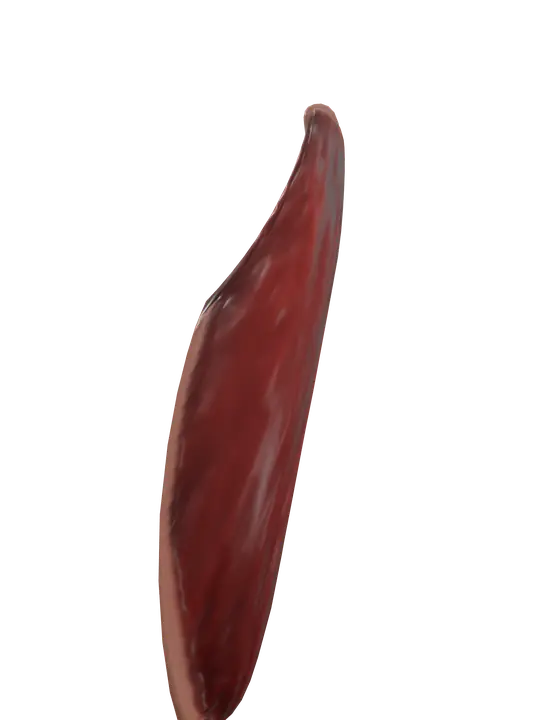
The teres minor is a rotator cuff muscle from the lateral scapula to the greater tubercle of the humerus. It laterally rotates the arm (axillary nerve).
Quick answer
- Latin name
- Musculus teres minor
- Origin
- Upper two thirds of the lateral border of the scapula, on its back surface
- Insertion
- Inferior facet of the greater tubercle of the humerus
- Action
- Laterally rotates the arm; holds the head of the humerus in the glenoid cavity; weakly adducts the arm
- Innervation
- Axillary nerve (C5–C6)
- Blood supply
- Circumflex scapular artery and posterior circumflex humeral artery
See it on the 3D body
The teres minor lit on the 3D shoulder, as in the shoulder quiz. Turn the body, peel the layers, tap any structure for its name.
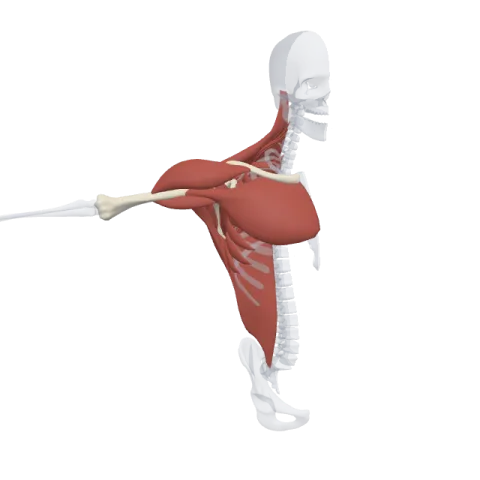
The teres minor is a small, cylindrical rotator cuff muscle that runs from the outer edge of the shoulder blade to the back of the humerus. It helps the infraspinatus turn the arm outward and holds the head of the humerus in the shoulder socket.
Where it is
The teres minor lies on the back of the shoulder, along the lateral border of the scapula, the edge that faces the armpit. It sits just below the infraspinatus, and the two are often partly fused. Most of it is hidden under the back of the deltoid.
Its name is descriptive: teres is Latin for "rounded" or "smooth", and minor sets it apart from the teres major, a bigger, separate muscle that lies just below it. The long head of the triceps passes between the two teres muscles, and this arrangement creates two small gaps that anatomy students learn to name:
- The quadrangular space, bounded by the teres minor above, the teres major below, the long head of the triceps on the inside and the humerus on the outside. The axillary nerve and the posterior circumflex humeral artery pass through it.
- The triangular space, bounded by the teres minor, the teres major and the long head of the triceps. The circumflex scapular artery runs through it to the back of the scapula.
Origin and insertion
- Origin: the upper two thirds of the lateral border of the scapula, on its back (dorsal) surface.
- Insertion: the inferior facet of the greater tubercle of the humerus, the lowest of the three facets used by the rotator cuff, and the back of the shoulder joint capsule.
Its tendon passes behind the shoulder joint and blends with the capsule, adding support to the back of the joint together with the infraspinatus tendon.
What it does
- Lateral rotation of the arm: it turns the humerus outward. It works as a partner of the infraspinatus, which is the larger and stronger lateral rotator, and of the posterior fibers of the deltoid.
- Stabilizing the shoulder: as a rotator cuff muscle, it pulls the head of the humerus into the glenoid cavity and stops it from gliding upward or backward when the larger shoulder muscles contract.
- Weak adduction: because it runs below the joint, it can help bring the arm toward the body, a minor role.
In practice, the teres minor works whenever you rotate the arm outward against resistance: pulling a bowstring back with the elbow out, combing the back of your hair or bringing the arm back before a throw.
Innervation and blood supply
The teres minor is supplied by the axillary nerve (roots C5 and C6), from the posterior cord of the brachial plexus. This is a key exam fact: it is the only rotator cuff muscle that is not supplied by the suprascapular or subscapular nerves. The axillary nerve passes through the quadrangular space, gives a branch to the teres minor, then winds around the surgical neck of the humerus to supply the deltoid.
Its blood comes from the circumflex scapular artery, which runs through the triangular space, and the posterior circumflex humeral artery, which travels with the axillary nerve.
How to remember it
- SITS: Supraspinatus, Infraspinatus, Teres minor, Subscapularis. The teres minor is the T.
- "Minor is in the cuff, major is not": the teres minor belongs to the rotator cuff; the teres major is a separate muscle that rotates the arm the other way.
- The teres minor shares its nerve with the deltoid: the axillary nerve gives the teres minor and the deltoid their motor supply.
- On the greater tubercle: S at the top, I in the middle, T at the bottom.
Compare it with the supraspinatus and the other cuff muscles on the muscles of the shoulder page.
Frequently asked questions
Is the teres minor part of the rotator cuff?
Yes. It is one of the four rotator cuff muscles, with the supraspinatus, the infraspinatus and the subscapularis. The teres major is not.
What is the action of the teres minor?
It laterally rotates the arm at the shoulder and helps hold the head of the humerus in the glenoid cavity. It also weakly adducts the arm.
Which nerve supplies the teres minor?
The axillary nerve, from roots C5 and C6. It is the only rotator cuff muscle supplied by this nerve.
What is the difference between the teres minor and the teres major?
The teres minor is a rotator cuff muscle that inserts on the greater tubercle and rotates the arm outward. The teres major lies below it, inserts on the front of the humerus and rotates the arm inward.
What passes through the quadrangular space?
The axillary nerve and the posterior circumflex humeral artery. The teres minor forms the upper boundary of this space.
