
Quick answer
- System
- Digestive system (accessory organs)
- Location
- Upper abdomen, the liver on the right under the diaphragm and the pancreas behind the stomach
- Function
- Make bile and digestive enzymes, process nutrients and help control blood sugar
- Parts in the app
- 6
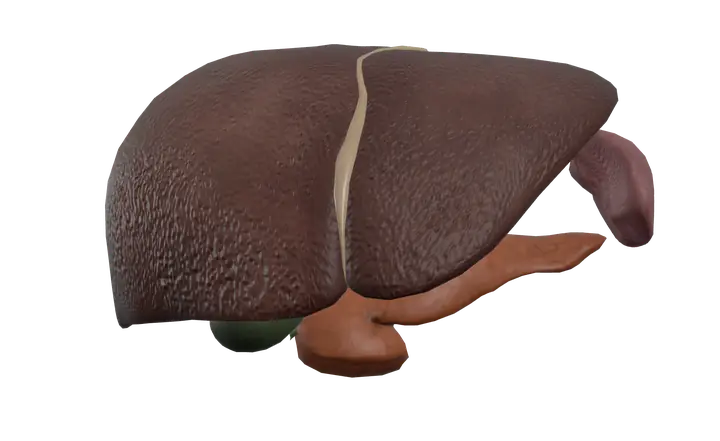
The liver and the pancreas are the two great glands of the digestive system. Food never passes through them, but the stomach and intestines could not digest it without the bile and enzymes they send into the duodenum. The pancreas is also an endocrine gland that helps control blood sugar. The app groups them with the gallbladder, the bile duct and the spleen, their neighbors in the upper abdomen.
Where it is
- The liver lies in the upper right part of the abdomen, tucked under the diaphragm and protected by the lower ribs. It is the largest gland in the body and extends across the midline toward the left.
- The gallbladder is a small pear-shaped sac in a hollow on the underside of the liver.
- The pancreas lies across the back wall of the abdomen, behind the stomach. Its head sits in the C-shaped curve of the duodenum, and its body and tail stretch to the left toward the spleen.
- The spleen sits in the upper left part of the abdomen, behind the stomach and under the diaphragm, protected by the lower left ribs.
In front, these organs are covered by the abdominal wall and muscles such as the rectus abdominis.
Parts you can explore in the app
In the app you can open these organs on their own and study them part by part:
- Liver: a large, wedge-shaped organ that makes bile and processes nutrients arriving from the intestines.
- Falciform ligament: a thin fold of peritoneum that attaches the front of the liver to the diaphragm and the front abdominal wall, and marks the division between the right and left lobes as seen from the front.
- Gallbladder: stores bile and concentrates it between meals.
- Bile duct: carries bile from the liver and gallbladder down to the duodenum.
- Pancreas: a long, soft gland that makes digestive enzymes and the hormones insulin and glucagon.
- Spleen: an organ of the lymphatic system that filters the blood and removes old red blood cells.
Cross sections (sagittal, coronal and axial) let you see how these organs sit together, which is far easier to understand in 3D than on a flat drawing.
What it does
The liver has many jobs. It makes bile, which helps digest fats. It receives blood from the digestive tract through the hepatic portal vein, so it is the first organ to process absorbed nutrients: it stores glucose as glycogen, makes plasma proteins such as albumin and clotting factors, and breaks down drugs, alcohol and other substances. It also stores some vitamins and iron, and gets rid of bilirubin, a product of old red blood cells, by releasing it in bile. The liver has a double blood supply: the hepatic portal vein brings nutrient-rich blood, and the hepatic artery brings oxygen-rich blood.
The gallbladder stores bile between meals and concentrates it by removing water. When fatty chyme reaches the duodenum, a hormone signals the gallbladder to contract and squeeze bile into the bile duct.
Bile does not contain digestive enzymes. Its bile salts break large fat droplets into tiny ones, so that enzymes have far more surface to work on. This is called emulsification.
The pancreas does two things:
- As an exocrine gland, its acinar cells make pancreatic juice: enzymes that digest proteins, carbohydrates, fats and nucleic acids, and bicarbonate that neutralizes the acid arriving from the stomach. The pancreatic duct joins the bile duct, and they open together into the duodenum.
- As an endocrine gland, small clusters of cells called pancreatic islets release hormones into the blood. Beta cells make insulin, which lowers blood glucose; alpha cells make glucagon, which raises it.
The spleen is not a digestive organ. It filters blood, removes worn-out red blood cells and recycles their iron, and houses white blood cells that respond to microbes carried in the blood.
How to study it
- Trace the path of bile. Liver cells, right and left hepatic ducts, common hepatic duct, joined by the cystic duct from the gallbladder to form the bile duct, which meets the pancreatic duct and opens into the duodenum.
- Head, neck, body, tail. The four parts of the pancreas, from the duodenum to the spleen.
- Exocrine versus endocrine. Exocrine secretions go into ducts (enzymes, bicarbonate); endocrine secretions go into the blood (insulin, glucagon). The pancreas does both, which makes it a favorite exam question.
- Insulin lowers, glucagon raises. A quick way to remember: insulin lets glucose in to cells.
- Don't file the spleen under digestion. It belongs to the lymphatic system even though it lives next to the stomach and pancreas.
- Use the axial section through the upper abdomen to see the liver on the right, the stomach and spleen on the left, and the pancreas lying across the back between them.
Frequently asked questions
What does the liver do?
It makes bile, processes and stores nutrients from digestion, makes plasma proteins, and breaks down drugs, alcohol and other substances.
Is the pancreas an endocrine or an exocrine gland?
Both. Most of it makes digestive enzymes that drain into the duodenum, while the pancreatic islets release insulin and glucagon into the blood.
What does the gallbladder do?
It stores and concentrates bile made by the liver, then releases it into the duodenum after a meal, especially a fatty one.
Is the spleen part of the digestive system?
No. The spleen is part of the lymphatic and immune systems. It filters the blood and removes old red blood cells.