
Quick answer
- System
- Digestive system
- Location
- From the mouth to the anus, with the stomach and intestines filling most of the abdomen
- Function
- Breaks food down, absorbs nutrients and water, and eliminates waste
- Parts in the app
- 6
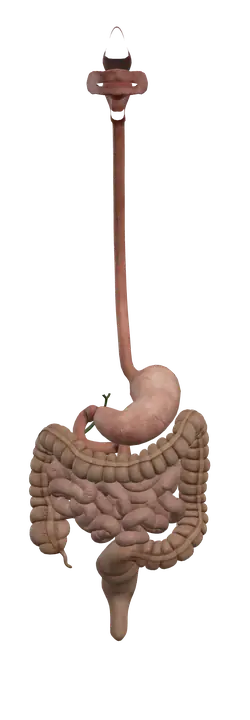
The digestive tract is one long, continuous tube that runs from the mouth to the anus. Along the way, food is chewed, mixed with juices, broken down into small molecules and absorbed into the blood, and what is left is removed as waste. The stomach and the intestines do most of this work, helped by the liver and pancreas, which deliver their secretions through the bile duct.
Where it is
- The oral cavity is the first part of the tract. From there, food passes down the pharynx, behind the larynx, and through the esophagus, which crosses the diaphragm to reach the abdomen.
- The stomach lies in the upper left part of the abdomen, just below the diaphragm.
- The small intestine coils through the central and lower abdomen. Its first part, the duodenum, curves in a C shape around the head of the pancreas.
- The large intestine frames the small intestine: it starts in the lower right corner, rises on the right, crosses the upper abdomen, descends on the left and ends in the pelvis with the rectum and anal canal.
The muscles of the abdominal wall, such as the rectus abdominis and the external oblique, cover these organs in front.
Parts you can explore in the app
In the app you can open the digestive organs on their own and study them part by part:
- Stomach: a J-shaped muscular bag that stores food, churns it and starts digesting proteins.
- Small intestine: the long, coiled tube where most digestion and absorption take place, made of the duodenum, jejunum and ileum.
- Large intestine: the wider final section, made of the cecum (with the appendix), the colon and the rectum, which absorbs water and forms feces.
- Tongue: a muscular organ that moves food around the mouth, shapes it into a ball for swallowing and carries most of the taste buds.
- Oral cavity: the mouth, where teeth, tongue and saliva start mechanical and chemical digestion.
- Bile duct: the tube that carries bile from the liver and gallbladder to the duodenum.
Cross sections (sagittal, coronal and axial) let you see how the stomach and the loops of intestine are packed together inside the abdomen.
What it does
In the mouth, teeth cut and grind food while saliva moistens it. Salivary amylase begins breaking down starch. The tongue mixes the food and pushes the soft ball, called a bolus, to the back of the throat for swallowing.
In the stomach, three layers of smooth muscle churn the food and mix it with gastric juice. Hydrochloric acid kills many microbes and creates the acidic conditions in which pepsin begins to digest proteins. The stomach also makes intrinsic factor, needed to absorb vitamin B12. The result is a thick liquid called chyme. A ring of muscle at the exit, the pyloric sphincter, releases it into the duodenum a little at a time.
In the small intestine, digestion is completed. Pancreatic juice and bile arrive in the duodenum through the bile duct and the pancreatic duct. Bile breaks fat into small droplets so enzymes can work on it, and pancreatic enzymes digest carbohydrates, proteins and fats. The inner wall is covered with circular folds, finger-like villi and microscopic microvilli, which together create a huge surface for absorbing nutrients into the blood and lymph.
In the large intestine, water and electrolytes are absorbed from what remains. Bacteria living there ferment leftover material and produce some vitamins, including vitamin K. The remaining waste becomes feces, which is stored in the rectum until it is eliminated.
Waves of muscle contraction called peristalsis push the contents along the whole tract.
How to study it
- Follow a meal. Mouth, pharynx, esophagus, stomach, duodenum, jejunum, ileum, cecum, ascending colon, transverse colon, descending colon, sigmoid colon, rectum, anal canal. Say it in order until it is automatic.
- Stomach regions. Cardia, fundus, body, pylorus, from the entrance to the exit.
- Small intestine: "Dow Jones Industrial." Duodenum, Jejunum, Ileum.
- Match each organ with its main job. Stomach: protein digestion and storage. Small intestine: most digestion and absorption. Large intestine: water absorption and waste.
- Know where secretions enter. Bile and pancreatic juice enter the duodenum, not the stomach. This is a common exam point.
- Use the axial section at the level of the upper abdomen to see the stomach on the left with the liver on the right.
Frequently asked questions
Where does most digestion happen?
In the small intestine. Enzymes from the pancreas and the intestinal wall, together with bile, complete the digestion of carbohydrates, proteins and fats there.
What does the stomach do?
It stores food, churns it, and mixes it with acid and enzymes that start digesting proteins. It then releases the liquid chyme into the small intestine in small amounts.
What does the large intestine do?
It absorbs water and electrolytes, hosts bacteria that ferment leftover material, and forms and stores feces.
Why is the bile duct shown with the digestive organs?
Because it delivers bile from the liver and gallbladder into the duodenum, where bile helps digest fats.