Study guide · Study
How to learn the bones of the skeleton: 206 bones in five groups
The adult skeleton has 206 bones. Learn them in five groups with their counts, in an order that works, with memory aids and free quizzes to test yourself.
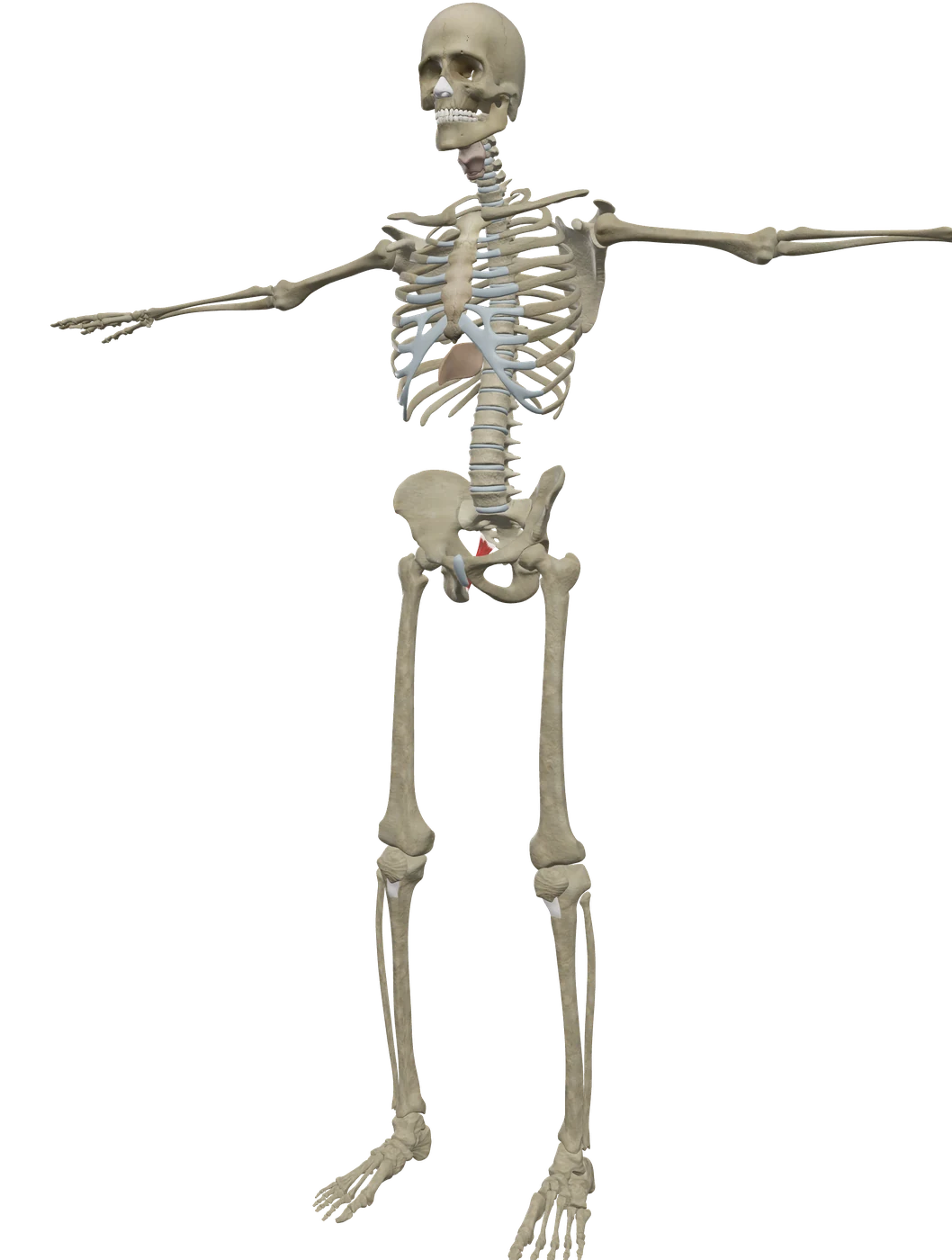
The best way to learn the bones of the skeleton is to split the 206 bones of the adult body into five groups, learn the large bones of each group first, and test yourself on a skeleton without labels every day. The five groups and their counts: the skull with its associated bones 29 (22 skull bones, the hyoid and 6 ear ossicles), the spine 26, the sternum and ribs 25, the upper limbs 64 and the lower limbs 62. Most of the list is repetition: 126 of the 206 bones are in the limbs and their girdles, and the right side mirrors the left.
How are the 206 bones divided?
The skeleton has two parts. The axial skeleton (80 bones) is the central axis: skull, vertebral column and rib cage. The appendicular skeleton (126 bones) is the limbs and the girdles that attach them to the axis.
| Group | Bones | Count |
|---|---|---|
| Skull and its associated bones | 8 cranial bones, 14 facial bones, the hyoid, 6 ear ossicles | 29 |
| Vertebral column | 7 cervical, 12 thoracic and 5 lumbar vertebrae, sacrum, coccyx | 26 |
| Rib cage (thoracic cage) | Sternum and 12 pairs of ribs | 25 |
| Upper limbs and pectoral girdles | On each side: clavicle, scapula, humerus, radius, ulna, 8 carpals, 5 metacarpals, 14 phalanges | 64 |
| Lower limbs and pelvic girdle | On each side: hip bone, femur, patella, tibia, fibula, 7 tarsals, 5 metatarsals, 14 phalanges | 62 |
The first three groups add up to 80, the last two to 126. The 12 thoracic vertebrae are counted with the vertebral column, although they also form the back of the rib cage.
In what order should you learn the bones?
There is no official order. This one goes from the bones that are easy to see and name to the ones that need the most repetition:
- The map. Learn the table above first: two parts, five groups, five counts. Every bone you learn later has a place to go.
- The limbs. They are 126 of the 206 bones, the long bones are large and easy to recognise, and the upper and lower limb follow the same plan.
- The spine and the rib cage. Here the work is numbers: 7, 12 and 5 vertebrae, 12 pairs of ribs.
- The wrist and the foot. Eight carpals and seven tarsals are small and look alike; they need a memory aid and several short sessions.
- The skull. Its 22 bones, all but the mandible locked together by sutures, are hard to tell apart on a whole skull: keep it for last, with a labelled diagram next to you.
Learn each bone's name, place and neighbours before its landmarks (tubercles, fossae, foramina). Landmarks only stick once you can already point to the bone.
Use the pattern shared by the arm and the leg
The upper and lower limb are built on the same plan, from the trunk outwards. Learn one and you have most of the other.
| Upper limb | Lower limb | |
|---|---|---|
| Girdle | Clavicle and scapula | Hip bone |
| One bone | Humerus | Femur |
| Two bones | Radius and ulna | Tibia and fibula |
| Short bones | 8 carpals | 7 tarsals |
| Palm or sole | 5 metacarpals | 5 metatarsals |
| Digits | 14 phalanges | 14 phalanges |
Three things break the pattern, and exam questions like them:
- The lower limb has one more bone, the patella, in front of the knee. Nothing matches it at the elbow.
- The thumb and the great toe have two phalanges (proximal and distal). The other digits have three (proximal, middle, distal). That gives 14 in each hand and each foot.
- The two hip bones meet in front and join the sacrum at the back, so the pelvis is a ring. The pectoral girdle is open: the scapula has no joint with the ribs or the spine, and the clavicle is its only bony link to the trunk.
To keep the paired bones apart: in the anatomical position (palms forward), the radius is on the thumb side and the ulna on the little finger side. In the leg, the tibia is the large bone on the big toe side, and the fibula is the thin bone on the outside. The tables on the bones of the arm and the bones of the hand list every bone of the upper limb.
Count the spine and the ribs
- Vertebrae: 7, 12, 5. A memory aid many students use (it is not from the textbook) is meal times: breakfast at 7 (cervical), lunch at 12 (thoracic), dinner at 5 (lumbar). Below them, the sacrum is five vertebrae fused into one bone, and the coccyx is usually four small fused vertebrae. That makes 24 separate vertebrae and 26 bones.
- Two vertebrae have names. C1 is the atlas, which carries the skull, and C2 is the axis, around which the atlas turns.
- Ribs: 12 pairs, one for each thoracic vertebra. Ribs 1 to 7 are true ribs: each reaches the sternum through its own cartilage. Ribs 8 to 12 are false ribs. Among them, ribs 11 and 12 are floating ribs: they do not reach the sternum at all.
- Sternum: one bone, three parts: manubrium, body and xiphoid process.
The pages on the bones of the spine and the bones of the rib cage give the detail of each level.
Memory aids for the wrist and the foot
Carpal bones. The OpenStax textbook gives this sentence: So Long To Pinky, Here Comes The Thumb. It starts on the thumb side of the row nearest the forearm and comes back along the other row:
- Proximal row, from the thumb side: scaphoid, lunate, triquetrum, pisiform.
- Distal row, from the little finger side: hamate, capitate, trapezoid, trapezium.
The trapezium is the one under the thumb. The carpal bones page shows the two rows and gives a second sentence that reads both rows from the thumb side. The app shows the carpals as one group, so test the eight names on paper.
Tarsal bones. There are seven. Learn them by position first:
- At the back, two large bones: the talus, which sits under the tibia, and the calcaneus, the heel bone, under the talus.
- In the middle, on the inner side: the navicular, in front of the talus.
- In front, side by side: the three cuneiforms (medial, intermediate, lateral) and the cuboid on the outer side, in front of the calcaneus.
The bones of the foot page has the full table and a sentence to recite them.
Leave the skull for last
The skull has 22 bones in two sets:
- 8 cranial bones around the brain: frontal, occipital, sphenoid, ethmoid (one of each), parietal and temporal (two of each).
- 14 facial bones: the mandible and the vomer (one of each), and two each of the maxilla, zygomatic, nasal, lacrimal, palatine and inferior nasal concha.
The mandible is the only one that moves. Seven more bones are counted with the skull: the hyoid in the neck, and three ossicles in each middle ear (malleus, incus, stapes).
Learn the cranial bones on a side view and a top view, then the facial bones on a front view. Anatomy Atlas 3D names the skull as one structure, with the mandible and the ossicles apart, so use a labelled diagram for the single skull bones (the OpenStax skull chapter in the sources has them).
Test yourself every day
Reading a list feels like learning, but most practical exams ask you to name a bone on a skeleton without labels. Test yourself for a few minutes every day rather than in one long session:
- Cover the names. On a diagram or a model, point to a bone, say its name out loud, then check.
- Go both ways. From the bone to the name, then from the name to the bone ("where is the cuboid?").
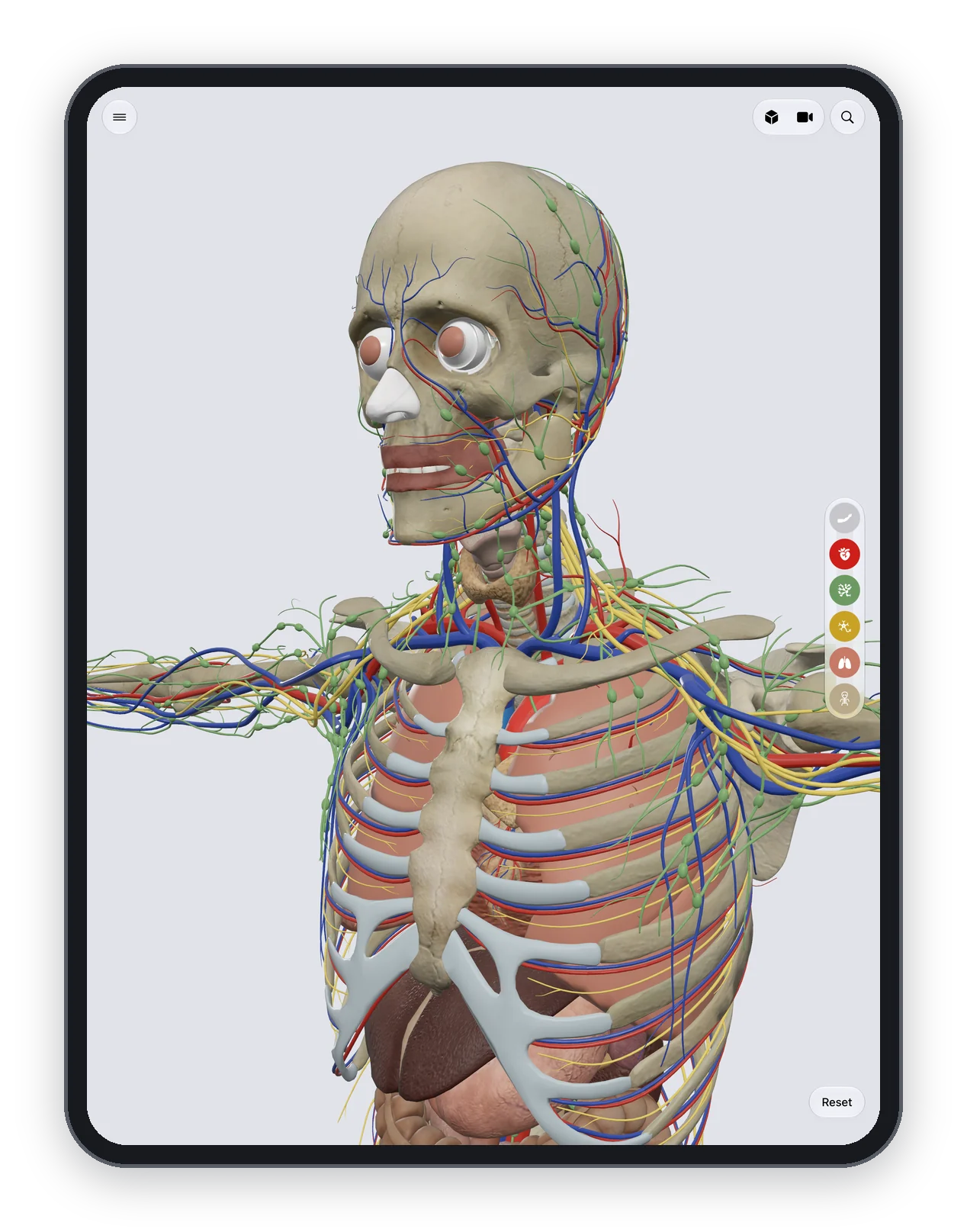
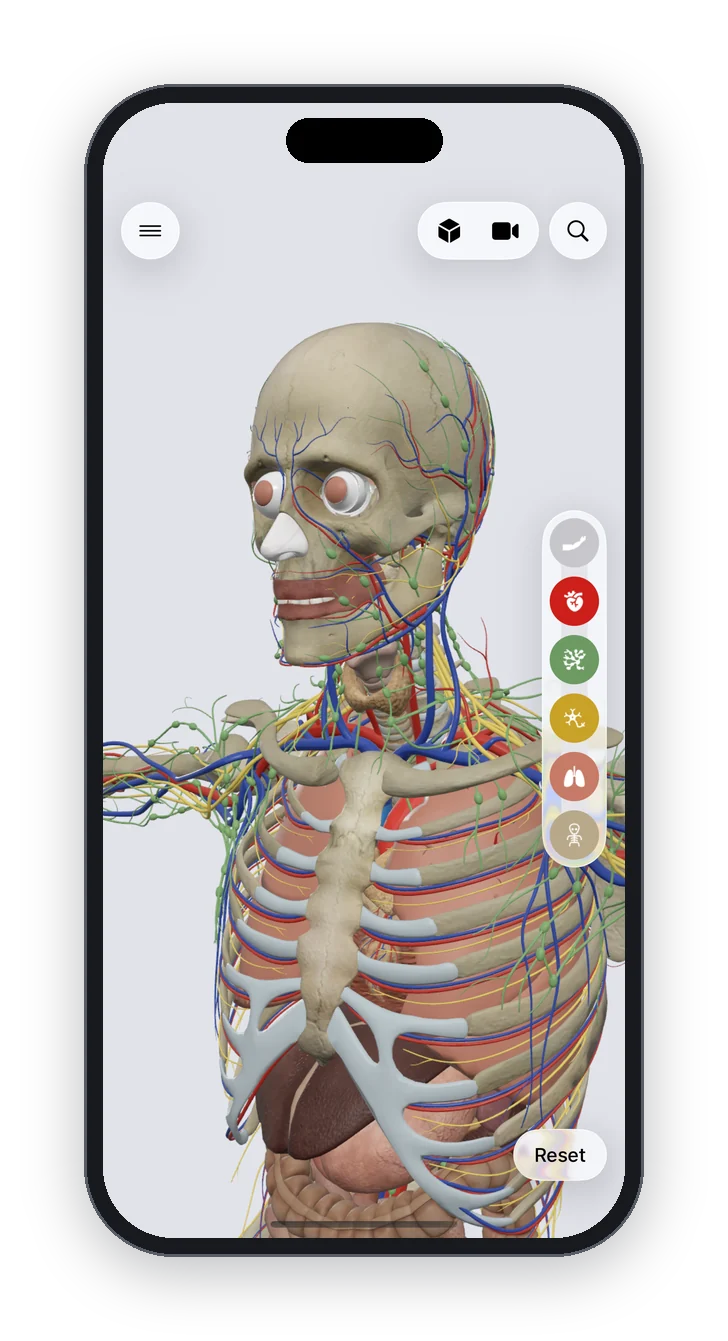
- Use a quiz. On this site, the free skeleton quiz shows a lit bone on the 3D body and asks its name. The region quizzes mix the bones with the muscles around them: arm and elbow, forearm and hand, hip and thigh, leg and foot, back and thorax. In the Anatomy Atlas 3D app, the quiz names a structure and you tap it on the body.
- Repeat what you missed. Write down the bones you got wrong and start the next session with them.
On your own body, you can feel many of them: the clavicle, the spine of the scapula, the olecranon of the ulna at the elbow, the patella, the front of the tibia and the two bumps at the ankle (the tibia on the inside, the fibula on the outside). The directional terms (proximal, distal, medial, lateral) are worth learning at the same time, because bone descriptions use them in every sentence.
A one-week plan
| Day | Learn | Test |
|---|---|---|
| 1 | The two parts, the five groups and their counts; the long bones of the limbs | Draw a stick skeleton and label it from memory |
| 2 | Girdles: clavicle, scapula, hip bone; the arm and leg pattern | The skeleton quiz, a first try |
| 3 | Vertebral column, ribs and sternum | Say the counts, then the back quiz and the thorax quiz |
| 4 | Carpals, metacarpals and phalanges of the hand | Write the eight carpals in two rows |
| 5 | Tarsals, metatarsals and phalanges of the foot | Place the seven tarsals on an empty outline |
| 6 | Cranial and facial bones | Label a side view and a front view of the skull |
| 7 | Nothing new | The whole skeleton quiz, then the bones you missed |
Change the pace to fit your course: the plan only fixes the order and the daily test.
Frequently asked questions
How many bones are in the human skeleton?
The adult skeleton has 206 bones: 80 in the axial skeleton (skull, vertebral column, rib cage) and 126 in the appendicular skeleton (limbs and girdles). Children have more, because several bones fuse during growth: the sacrum, for example, starts as five separate vertebrae.
What is the easiest way to memorize the bones of the body?
Group them and count them: skull 29 with its associated bones, spine 26, rib cage 25, upper limbs 64, lower limbs 62. Learn the large bones of each group first, use the shared pattern of the arm and the leg, then test yourself every day on a skeleton without labels.
Which bones should I learn first?
The long bones of the limbs: humerus, radius, ulna, femur, tibia and fibula, with the clavicle, scapula and hip bone. They are large, easy to recognise and give you landmarks for placing the smaller bones.
What is the mnemonic for the carpal bones?
"So Long To Pinky, Here Comes The Thumb": scaphoid, lunate, triquetrum, pisiform in the proximal row from the thumb side, then hamate, capitate, trapezoid, trapezium in the distal row from the little finger side.
How many bones are in the hand and in the foot?
Each hand has 27 bones: 8 carpals, 5 metacarpals and 14 phalanges. Each foot has 26: 7 tarsals, 5 metatarsals and 14 phalanges.
Is the skull one bone?
No. The skull is 22 bones: 8 cranial bones around the brain and 14 facial bones. In an adult they are joined by immovable joints called sutures, except the mandible, which moves.
Sources
- OpenStax, Anatomy and Physiology 2e, 7.1 Divisions of the skeletal system
- OpenStax, Anatomy and Physiology 2e, 7.2 The skull
- OpenStax, Anatomy and Physiology 2e, 7.3 The vertebral column
- OpenStax, Anatomy and Physiology 2e, 7.4 The thoracic cage
- OpenStax, Anatomy and Physiology 2e, 8.1 The pectoral girdle
- OpenStax, Anatomy and Physiology 2e, 8.2 Bones of the upper limb
- OpenStax, Anatomy and Physiology 2e, 8.3 The pelvic girdle and pelvis
- OpenStax, Anatomy and Physiology 2e, 8.4 Bones of the lower limb
- Z-Anatomy, the libre 3D atlas of anatomy
- TA2 Viewer (Terminologia Anatomica, 2nd edition)
