
Joint · Upper limb
Elbow joint anatomy: bones, ligaments and muscles
The elbow joint links the humerus, ulna and radius in one capsule. Learn its three articulations, three main ligaments and the muscles that flex and extend it.
The elbow joint is the synovial hinge joint where the humerus meets the ulna and the radius. The biceps and brachialis bend it, the triceps straightens it, two collateral ligaments stop it moving sideways, and the annular ligament holds the head of the radius so that the forearm can turn.
Which bones form the elbow joint?
Three bones meet at the elbow:
- The humerus, whose lower end has two smooth surfaces side by side: the spool-shaped trochlea on the medial side and the rounded capitulum on the lateral side. The medial and lateral epicondyles stick out above them.
- The ulna, whose C-shaped trochlear notch wraps around the trochlea. The notch is bordered by the olecranon behind, which is the point of your elbow, and the coronoid process in front.
- The radius, whose disc-shaped head has a shallow cup on top that rests on the capitulum.
Each movement ends with a bone sliding into a hollow on the humerus. Bend the elbow and the coronoid process and radial head settle into the coronoid fossa and radial fossa on the front. Straighten it and the olecranon drops into the larger olecranon fossa on the back.
What are the three articulations of the elbow?
The elbow is one joint with one capsule, but three pairs of surfaces meet inside it:
| Articulation | Between | Type and movement |
|---|---|---|
| Humeroulnar joint | Trochlea of the humerus and trochlear notch of the ulna | Hinge: flexion and extension |
| Humeroradial joint | Capitulum of the humerus and head of the radius | Moves with the hinge; the radial head also spins here |
| Proximal radioulnar joint | Rim of the radial head and radial notch of the ulna | Pivot: the radius rotates in pronation and supination |
The humeroulnar joint makes the hinge. The proximal radioulnar joint shares the capsule of the elbow, but it serves the forearm: it lets the radius rotate, and does not bend the elbow. That is why you can turn your palm up and down with your elbow held still.
What are the ligaments of the elbow?
The capsule is thin in front and behind, which leaves it slack for bending and straightening. Ligaments reinforce its two sides:
| Ligament | Where it runs | What it does |
|---|---|---|
| Ulnar (medial) collateral ligament | A triangle of fibers fanning from the medial epicondyle down to the upper ulna | Blocks side-to-side movement; its strong anterior part resists hyperextension |
| Radial (lateral) collateral ligament | Starts on the lateral epicondyle and merges with the annular ligament | Blocks side-to-side movement on the outer side |
| Annular ligament | A ring around the head of the radius | Keeps the radial head seated in the radial notch of the ulna as it turns |
The radial collateral ligament ends on the annular ligament, not directly on the radius.
Which muscles move the elbow?
Muscles that cross the front of the elbow bend it, and muscles that cross the back straighten it. Two more groups turn the forearm.
| Movement | Muscles | Where they end |
|---|---|---|
| Flexion | Brachialis, biceps brachii, brachioradialis, helped by the pronator teres | Coronoid process and tuberosity of the ulna (brachialis), radial tuberosity (biceps), lower end of the radius (brachioradialis), middle of the radius (pronator teres) |
| Extension | Triceps brachii, anconeus | Olecranon of the ulna (triceps), side of the olecranon and upper ulna (anconeus) |
| Pronation (palm down) | Pronator teres, pronator quadratus | Radius |
| Supination (palm up) | Supinator, biceps brachii | Upper radius |
The epicondyles also anchor forearm muscles that move the wrist and fingers. The medial one is larger and carries the superficial flexors; the smaller lateral one carries the superficial extensors. The muscles of the forearm table lists their origins, insertions and actions.
In front of the elbow lies the cubital fossa, a triangular hollow between the pronator teres and the brachioradialis.
Why does the forearm angle away from the body?
Hold your arm straight down, palm forward, and look at the line from shoulder to wrist. It bends outward at the elbow by 5 to 15 degrees: the carrying angle. The bend keeps a swinging hand or a carried bag clear of the hip. OpenStax reports a larger angle in females and links it to the wider pelvis.
How to study the elbow joint in 3D
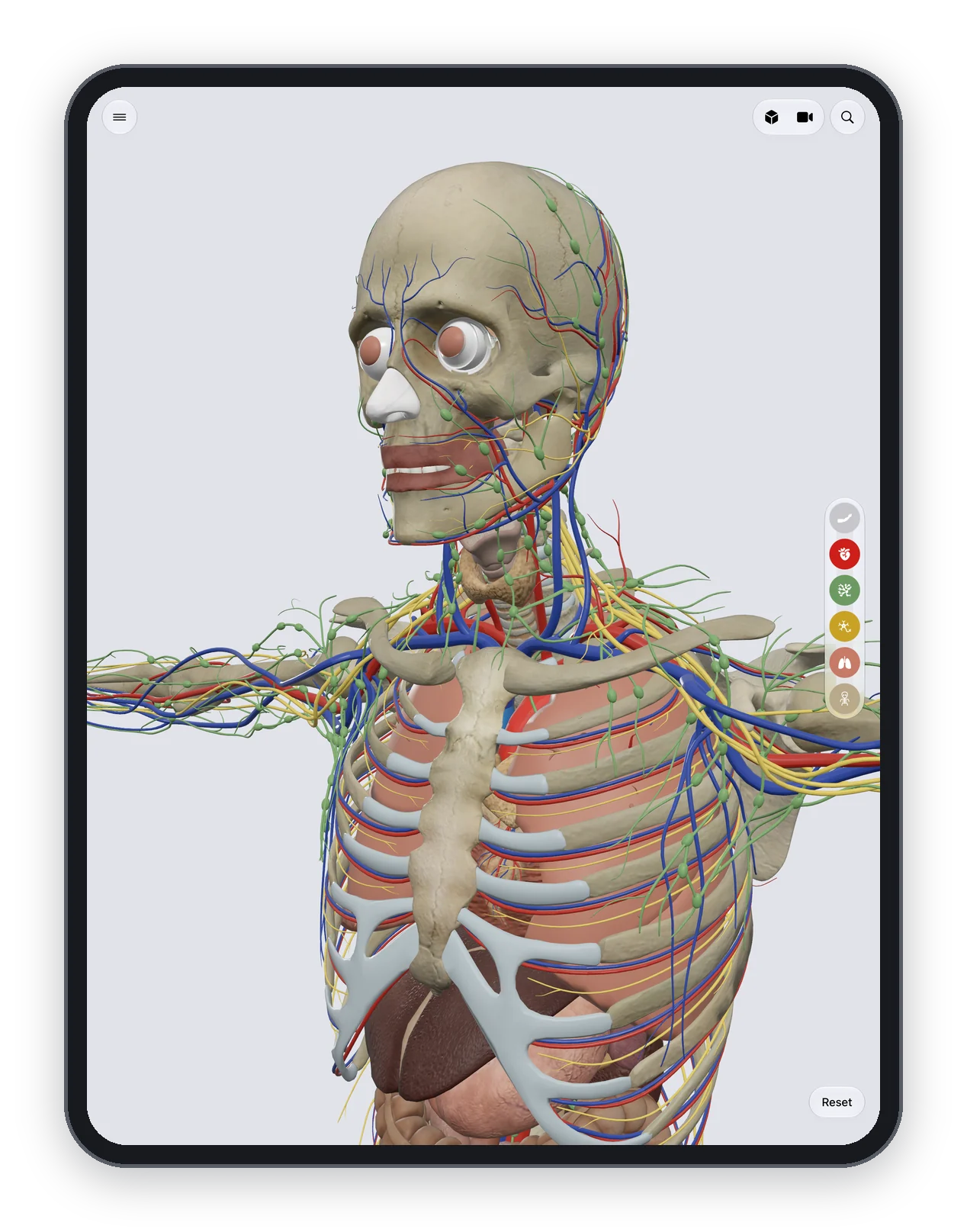
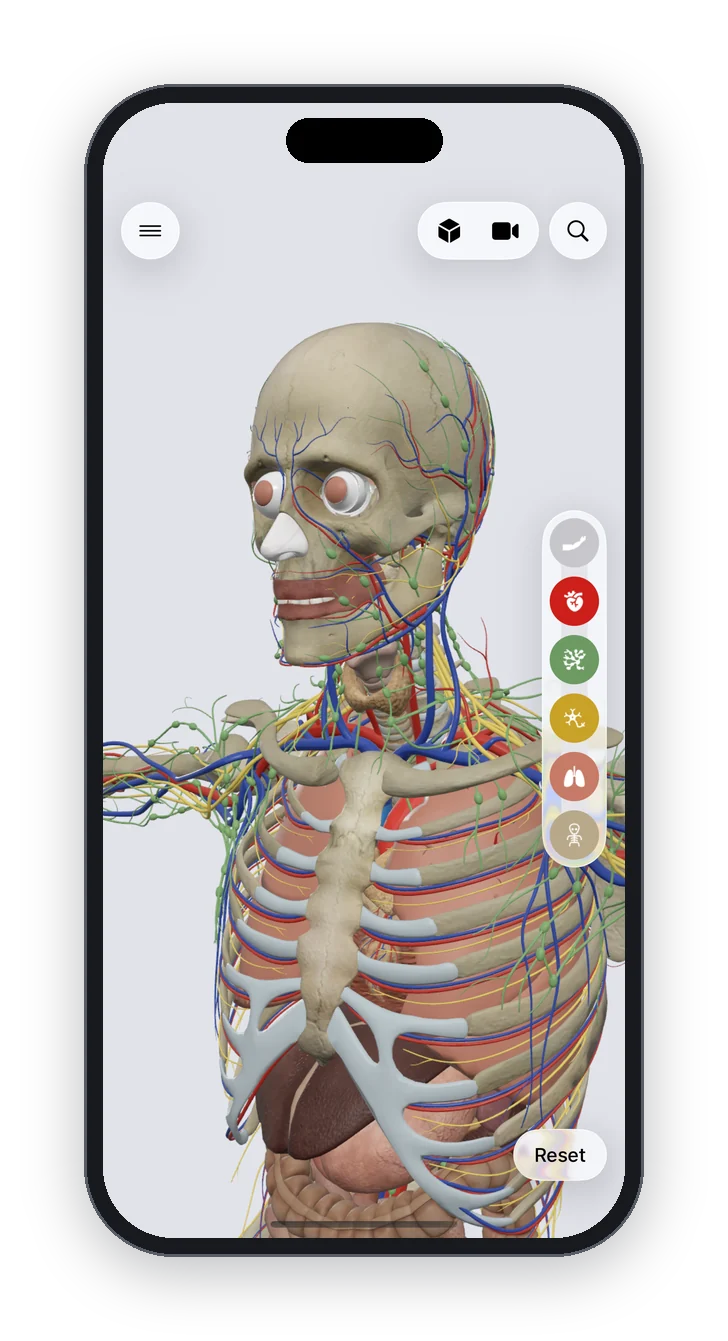
Anatomy Atlas 3D is a free 3D human anatomy atlas for iPad and iPhone: 2,000 structures, no account, no ads, works offline, English and Latin names, and a tap-the-structure quiz. It shows the bones and most of the muscles of the elbow, but not the anconeus, the supinator or the ligaments, so use it for the shape of the joint and its main movers. The landmarks below are parts of the bones, not separate labels:
- Peel away the muscle layer and look at the lower humerus from the front. Find the trochlea, the capitulum and the two epicondyles.
- Turn the skeleton to the back and find the olecranon fossa, then follow the olecranon down into the ulna.
- Bring the muscles back and tap the biceps, then the triceps, to read where each one ends on the forearm.
- Test yourself with the arm and elbow quiz or the upper limb muscles quiz, and find every upper limb page on the upper limb hub.
The knee joint is another big hinge. It has collateral ligaments too, but also two crossed ligaments and two menisci inside.
Frequently asked questions
What type of joint is the elbow?
A synovial hinge joint. The hinge is the humeroulnar joint, which allows only flexion and extension. The same capsule also holds the humeroradial joint and the proximal radioulnar joint, a pivot joint.
What are the three bones of the elbow?
The humerus of the upper arm, and the ulna and radius of the forearm.
What are the main ligaments of the elbow?
The ulnar collateral ligament on the medial side, the radial collateral ligament on the lateral side, and the annular ligament, which circles the head of the radius.
What is the pointy bone of the elbow called?
The olecranon, the upper end of the ulna. The triceps brachii inserts on it.
Which muscles bend and straighten the elbow?
The brachialis, biceps brachii and brachioradialis bend (flex) it, helped by the pronator teres. The triceps brachii, helped by the anconeus, straightens (extends) it.
Does the elbow turn the palm over?
Not the hinge itself. The palm turns at the radioulnar joints: the head of the radius spins inside the annular ligament at the elbow, and the lower end of the radius moves around the ulna at the wrist.
Sources
- OpenStax, Anatomy and Physiology 2e, 9.6 Anatomy of selected synovial joints
- OpenStax, Anatomy and Physiology 2e, 8.2 Bones of the upper limb
- OpenStax, Anatomy and Physiology 2e, 11.5 Muscles of the pectoral girdle and upper limbs
- StatPearls, Anatomy, Shoulder and Upper Limb, Forearm Muscles
- StatPearls, Anatomy, Shoulder and Upper Limb, Elbow Cubital Fossa
- Z-Anatomy, the libre 3D atlas of anatomy
