Muscle · Upper limb
Pronator quadratus: origin, insertion, action and innervation
The pronator quadratus joins the lower ends of the ulna and radius. It is the main forearm pronator and is supplied by the anterior interosseous nerve.
Quick answer
- Latin name
- Musculus pronator quadratus
- Origin
- Distal quarter of the anterior surface of the ulna
- Insertion
- Distal quarter of the anterior surface of the radius
- Action
- Pronates the forearm (turns the palm down); holds the lower ends of the radius and ulna together
- Innervation
- Anterior interosseous nerve, a branch of the median nerve (C8-T1)
- Blood supply
- Anterior interosseous artery
See it on the 3D body
The pronator quadratus lit on the 3D forearm and hand, as in the forearm and hand quiz. Turn the body, peel the layers, tap any structure for its name.
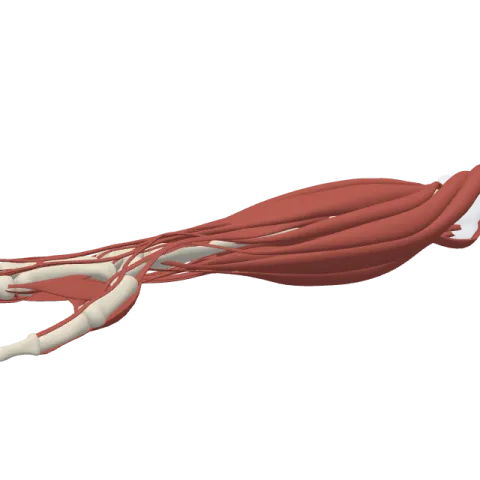
The pronator quadratus is a small, square muscle that lies deep in the front of the forearm just above the wrist, joining the lower ends of the ulna and the radius. It is the main muscle that turns the palm down (pronation) and is supplied by the anterior interosseous nerve.
Where it is
The pronator quadratus is the deepest muscle of the anterior forearm. It lies flat on the front of the ulna, the radius and the interosseous membrane, in the last few centimeters above the wrist. The tendons of the flexor digitorum profundus and the flexor pollicis longus run over it, with the radial and ulnar arteries in front of it on either side.
Quadratus means "squared", which describes its shape: it is roughly as wide as it is tall, and its fibers run almost horizontally from one bone to the other. It attaches only to the two forearm bones and does not cross the elbow or the wrist.
Some descriptions divide it into a superficial part and a deep part. The deep fibers lie close to the distal radioulnar joint, where the lower end of the radius turns around the head of the ulna.
Origin and insertion
- Origin: the distal quarter of the anterior surface of the ulna, along a faint oblique ridge.
- Insertion: the distal quarter of the anterior surface of the radius, reaching around to its lateral edge.
When it contracts, it pulls the lower end of the radius across the front of the ulna.
What it does
- Pronation of the forearm: it rolls the radius over the ulna at the wrist end, turning the palm to face down (or back, in the anatomical position). It starts the movement and does most of the work when pronation is slow and meets no resistance.
- Holds the forearm bones together: its deep fibers keep the lower ends of the radius and ulna pressed against each other, which helps when force goes up through the hand, as when you push yourself up from a chair.
The pronator teres, higher up near the elbow, joins in when pronation has to be fast or strong. The supinator and the biceps brachii turn the palm back up.
Everyday pronation movements include pouring liquid out of a cup and turning the hands palm down onto a keyboard.
Innervation and blood supply
The pronator quadratus is supplied by the anterior interosseous nerve (C8-T1; some books give C7-C8), a branch of the median nerve. The nerve runs down the front of the interosseous membrane and ends here, in the pronator quadratus and the wrist joint. Its blood comes from the anterior interosseous artery, which travels with the nerve.
How to remember it
- Quadratus = square: a small square patch of muscle across the bottom of the forearm.
- Teres at the top, quadratus at the bottom: the two pronators sit at opposite ends of the forearm, one near the elbow and one near the wrist.
- The nerve's last stop: the anterior interosseous nerve ends in the pronator quadratus.
- Horizontal fibers, horizontal job: its fibers run straight across, from bone to bone, which suits a muscle that only rotates.
The muscles of the forearm page shows both pronators and the deep layer. Test yourself in the forearm and hand quiz.
Frequently asked questions
What is the action of the pronator quadratus?
It pronates the forearm, turning the palm down, and helps hold the lower ends of the radius and ulna together.
Which is the main pronator of the forearm?
The pronator quadratus. It starts pronation and does most of the work in slow movements; the pronator teres adds force and speed.
What nerve supplies the pronator quadratus?
The anterior interosseous nerve, a branch of the median nerve.
Where is the pronator quadratus located?
Deep in the front of the forearm, just above the wrist, lying on the lower quarter of the ulna and radius.
